
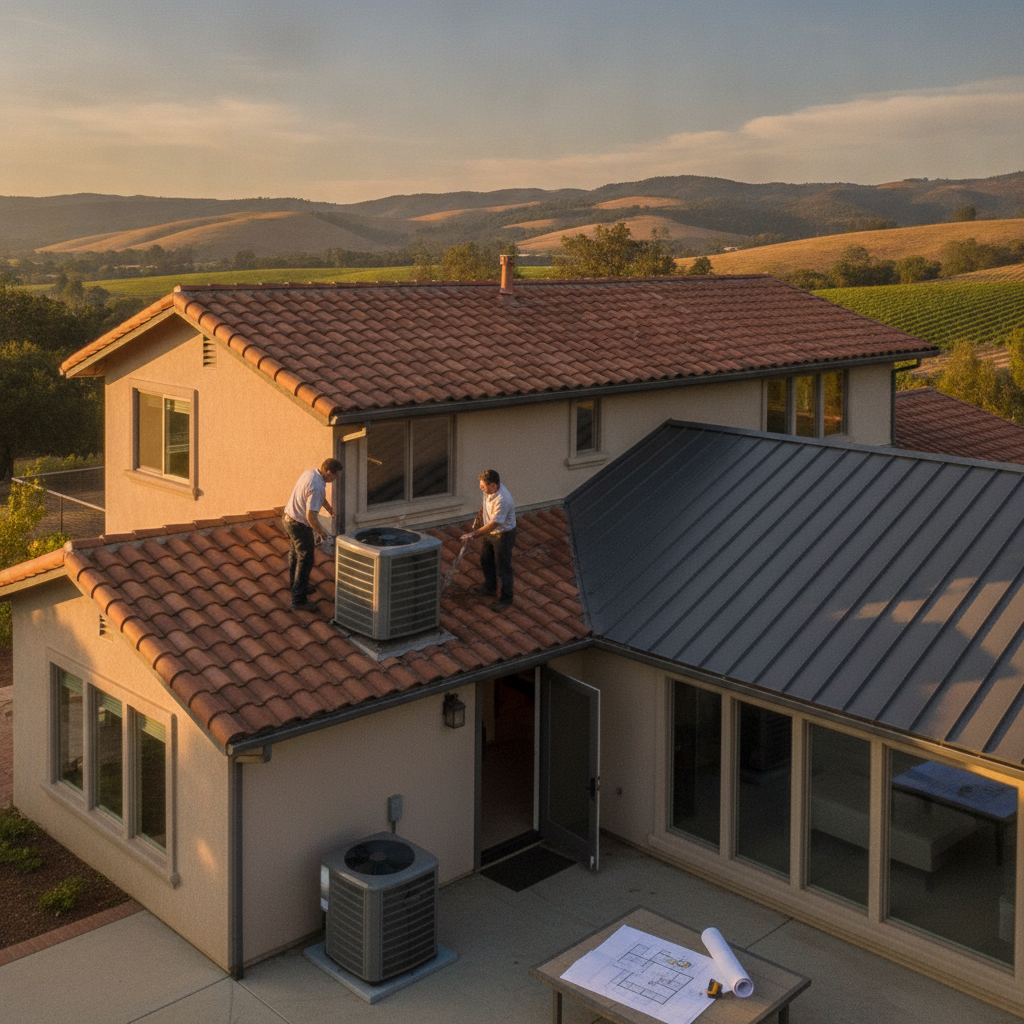
What Sonoma County Homeowners Should Know About HVAC and Concrete Tile or Metal Roofs — How Your Roof Type Affects Heating, Cooling, and System Performance
If you live in Sonoma County and your home has a concrete tile or metal roof, your HVAC system is working in conditions that most generic HVAC advice simply doesn’t account for. The short answer is this: your roof type directly affects how much heat enters your attic, how hard your cooling equipment has to work, and in some cases, whether your system was sized correctly for your home in the first place. This is especially relevant in neighborhoods like Fountaingrove in Santa Rosa, newer developments in Windsor, and Wine Country builds throughout Healdsburg and Petaluma, where concrete tile and standing-seam metal roofs have become increasingly common over the last two decades.
Most HVAC companies — and most of the competitor content we’ve reviewed locally — talk about insulation, duct sealing, and thermostat settings. Very few address the upstream thermal environment that your roof creates before conditioned air even enters the picture. That gap is what this article is here to fill.
Why Your Roof Type Is an HVAC Issue, Not Just a Roofing Issue
Here’s the basic physics: your attic sits between your roof and your living space, and in Sonoma County’s hot, dry summers, attic temperatures can regularly hit 140–160°F under a standard composition shingle roof with poor ventilation. Concrete tile and metal roofs change that dynamic — but not always in the way homeowners expect.
Concrete tile roofs have a natural air gap between the tile and the roof deck beneath. That gap allows some passive ventilation and reduces direct heat transfer compared to flat-laid composition shingles. However, the tile itself is dense and absorbs heat throughout the day, releasing it slowly into the late afternoon and evening — exactly when you’re home and expecting your AC to keep up. If your attic is under-ventilated or your duct system runs through the attic space (which it does in most Sonoma County homes), that stored heat is fighting your air conditioner all evening long.
Metal roofs — particularly the standing-seam profiles popular on newer Sebastopol farmhouse-style homes and post-fire rebuilds in Santa Rosa — actually shed heat faster than tile. They can be excellent performers, especially with a proper radiant barrier installed beneath. But they also transfer heat rapidly when they do absorb it, and without adequate attic insulation and ventilation, your AC system can still end up working overtime during peak afternoon hours in July and August.
The Sizing Problem Nobody Talks About
One of the most common oversights we see — especially on homes that had roof replacements or major roofing upgrades in recent years — is that the HVAC system was sized for the original roof assembly and thermal profile. Change the roof, and you may have changed the cooling load in ways that weren’t recalculated.
A proper HVAC sizing calculation (called a Manual J load calculation) accounts for your roof’s thermal resistance, the attic’s insulation level, your climate zone, and how much of your ductwork is exposed to unconditioned attic air. In Sonoma County’s Mediterranean climate, where summer afternoons can push well into the 90s and 100s while coastal air drops temperatures sharply at night, getting that calculation right matters. An undersized system runs constantly and can’t catch up. An oversized one short-cycles, wastes energy, and wears out faster.
If you’ve had a new roof installed in the past five years and haven’t had your HVAC system evaluated since, it’s worth a conversation with a local contractor who will actually run the numbers rather than just size the replacement unit to match whatever was there before.
How This Affects Heat Pump Performance Specifically
Heat pumps have become increasingly popular in Sonoma County as PG&E energy rates climb and homeowners look to reduce dependence on natural gas. Santa Rosa’s climate is genuinely well-suited to heat pump technology — mild winters mean the equipment rarely has to strain during heating season, and modern cold-climate heat pumps handle the occasional freeze just fine.
But heat pumps are also more sensitive to accurate sizing than older gas-plus-AC systems. If your roof is creating a higher-than-expected thermal load on your attic and your ductwork, a heat pump sized without accounting for that will run longer cycles, produce less comfort, and may leave you disappointed with a system that’s actually performing exactly as it was (incorrectly) sized to perform. Learn more about heat pump installation and sizing for Sonoma County homes here.
What You Can Actually Do About It
The good news is that the relationship between your roof and your HVAC system isn’t fixed. There are practical steps that make a real difference:
- Radiant barrier sheathing or foil: Installed on the underside of the roof deck or the attic floor, a radiant barrier can cut attic temperatures by 20–30°F during peak summer heat. This directly reduces the load on your AC and the temperature your ductwork is sitting in.
- Attic insulation upgrades: Most older Santa Rosa homes — particularly in neighborhoods like Rincon Valley and Bennett Valley — were built with R-19 or less in the attic. Current best practice for our climate zone is R-38 to R-60 depending on the assembly. More insulation means your ducts stay cooler and your system works less.
- Sealed and insulated ductwork: If your ducts run through an unconditioned attic — which they do in most homes without a conditioned attic assembly — duct insulation and sealing can prevent significant efficiency losses regardless of your roof type.
- Whole-house ventilation: Properly placed attic ventilation (not just passive ridge and soffit vents) can purge heat more effectively during the evenings when outdoor temperatures drop — something Sonoma County’s coastal-influenced nights make more practical than in hotter inland climates.
A Note on Post-Fire Rebuilds and New Construction in Sonoma County
Following the 2017 and 2019 wildfires, a significant number of homes in Fountaingrove, Coffey Park, and surrounding areas were rebuilt from the ground up. Many of those rebuilds went with Class A fire-rated metal roofing — a smart call for fire resilience, but one that sometimes came with HVAC systems installed before the full building envelope was finalized or without a complete post-construction load calculation.
If your home was rebuilt after one of those fire events and you’ve had ongoing comfort issues — rooms that don’t cool evenly, a system that runs constantly in summer, or heating that feels uneven in winter — the roof-attic-HVAC interaction is worth investigating before you assume the equipment itself is faulty.
We’ve been doing this work in Santa Rosa since 1992, and we’ve seen this pattern often enough that it’s one of the first things we look at when a customer calls with a comfort problem in a newer or rebuilt home. You can learn more about our Santa Rosa service area and the types of homes we work in regularly.
Frequently Asked Questions
Does a metal roof mean my home will stay cooler in summer?
Not automatically. A metal roof sheds radiant heat faster than some alternatives, but without proper attic insulation and ventilation beneath it, your attic can still get extremely hot. The roof material is one factor — the complete assembly, including the air gap, decking, insulation, and ventilation, determines how much of that heat reaches your living space and your HVAC system.
Should I have my HVAC system resized after a roof replacement?
It’s worth having a qualified contractor assess it, especially if the roofing material changed significantly. A roof replacement that includes a radiant barrier or substantially different thermal mass can shift your home’s cooling load enough to matter. Whether a full resizing is needed depends on the specifics of your home, but at minimum, a conversation with your HVAC contractor is a good idea.
My concrete tile roof home in Petaluma is always warm upstairs in summer even though the AC runs constantly. What’s going on?
This is a common complaint, and the tile roof is often a contributing factor. Heat absorbed by the tile through the afternoon radiates downward into the attic during the evening — and if your ducts are in that attic and your insulation is thin, your AC is fighting that heat load from both above and within your duct system. Improving attic insulation and sealing your ducts are often more effective fixes than upgrading the HVAC equipment itself.
Does my roof type affect HVAC equipment lifespan?
Yes, indirectly. Equipment that runs longer cycles under heavier loads due to excessive attic heat wears out faster. Compressors, in particular, are stressed by sustained high-load operation. Reducing the thermal burden on your system — through better attic performance — is one of the less-obvious ways to extend the life of your HVAC equipment.
Can a heat pump handle a home with a tile roof in Sonoma County?
Absolutely, provided it’s correctly sized for the actual load. Sonoma County’s climate is genuinely well-matched to heat pump technology. The key is ensuring the equipment selection accounts for your specific home’s thermal characteristics — including what’s happening in your attic. A contractor who skips the load calculation and just matches the tonnage of your old system is not doing you any favors.
Talk to Someone Who Knows These Homes
At Stout’s Heating & AC, Inc., we’ve been working on homes throughout Santa Rosa, Petaluma, Healdsburg, Windsor, Sebastopol, and Rohnert Park since 1992. We know how these homes are built, how the rooflines interact with attic conditions, and what questions to ask when a system isn’t performing the way it should. If you’re dealing with comfort problems, higher-than-expected energy bills, or you’re planning an HVAC upgrade and want to make sure the sizing is actually done right for your specific home, we’re happy to take a look.
Request a free estimate or schedule a consultation online, or give us a call directly at (707) 527-1504. We’ll give you a straight answer — no pressure, no upselling, just an honest assessment of what your home actually needs.