
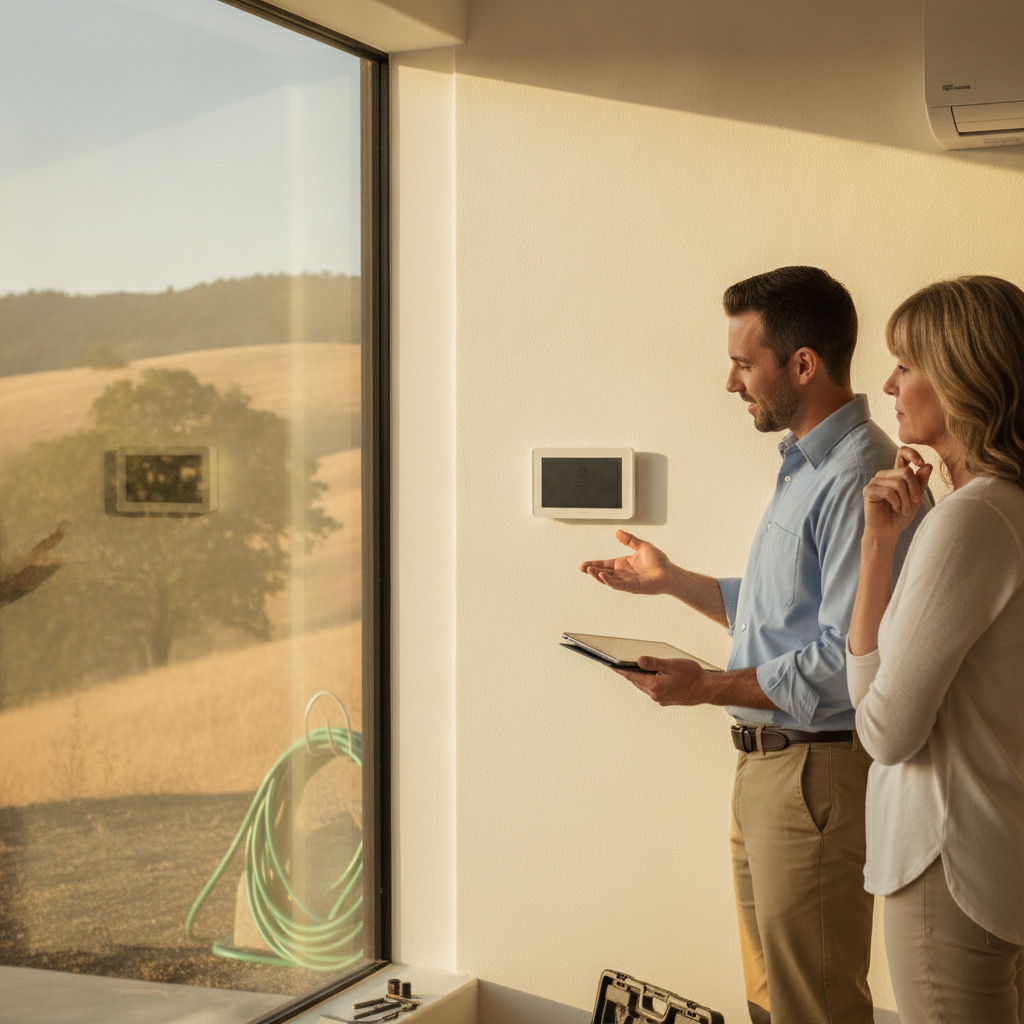
What Sonoma County Homeowners Should Know About HVAC and Smart Thermostats — What They Actually Do, What They Don’t, and Whether the Upgrade Is Worth It
Yes, a smart thermostat can genuinely save you money and make your home more comfortable — but only if your HVAC system is in decent shape, your thermostat wiring supports the upgrade, and you pick the right model for how you actually heat and cool your home. For homeowners in Santa Rosa and across Sonoma County, the honest answer is that smart thermostats are often a worthwhile investment, but the marketing around them tends to oversell what they can do on their own. This article breaks down what they actually do, where they fall short, and what to know before you buy one.
The Real Benefit of a Smart Thermostat — and Where It Stops
A smart thermostat controls when your heating and cooling system runs. That’s essentially it. What makes it “smart” is that it does this with more precision and flexibility than a basic programmable thermostat — learning your schedule, adjusting based on occupancy, letting you control the temperature remotely, and (in some cases) integrating with utility demand-response programs like those offered through PG&E.
What it cannot do is make an inefficient system efficient. If your furnace is undersized, your ducts are leaking, or your AC refrigerant is low, a smart thermostat won’t solve any of that. It’ll just manage the schedule of a system that isn’t performing well to begin with. We see this fairly often — homeowners in Rohnert Park or Petaluma install a Nest or Ecobee hoping it will cut their PG&E bill, and they’re frustrated when it doesn’t move the needle much. Usually that’s because the underlying system or the ductwork is where the real inefficiency lives.
That said, when your system is solid, a smart thermostat can make a meaningful difference — particularly in Sonoma County’s climate, where the temperature swings between morning and afternoon can be dramatic in the summer. Running your AC at full blast all day to hit 72 degrees by 5 PM is expensive. Running it at a lower output throughout the day and letting the thermostat manage the ramp-up intelligently is not.
Compatibility — The Part Nobody Talks About Enough
This is the section that most smart thermostat guides skip, and it’s the one that causes the most problems.
Most smart thermostats are designed to work with conventional gas furnace and central AC systems. If that’s what you have, compatibility is usually straightforward. But if you have a heat pump — which is increasingly common in newer construction in Fountaingrove, Windsor, and other parts of Sonoma County — the wiring requirements are different, and not every smart thermostat handles heat pump systems correctly.
Heat pumps use a reversing valve to switch between heating and cooling modes, and they typically require a dedicated wire (called the O/B wire) that basic thermostats don’t account for. Some popular consumer smart thermostats handle this fine. Others do not — or they handle it only in specific configurations. If you install the wrong thermostat on a heat pump system, you can end up with a system that heats when it should cool, runs the auxiliary heat constantly, or throws fault codes that require a service call to diagnose.
If you have a heat pump, a dual fuel system, or anything more complex than a single-stage gas furnace with central AC, it’s worth having a technician verify compatibility before you buy a thermostat — not after.
Similarly, most smart thermostats require a common wire (C-wire) to maintain continuous power. Older homes — especially those in Santa Rosa’s West End, South Park, or Railroad Square neighborhoods — often have older thermostat wiring that doesn’t include a C-wire. You may need an adapter kit, a new wire run, or a different thermostat model that can work without one. It’s a solvable problem, but it’s not always plug-and-play the way the box makes it look.
What Santa Rosa’s Climate Actually Means for Thermostat Strategy
Sonoma County has a Mediterranean climate — hot, dry summers and cool, wet winters. That sounds simple enough, but the day-to-day variation is what creates real opportunities for a smart thermostat to help.
Summer mornings here are often cool enough that you don’t need AC at all, but by 2 PM in Rincon Valley or Healdsburg, you might be looking at 95 degrees. A well-configured smart thermostat can pre-cool your home during the cooler part of the day before PG&E’s peak pricing kicks in, then coast on that stored coolness rather than running your system hard mid-afternoon when electricity is most expensive. That’s a real, meaningful strategy — and it’s something a basic programmable thermostat handles clumsily by comparison.
In winter, Sonoma County doesn’t get brutally cold, but we do get stretches of nights in the 30s, particularly in inland areas like Sebastopol or Glen Ellen. Smart thermostats are good at managing setback temperatures — letting the house cool down overnight and warming it up before you get out of bed — without the over-shoot that wastes energy.
PG&E Programs and Rebates — Worth Knowing About
PG&E has periodically offered rebates for smart thermostat installation as part of their energy efficiency programs. These programs change, and availability isn’t guaranteed, but it’s worth checking before you buy. Some smart thermostat manufacturers also offer their own rebate programs, and certain models qualify for enrollment in PG&E’s SmartAC or demand-response programs, which can reduce your bill further by allowing the utility to make small adjustments to your thermostat during high-demand periods.
If energy cost reduction is a primary goal, it’s also worth knowing that rebates and incentives for high-efficiency HVAC systems themselves — particularly heat pumps — are often more substantial than what you’d save on a thermostat alone. A thermostat upgrade might save you a few hundred dollars a year in a best-case scenario. A system upgrade can do significantly more. We can walk you through the current landscape of financing and rebate options when you talk to us — we stay current on what’s actually available through California and federal programs.
DIY Install vs. Professional Install — Honest Take
If you have a simple system, good wiring, and some comfort with basic electrical work, DIY installation is reasonable for most smart thermostats. The apps that walk you through it have gotten genuinely good.
But there are situations where we’d recommend having someone do it for you:
- You have a heat pump, dual fuel, or multi-stage system
- You’re not sure what wiring you have at the thermostat
- You’ve already bought a thermostat and it’s not behaving correctly after installation
- Your system is older and you’re not certain the wiring is up to what the new thermostat needs
- You want it done correctly the first time and don’t want to troubleshoot
We install smart thermostats regularly alongside other service calls — if you’re already having your system tuned up or repaired, it’s often a natural time to swap out an old thermostat at the same visit.
Frequently Asked Questions
Will a smart thermostat work with my older HVAC system?
Usually, yes — but it depends on your wiring and system type. Most systems installed after the early 1990s can support a smart thermostat with the right model selection. The bigger variables are whether you have a C-wire and whether your system is a conventional furnace/AC setup or something more complex like a heat pump. When in doubt, have someone check before you buy.
Does a smart thermostat actually save money in Sonoma County?
It can, particularly if you use it to manage pre-cooling during off-peak hours and reduce setback temperatures at night. Real-world savings vary widely — anywhere from minimal to a few hundred dollars per year depending on your system, your habits, and your home. It’s not a magic fix for a system that’s struggling.
I have a Nest thermostat and my heat pump isn’t working right. What’s going on?
This is a fairly common issue. Some Nest models don’t handle heat pump wiring configurations well, particularly older single-stage heat pumps or systems without a dedicated C-wire. The O/B reversing valve setting in particular can be configured incorrectly during setup. This usually requires someone to look at the wiring and thermostat settings directly — it’s not always obvious from the app.
Can a smart thermostat help with air quality during wildfire season?
Indirectly. Some smart thermostats can trigger a ventilation hold — stopping your system from pulling in outside air — which helps during smoke events if your system recirculates indoor air. But this depends on your system having that capability. For real air quality protection during wildfire season, you need a filtration upgrade at the system level, not just thermostat-level controls.
What brands of smart thermostats do you install?
We work with most major brands and can recommend the right model for your specific system. The “best” thermostat depends on what you have — a thermostat that works great on one system may be a poor fit for another.
Talk to Someone Who Knows Your System
Smart thermostats are a genuinely useful upgrade for most homes in Santa Rosa and Sonoma County — but getting the most out of one means making sure it’s the right model, correctly installed, and paired with a system that’s actually running the way it should. If you’re not sure where to start, or if you’ve already installed one and something isn’t working right, we’re happy to take a look.
Stout’s Heating & AC has been serving Santa Rosa and the surrounding area since 1992. We’re a local, family-owned company — not a franchise — and we give you a straight answer about what will actually help your home and what won’t. Reach out to schedule a visit or ask a question — we’re here when you need us.