
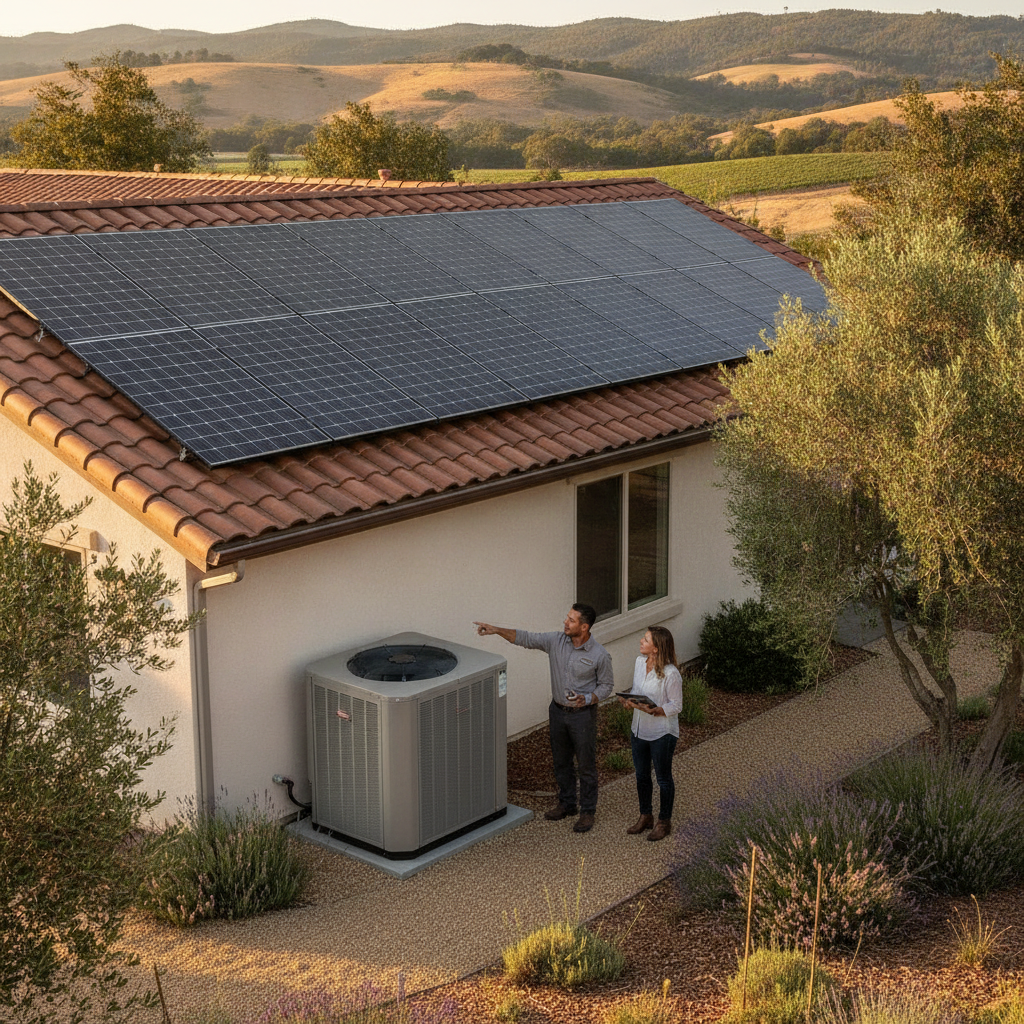
What Sonoma County Homeowners Should Know About HVAC and Solar Panels — How Your Heating and Cooling System Interacts With a Solar Array
If you have solar panels on your roof — or you’re seriously considering adding them — your HVAC system is the single largest variable in whether that investment actually pays off. In Santa Rosa and across Sonoma County, we see this combination more and more often, and the honest answer most solar companies won’t tell you upfront is this: the wrong HVAC system can wipe out most of your solar savings before you ever notice. Here’s what you actually need to know before signing anything, upgrading anything, or assuming the two systems will just work well together.
Your HVAC System Is Probably Your Home’s Biggest Energy Load
Across most homes in Sonoma County, heating and cooling accounts for roughly 40 to 60 percent of total household electricity consumption — sometimes more in older homes with inefficient systems. That means if you’re sizing a solar array without factoring in your HVAC equipment, or if your HVAC system is old and inefficient, you’re essentially trying to fill a leaking bucket.
Solar companies typically size your array based on your past utility bills. That’s a reasonable starting point, but it doesn’t account for what your energy use will look like after you make changes — and if you’re planning to upgrade your HVAC or switch from gas to electric heating, your consumption profile is going to shift significantly. A gas furnace home converting to an electric heat pump will see electricity use go up even as gas costs disappear. If nobody modeled that into your solar proposal, your array may be undersized from day one.
This is a gap that’s worth getting right before installation, not after.
Heat Pumps and Solar Are a Natural Match — But Only If They’re Sized Correctly
In Santa Rosa’s Mediterranean climate — hot, dry summers and cool, wet winters — a modern heat pump handles both heating and cooling from a single system. That efficiency is exactly why heat pumps pair so well with solar: they produce more output per unit of electricity than any resistance-based electric heater, and they run on electricity your panels are already generating.
A high-efficiency heat pump with a strong SEER2 rating (the updated efficiency standard now in use) will use meaningfully less electricity than a standard central AC unit paired with an electric furnace. That difference directly affects how many panels you need — and how quickly your solar system pays for itself.
If you’re already planning a solar installation and haven’t yet replaced your HVAC system, it’s worth getting a heat pump assessment first. Installing solar sized around an old, inefficient gas-plus-AC setup and then replacing that equipment later means your panels may not cover the new load — or you may have over-invested in panels you didn’t need. Sequencing matters. Learn more about heat pump options for Sonoma County homes.
The SEER Rating Conversation Your Solar Company Won’t Have With You
Most solar installers are not HVAC contractors, and most HVAC contractors are not solar specialists. That gap between the two trades is where homeowners often lose money. When you’re combining the two systems, the efficiency of your HVAC equipment — measured in SEER2 for cooling and HSPF2 for heat pump heating — directly affects the size of the solar array you need.
Here’s a simple way to think about it: a 14 SEER air conditioner uses roughly 20 to 30 percent more electricity than a 20 SEER unit to produce the same amount of cooling. Over a full summer in the Santa Rosa area, that adds up to real kilowatt-hours. A solar company may tell you that you need 24 panels to cover your home. But if you upgrade to a high-efficiency heat pump at the same time, you might get there with 18. The upfront savings on fewer panels can offset a significant portion of the heat pump’s cost.
Nobody is going to volunteer this math to you. But it’s worth asking both contractors to coordinate before you commit to either project.
What About Homes That Still Use Gas for Heat?
A lot of homes in Santa Rosa and communities like Windsor, Healdsburg, and Petaluma have a gas furnace paired with a central air conditioner. This is the most common HVAC setup we see across Sonoma County, and it creates a specific solar complication worth understanding.
Your solar panels generate electricity. They do nothing for your gas bill. So if you’re running a gas furnace through the winter, your solar system only offsets your cooling costs in summer and your electricity for everything else year-round — it doesn’t touch your heating costs at all. That’s fine if you’re aware of it, but many homeowners assume their solar panels are covering the whole house and are surprised when their gas bills don’t change.
If the goal is energy independence or reducing total utility spending, a hybrid heat pump system (which uses an electric heat pump as the primary heat source and a gas furnace as backup only on the coldest days) is a middle path worth considering. It reduces your gas dependency significantly without requiring a full electric conversion. See how heat pump hybrid systems work — and whether that setup makes sense for your home.
PG&E Time-of-Use Rates Change the Calculus
PG&E’s time-of-use (TOU) rate plans — which most new solar customers are automatically enrolled in — charge different amounts for electricity depending on when you use it. Peak rates typically apply in the late afternoon and early evening, which is often right when your solar panels are ramping down and your air conditioner is working hardest after a hot Sonoma County afternoon.
This matters for HVAC in a specific way. If your air conditioner is running hardest between 4 and 9 PM, you may be drawing heavily from the grid at peak rates even if your panels produced plenty of power earlier in the day. A programmable or smart thermostat that pre-cools your home during mid-day solar production hours — before peak rates kick in — can significantly reduce what you’re actually paying. This is a small operational adjustment that makes a real difference, and it’s something most solar installers won’t walk you through.
Wildfire Season Adds Another Layer
Sonoma County’s annual wildfire season creates an HVAC consideration that’s local and very real: when air quality is poor, you want your system running in recirculation mode with good filtration, not pulling smoky outdoor air into the house. At the same time, solar panels operating under heavy smoke cover produce significantly less power — sometimes 40 percent less on a badly smoky day.
That combination — high HVAC demand for filtration and poor solar output — is worth knowing about if you’re running your system on solar. It doesn’t change the overall value calculation much, but it does mean that having a grid connection (rather than going fully off-grid) is genuinely important for households in fire-prone areas like the hillside neighborhoods above Santa Rosa, Sonoma Valley, and communities near Healdsburg.
Frequently Asked Questions
Do I need to upgrade my HVAC system before installing solar?
Not necessarily, but it’s worth having an HVAC contractor assess your current system’s efficiency before your solar installer sizes the array. If your system is more than 12 to 15 years old, upgrading first may allow you to install fewer panels and still cover your energy needs.
Will a heat pump actually work well in Santa Rosa winters?
Yes. Modern heat pumps perform efficiently down to temperatures well below what Santa Rosa typically sees in winter. Sonoma County’s moderate climate is actually well-suited to heat pump heating — it’s extreme cold climates where heat pump efficiency drops significantly.
Can my existing HVAC equipment work with a solar system?
Yes — your HVAC system doesn’t need to be modified to work with solar. Solar connects at the electrical panel level. The question is whether your existing system is efficient enough to make good use of the electricity your panels generate.
What brands of heat pumps are available in Sonoma County?
We work with Trane, Carrier, Daikin, Mitsubishi Electric, Fujitsu, LG, and American Standard, among others. Brand selection depends on your home’s layout, existing ductwork, and specific efficiency goals.
Are there rebates available if I pair a heat pump with solar?
Yes. California and PG&E offer rebates on qualifying high-efficiency heat pumps, and federal tax credits are available for both heat pump equipment and solar installations. These programs change periodically, so it’s worth confirming current availability when you’re ready to move forward.
Ready to Talk Through How This Works for Your Home?
At Stout’s Heating & AC, Inc, we’ve been working with homeowners in Santa Rosa and across Sonoma County since 1992. We’re not a solar company — but we understand exactly how your HVAC system affects your energy profile, and we can help you make sense of the full picture before you commit to either upgrade. Whether you’re planning ahead, already have panels installed, or just want an honest second opinion on what your system is actually using, we’re a straightforward call or message away.
Request a free estimate or reach us directly at (707) 527-1504. We’re happy to walk through your specific setup and help you figure out what actually makes sense — no pressure, no upsell.