
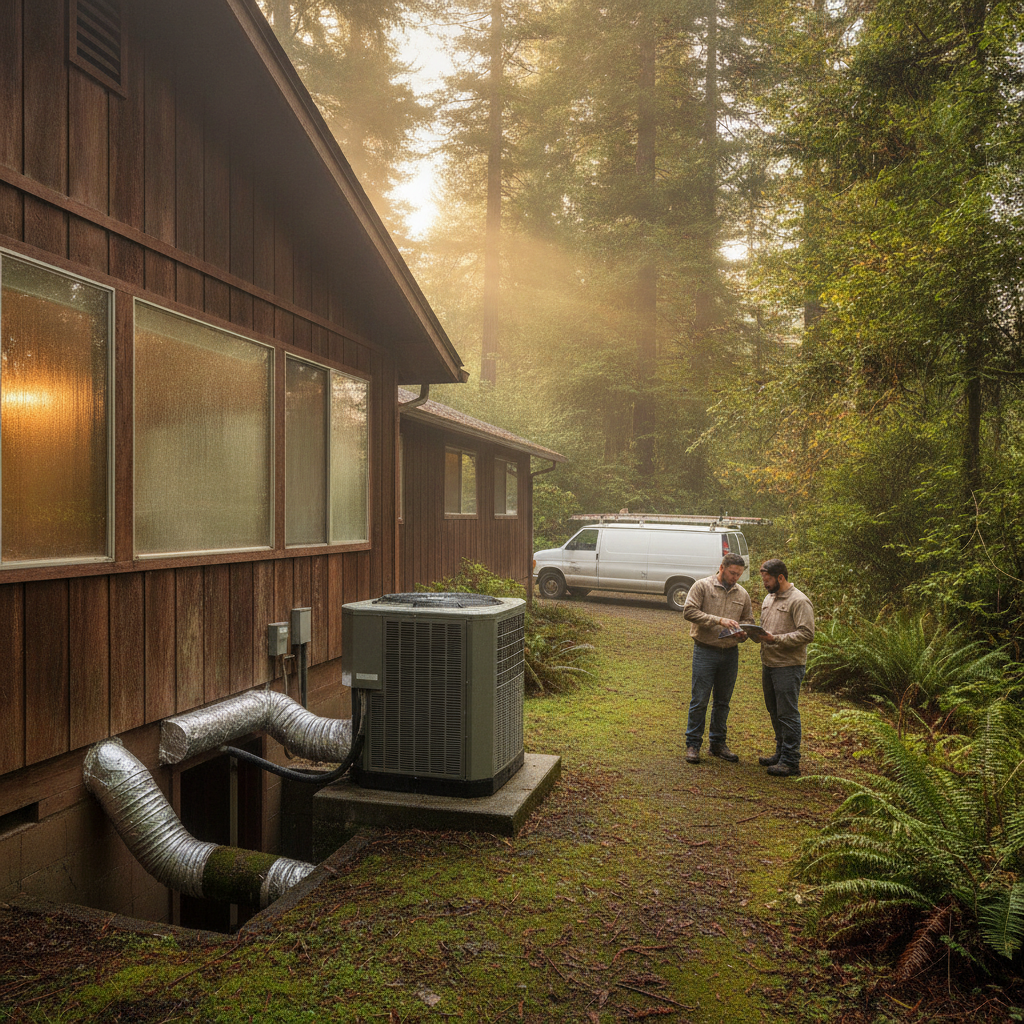
What Guerneville and the Russian River Valley Homeowners Should Know About Heating and Cooling in a Humid Climate — Why Standard HVAC Advice Doesn’t Always Apply Here
If you live along the Russian River in Guerneville, Monte Rio, or Forestville, your heating and cooling situation is genuinely different from what most HVAC contractors — and most online guides — are designed for. The Russian River Valley runs significantly wetter and cooler than Santa Rosa, Rohnert Park, or most of inland Sonoma County. Fog lingers well into summer mornings. Winter humidity settles into the redwoods and doesn’t let go. And older homes in the area — many of them vacation cabins converted to year-round residences — were never designed with modern climate comfort in mind. The standard HVAC playbook doesn’t always translate here, and that matters when you’re deciding what to install, repair, or replace.
The Russian River Microclimate Is Not the Same as the Rest of Sonoma County
Most of Sonoma County follows a classic Mediterranean pattern: hot, dry summers and cool, wet winters. That’s the baseline most HVAC systems sold and installed in the region are optimized for. Guerneville is a different story. The Russian River corridor acts as a funnel for marine air pushing in from the coast, which means you often get elevated humidity throughout the summer — not just in the evening. Relative humidity in the mid-60s to mid-70s percent during July and August isn’t unusual here, while Santa Rosa might be sitting at 30 to 40 percent on the same day.
That matters because air conditioning doesn’t just cool air — it also removes moisture from it. A system sized purely for temperature load in a dry climate won’t necessarily handle the latent heat load (the moisture) in a place like Guerneville without running longer cycles and working harder. If your AC cools your home down quickly but leaves it feeling clammy, that’s not just a comfort problem — it’s a sign the system may not be matched to your actual conditions.
What Moisture Does to Your HVAC Equipment Over Time
High ambient humidity accelerates wear on several parts of your HVAC system. Evaporator coils, drain pans, and the interior of air handlers are particularly vulnerable. If moisture doesn’t drain properly — which happens when drain lines clog or when the system isn’t running long enough to pull adequate condensation — standing water inside the air handler creates conditions where mold and mildew can grow inside the equipment itself.
This isn’t a hypothetical. It’s something we see regularly in homes along the river that have central air systems with ductwork running through unconditioned crawl spaces. When cool, moisture-laden air meets warmer surfaces in a crawlspace, condensation can form on the outside of ducts. Over time, that leads to duct degradation, insulation damage, and in some cases, mold growth that works its way back into the home’s air supply.
If your home has a central system with ductwork, and the ducts run under the floor in a vented crawlspace, this is worth discussing with a contractor who actually understands your local conditions — not just someone who installs the same system they’d put in a Fountaingrove hillside house.
Why Ductless Mini-Splits Are Often a Better Fit for Russian River Homes
A significant portion of homes in Guerneville and the surrounding river communities were built as seasonal cabins — small footprints, minimal insulation, no existing ductwork, and crawlspaces that weren’t engineered for the kind of infrastructure a central forced-air system demands. For these homes, a ductless mini-split system is often the most practical solution, and in a humid climate, it carries some real performance advantages too.
Modern ductless systems from manufacturers like Mitsubishi Electric, Fujitsu, and Daikin include variable-speed compressors that modulate output in small increments rather than simply turning on and off. This longer, lower-intensity runtime is actually better for dehumidification — the evaporator coil stays cold longer, which means more moisture gets wrung out of the air. A system that short-cycles because it’s oversized for the temperature load may leave you feeling cool but still damp.
There’s also the question of where to put equipment. In a home without attic space suitable for a furnace and air handler, and with a crawlspace that’s chronically damp, a wall-mounted ductless unit avoids those problem zones entirely. The refrigerant lines run through a small exterior penetration, and the outdoor unit sits on a pad or wall mount — keeping the system away from the conditions that cause the most damage. Heat pump-based ductless systems also give you year-round heating and cooling from a single installation, which matters when your winters involve sustained dampness rather than hard freezes.
Heating Considerations in a Damp Winter Climate
Guerneville winters are mild in terms of temperature — you’re rarely below freezing for extended periods — but the sustained dampness makes homes feel colder than the thermometer suggests. A home that sits at 48°F with 80% relative humidity feels considerably colder than a dry home at the same temperature. That means heating systems here often run more hours per day than comparable systems in drier inland communities.
For homes still using older wall furnaces, propane systems, or electric resistance baseboard heaters, the operating costs during a Russian River winter add up quickly. A modern heat pump — whether a ductless system or a ducted heat pump installed as part of a full system replacement — can move three to four units of heat energy for every unit of electricity it consumes, which makes a meaningful difference on your PG&E bill across a long, wet heating season.
One important note: heat pumps work on refrigerant, and refrigerant systems have components that are vulnerable to corrosion. Homes in coastal and river communities should discuss equipment coating and corrosion protection with their contractor before installation. Some manufacturers offer additional protection for environments with elevated moisture exposure. This is the kind of detail that doesn’t show up in a standard installation quote but makes a real difference in how long your equipment lasts.
The Dehumidification Question — and Why Your HVAC System Alone May Not Be Enough
In particularly humid stretches of summer, or in homes that are tightly sealed enough that moisture has nowhere to escape, some Russian River homeowners find that their air conditioning — even a well-sized, well-maintained system — can’t keep indoor humidity in a comfortable range on its own. When that’s the case, the answer isn’t necessarily a bigger AC system. Oversizing creates the short-cycling problem mentioned earlier and can make things worse.
A dedicated whole-home dehumidifier, integrated into the HVAC system or installed as a standalone unit, gives you independent humidity control without sacrificing cooling efficiency. These systems pull moisture from the air continuously, even when the AC isn’t running, and can make a dramatic difference in comfort and in protecting the home from long-term moisture damage. They’re also worth discussing if you have a crawlspace with persistent moisture issues, since crawlspace humidity directly affects the air quality and comfort in the living space above. Proper ventilation tied into a dehumidification strategy can address both the comfort and the moisture management side of the problem at once.
What to Ask Any HVAC Contractor Before They Size Your System
If you’re getting quotes for a new system — or even for a significant repair — in a Russian River home, there are a few questions worth asking upfront:
- Are you doing a Manual J load calculation, or just estimating based on square footage? Square footage alone doesn’t account for your home’s insulation, window area, infiltration, or the local humidity load. A proper load calculation is the baseline for correct sizing.
- How are you accounting for latent heat load? If a contractor looks confused by this question, that’s information worth having. Latent load is the moisture component of the cooling calculation, and it matters here more than it does in a drier part of Sonoma County.
- Where will the equipment be located, and how does that interact with the crawlspace or attic conditions? Equipment placement in a damp environment affects both performance and longevity.
- What corrosion protection does the equipment you’re recommending include? Some models and brands have better factory coatings or optional protection packages for humid environments.
Frequently Asked Questions
Can a standard central AC system handle Guerneville’s humidity?
It can, but it needs to be correctly sized for the latent load — not just the temperature load. Many systems installed in the area are sized for drier conditions and underperform on muggy summer days. If your home feels cool but clammy, that’s worth investigating.
Is a heat pump practical for a Russian River home that gets cold and damp in winter?
Yes — modern heat pumps perform well in the mild-to-cool temperatures typical of a Guerneville winter. They’re not designed for sustained hard freezes, but the Russian River Valley rarely sees those. A heat pump here is a practical year-round solution.
My cabin has no existing ductwork. What are my realistic options for heating and cooling?
A ductless mini-split system is usually the cleanest answer. It requires no ductwork, handles both heating and cooling, and can be installed in most older cabins without major structural modifications. Multi-zone systems can handle several rooms from a single outdoor unit.
How do I know if my crawlspace moisture is affecting my indoor air quality?
Signs include musty odors, visible condensation on floors or lower walls, increased allergy or respiratory symptoms, and visible mold in the crawlspace itself. An HVAC contractor experienced with the area can assess whether your ventilation setup is contributing to the problem.
Does Stout’s Heating & AC service the Guerneville and Russian River area?
Yes — we serve communities throughout Sonoma County, including Guerneville, Forestville, Sebastopol, and the surrounding area, from our Santa Rosa location. We’ve been doing this work since 1992 and understand the range of conditions across the county.
Ready to Talk Through Your Options?
If you own a home along the Russian River and you’ve been managing with an undersized, aging, or just plain wrong HVAC system, you don’t have to figure this out alone. At Stout’s Heating & AC, Inc., we’ve been serving Sonoma County — including the wetter, cooler western communities — since 1992. We’re not going to hand you a generic quote built for a Santa Rosa tract home. We look at what you actually have, where you actually live, and what’s going to hold up in your conditions.
Request a free estimate or call us at (707) 527-1504 to schedule a visit. We’re happy to take a look at what you’re working with and give you a straight answer about what makes sense — whether that’s a repair, a system replacement, or just a better maintenance plan for what you already have.