
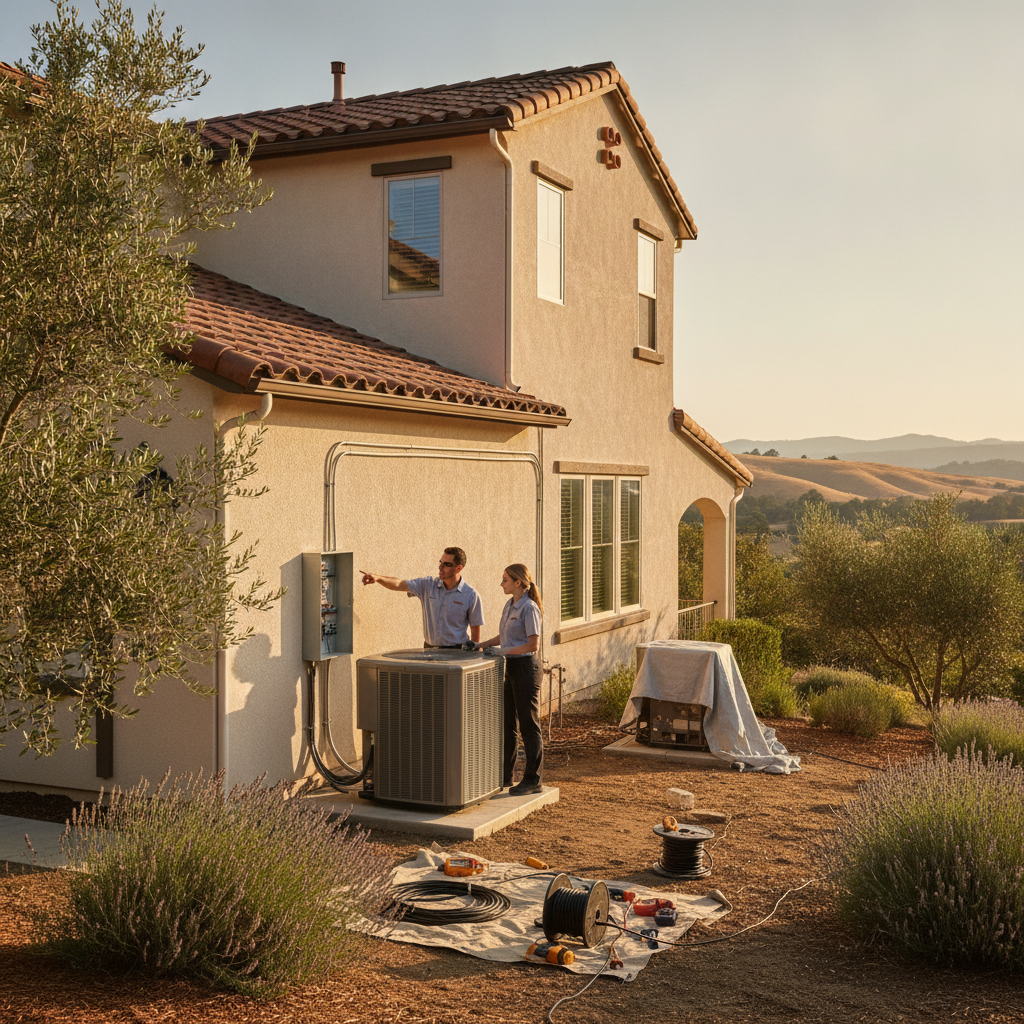
What Santa Rosa Homeowners Should Know About HVAC and Home Electrification — Timing Your Upgrade, Managing Your Electrical Panel, and What to Expect When You Go All-Electric
If you own a home in Santa Rosa and you’ve started researching heat pumps, EV chargers, induction ranges, or heat pump water heaters, you’ve probably run into one uncomfortable reality: electrifying your home isn’t just about picking the right appliances. It’s about whether your house can actually handle all of them at once — and how you sequence the upgrades so you’re not spending money twice. HVAC is almost always the biggest piece of the electrification puzzle, and getting it right requires a conversation most local contractors aren’t having with their customers.
Why Your Electrical Panel Is the Starting Point, Not an Afterthought
Most Santa Rosa homes built before the 1990s were wired with a 100-amp service panel — enough for lights, appliances, and a gas furnace. But the moment you start adding a heat pump, an EV charger, and a heat pump water heater, you’re looking at a house that may need 200-amp service, and in some cases a panel upgrade before any of the equipment can be installed safely.
This isn’t a scare tactic — it’s just math. A standard ducted heat pump system for a 1,800-square-foot home might draw 15–25 amps depending on the size. An EV charger adds another 30–50 amps. A heat pump water heater pulls another 15 amps. If your panel is already near capacity, layering these systems on top of each other creates real problems: tripped breakers, overloaded circuits, or equipment that fails early because it’s not getting consistent power.
Before you call anyone about a heat pump installation, have an electrician assess your panel. In some cases, a simple load calculation will show you have more capacity than you thought. In others, a panel upgrade is going to be part of the budget — typically somewhere in the $2,000–$5,000 range depending on the scope of work, though your electrician will give you an accurate quote. Either way, you want to know before you buy the equipment.
How HVAC Fits Into a Whole-Home Electrification Plan
Heating and cooling is almost always the first or second thing homeowners tackle when they go all-electric — and for good reason. It’s the largest energy user in most homes, and it’s the upgrade that delivers the most noticeable day-to-day comfort improvement.
For most Santa Rosa homeowners, a heat pump system makes the most practical sense. Santa Rosa’s Mediterranean climate — warm, dry summers and cool, wet winters — is nearly ideal for heat pump operation. Unlike colder climates where heat pumps struggle when temperatures drop into the teens, Sonoma County winters rarely push below freezing for extended periods. A modern cold-climate heat pump handles local winter temperatures with ease, and you get efficient air conditioning built in for those July and August heat waves.
If you’re not ready to fully cut the gas line — or if your home has older ductwork and you want a hedge against very cold nights — a dual fuel system is worth understanding. It pairs a heat pump with a gas furnace backup, switching automatically based on outdoor temperature and which energy source is more cost-effective at any given moment. For homes in higher-elevation areas of Sonoma County or on properties where gas is already well-established, this hybrid approach can be a smart middle step on the way to full electrification.
The Sequencing Problem — and Why Order Matters
One of the most common and costly mistakes homeowners make during electrification is doing things in the wrong order. Here’s what we see happen: someone installs a heat pump without upgrading the panel, then realizes they can’t add the EV charger they planned for. Or they upgrade the panel first but don’t account for the water heater or the dryer, so they’re short on circuits and have to go back to the electrician for more work.
A smarter sequence for most Santa Rosa households looks something like this:
- Start with a whole-home energy assessment. Know what you’re working with before you spend anything. Many utilities and nonprofits offer these at low or no cost.
- Upgrade the panel if needed. Get this done first so every subsequent installation is straightforward.
- Install the heat pump system. This is typically the biggest cost and the biggest payoff, and once you have adequate electrical service it goes in cleanly.
- Add the EV charger and water heater. These are relatively straightforward once the panel is sorted.
- Address the range and dryer last. These are smaller loads and easier to swap out over time.
Getting this sequence right — and having your HVAC contractor and electrician communicate early — can save you thousands in redundant work and scheduling delays.
What Homes in Coffey Park and Fountaingrove Should Know
A significant number of homes in Santa Rosa were rebuilt after the 2017 fires, particularly in Coffey Park and Fountaingrove. Many of those rebuilt homes already have 200-amp panels, better insulation, and were built with electrification in mind. If your home was rebuilt post-2017, you may have fewer panel concerns than a comparable home in Roseland or the West End that was never touched.
That said, even newer homes sometimes have subpanels in garages or outbuildings that weren’t sized for an EV charger plus heat pump load. Don’t assume a newer home means no electrical work — always have it assessed.
California Rebates, PG&E Programs, and Federal Tax Credits
This is an area where getting current information matters, because programs change. As of now, there are meaningful financial incentives available for Santa Rosa homeowners going all-electric:
- Federal tax credits (IRA): The Inflation Reduction Act provides a 30% tax credit (up to $2,000) for heat pump installation, plus separate credits for heat pump water heaters and weatherization improvements. These are nonrefundable credits, meaning they reduce your tax liability — talk to a tax advisor about your specific situation.
- California TECH Clean program: Point-of-sale rebates for heat pump HVAC systems and heat pump water heaters, available through participating contractors. Income-qualified households can receive higher amounts.
- PG&E EV programs and rate plans: If you’re adding an EV charger, PG&E offers time-of-use rate plans that can significantly reduce your overall electricity costs when you shift usage to off-peak hours — which also benefits heat pump operation.
We keep up with these programs so we can help you understand what you may qualify for before you commit to any system. Visit our current offers page for information on financing and any available specials — and ask us directly about rebate eligibility when we come out for an estimate.
What to Watch Out For With Ductless Systems and Electrification
For older Santa Rosa homes — the craftsman bungalows in the West End, the mid-century ranches in Bennett Valley, the small cottages in Sebastopol and Petaluma — adding traditional ducted heating and cooling isn’t always feasible or cost-effective. In those cases, ductless mini-split heat pumps offer a cleaner path to electrification. They require no ductwork, are highly efficient, and can be installed in stages room by room if needed.
The tradeoff is that each indoor unit needs its own circuit, so you’ll still need to plan your panel capacity carefully. A multi-zone mini-split system for a three-bedroom home might need two to four dedicated circuits depending on how the zones are configured. Again — this is a conversation to have before you buy anything.
Frequently Asked Questions About HVAC and Home Electrification in Santa Rosa
Do I have to remove my gas furnace to install a heat pump?
No. Many Santa Rosa homeowners install a heat pump alongside their existing gas furnace as a hybrid system. The heat pump handles most heating and all cooling, and the gas furnace kicks in during the coldest days or when gas is more cost-effective than electricity. You can transition fully off gas at a later point.
How long does a heat pump HVAC installation typically take?
For a straightforward replacement of an existing system with similar ductwork, a day or two of installation is typical. If ductwork modifications, panel work, or permits are involved, plan for a slightly longer timeline. We’ll give you a realistic schedule when we assess your home.
Will a heat pump actually save me money on my PG&E bill?
In most cases, yes — especially if you’re replacing an older gas furnace and standard central AC. Heat pumps move heat rather than generate it, making them two to three times more efficient per unit of energy. Rising PG&E electricity rates and volatile gas prices both factor into the calculation, and the math has been shifting in favor of electricity for most Sonoma County households.
Do I need permits for a heat pump installation in Santa Rosa?
Yes. Mechanical and electrical permits are typically required for heat pump installations in the City of Santa Rosa and throughout Sonoma County. We handle the permit process as part of installation — you shouldn’t have to manage that yourself.
What brands do you install for heat pump systems?
We install and service systems from Trane, Carrier, Daikin, Mitsubishi Electric, Fujitsu, LG, Amana, American Standard, and others. We’re not tied to a single brand, which means we recommend what actually fits your home and budget rather than whatever a manufacturer is pushing this quarter.
Ready to Talk Through Your Electrification Plan?
We’ve been doing this work in Santa Rosa and Sonoma County since 1992 — through housing booms, fire rebuilds, and now the shift toward electrification. We’re not going to oversell you a system your home isn’t ready for, and we’re not going to leave you to figure out the panel situation on your own. If you’re thinking through an HVAC upgrade as part of going all-electric, we’re glad to come out, assess what you’re working with, and give you a straight answer about what makes sense for your home and your timeline.
Reach out to schedule a free estimate or ask questions — you can find us at stoutshvac.com/contact-us or call us directly at (707) 527-1504. No pressure, no upselling — just honest guidance from a local contractor who knows what homes in this area actually need.