
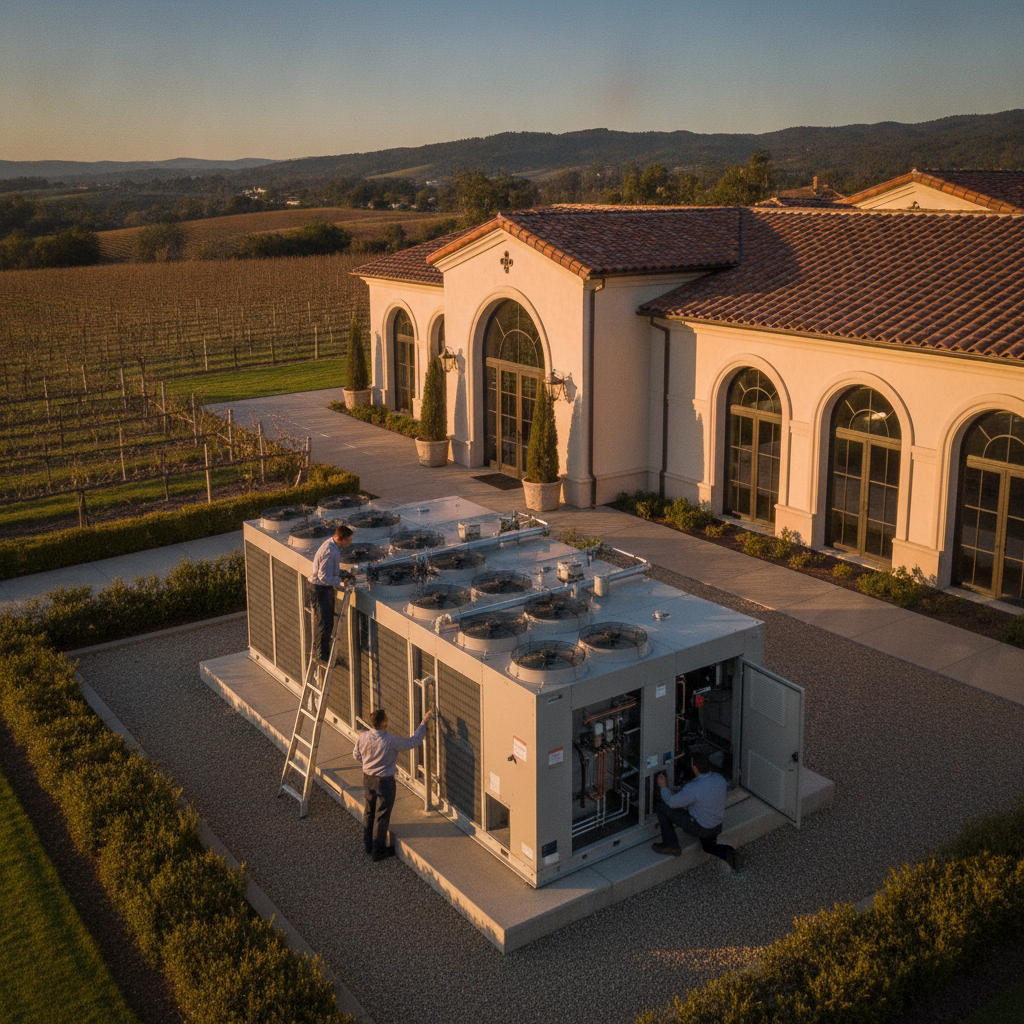
What Santa Rosa Winery and Hospitality Businesses Should Know About Commercial HVAC in Wine Country — Seasonal Swings, Guest Comfort, and Systems That Keep Up
If you own or manage a tasting room, boutique inn, winery event space, or restaurant anywhere in Sonoma County — from Santa Rosa out to Healdsburg or down toward Kenwood and Sonoma — your HVAC system is doing something most commercial equipment was never specifically designed for: handling wildly uneven occupancy, dramatic temperature swings between morning and afternoon, and the constant pressure to make every guest experience feel effortless. A system failure during a weekend harvest event or a packed Saturday tasting isn’t just uncomfortable — it costs you bookings, reviews, and reputation. Here’s what you actually need to know.
Why Wine Country Hospitality HVAC Is a Different Problem
Most commercial HVAC guidance is written for offices and retail spaces — environments with fairly predictable occupancy and relatively stable load demands. Your business probably doesn’t work that way. A tasting room might sit empty Tuesday morning and be packed with 80 visitors by Saturday afternoon. An event barn or vineyard pavilion might host a wedding in October heat, then go unoccupied for days. A Healdsburg wine bar might be slammed during the summer tourism season and nearly quiet by January.
Sonoma County’s Mediterranean climate adds another layer. Summers are hot and dry — inland areas around Santa Rosa and Windsor can hit 100°F or above during heat events — but mornings are often cool and evenings drop off quickly. That daily temperature swing means a system that was sized and set up for midday peak load will frequently be working against you at other times of day. You’re not just fighting the heat; you’re managing a moving target.
Wildfire smoke season has also changed the calculus for many hospitality operators. Guests who are sensitive to air quality will notice immediately if your space smells like smoke or feels stuffy. Tasting rooms especially — where guests are paying close attention to aromas — need to maintain genuinely clean, neutral air, not just air that’s been temperature-controlled.
The Zoning Problem Most Hospitality Operators Underestimate
One of the most common HVAC complaints we hear from winery and hospitality clients is that their system works fine in one part of the building and fails completely in another. The barrel room needs to stay cool and consistent. The tasting bar is packed with people generating body heat. The covered patio has no conditioning at all. The private event room is used twice a week and blasting conditioned air the rest of the time.
Running one central system to serve all of those spaces equally is an exercise in compromise — and usually means at least one area is always wrong. Proper commercial zoning, using either a multi-zone commercial AC setup or a VRF (variable refrigerant flow) system, lets you condition each area independently based on actual demand. You’re not paying to cool an empty event room at full blast while your tasting bar is doing the real work.
VRF systems in particular have become the go-to solution for mixed-use winery and hospitality properties precisely because they handle partial loads efficiently, can run heating and cooling in different zones simultaneously, and don’t require the ductwork that older commercial buildings often lack or have in poor condition.
Seasonal Peaks and the Maintenance Gap Nobody Talks About
Here’s the pattern we see repeatedly with hospitality clients across Sonoma County: the system runs hard during tourist season — summer and fall harvest — and then gets minimal attention over the slower winter months. By the time the following spring arrives, the equipment has accumulated a season’s worth of deferred maintenance and is starting the busiest stretch of the year in a compromised state.
For a winery or hospitality business, that’s the worst possible time to discover a failing compressor, a refrigerant leak, or a clogged condenser. Emergency HVAC service during peak season is expensive, disruptive, and sometimes means waiting days for parts when demand is high regionally.
The smarter approach is to schedule bi-annual commercial maintenance — once in spring before the heat season, once in fall before heating demand picks up — and use the quieter winter period to address anything that needs more significant repair or replacement. A commercial HVAC maintenance plan lets you budget predictably for upkeep rather than absorbing the full cost of emergency repairs at the worst moments. That’s not just good operations management; it’s risk management for your guest experience.
What the Gap in Local HVAC Advice Looks Like for Hospitality Operators
Most local HVAC contractors — including some of our competitors — focus their commercial content almost entirely on office buildings, retail spaces, and restaurants in a generic sense. There’s very little guidance written specifically for the mixed-use, occupancy-variable, air-quality-sensitive environment of a Sonoma County winery, inn, or event venue. That gap matters, because the equipment recommendations, the zoning approach, and the maintenance schedule for a tasting room operation are genuinely different from what works for a dental office or a grocery store.
When you’re evaluating a commercial HVAC contractor for your hospitality property, ask them directly: have they worked with tasting rooms, event barns, or boutique inns before? Can they speak to VRF system options and how zoning would work for your specific layout? Do they understand the air quality standards that matter in a space where guests are paying attention to what they smell? If the answers are vague, keep looking.
Energy Costs and Why They Hit Hospitality Harder
PG&E rate increases have hit commercial properties across Sonoma County hard over the past several years, and hospitality businesses often have longer operating hours than offices or retail — which means the meter is running more of the time. An aging or improperly sized commercial system that’s cycling inefficiently can quietly add hundreds of dollars a month to your utility bill during peak season.
High-efficiency commercial equipment — including heat pump-based systems and VRF technology — can significantly reduce that load. There are also California and utility rebate programs available for qualifying commercial equipment upgrades. If your current system is more than 12–15 years old and you’re seeing utility bills that feel out of proportion, it’s worth getting a professional load calculation done to see whether your equipment is actually matched to your current building and usage pattern. You can explore current offers and financing options to understand what an upgrade might look like financially.
Frequently Asked Questions
Can a standard commercial AC system handle a tasting room’s needs?
It depends on the space, but often a single-zone commercial system is a poor fit for a tasting room that has distinct areas with different load demands — a bar area full of people, a barrel storage zone that needs temperature consistency, and event space that’s intermittently occupied. A zoned or VRF system typically performs much better and costs less to operate over time.
How do I manage air quality in a tasting room during wildfire smoke season?
This requires both good filtration on your HVAC system — MERV-13 filters at minimum, or a dedicated air purification unit — and careful attention to how much outside air you’re bringing in during smoke events. A commercial HVAC contractor familiar with Sonoma County conditions can help you configure your system to prioritize recirculated, filtered air when outdoor air quality is poor. Your guests will notice the difference.
How often should commercial HVAC equipment in a hospitality setting be serviced?
Twice a year is the baseline — spring before summer cooling demand and fall before heating season. For high-occupancy venues like event barns or busy tasting rooms, quarterly filter changes and visual checks between professional visits are also a good idea. Equipment that runs hard during tourist season needs more attention, not less.
What’s the right HVAC setup for an outdoor or semi-covered event space?
Traditional ducted systems don’t work well for open or semi-open pavilions. Ductless mini-splits, radiant heating for covered areas, and high-volume low-speed fans are commonly used in combination. The right answer depends on how enclosed the space is, what seasons you use it in, and what your budget looks like. It’s worth a site visit from a commercial contractor before committing to any equipment.
We lease our tasting room building — is HVAC the landlord’s responsibility?
It depends on your lease terms, which vary widely in commercial hospitality properties. Many commercial leases in Sonoma County place maintenance responsibility on the tenant while the landlord handles replacement. Read your lease carefully and, if it’s ambiguous, clarify in writing before the summer season. Either way, you want to know who’s responsible before something breaks on a busy Saturday.
Talk to Someone Who Knows the Local Market
Stout’s Heating & AC, Inc has been serving commercial clients across Santa Rosa and Sonoma County since 1992. We work with hospitality operators, restaurant owners, and winery properties throughout the region — including areas like Healdsburg, Petaluma, Windsor, and Sonoma — and we understand the specific demands that Wine Country businesses face. We’re not a franchise or a call center; when you call us, you’re talking to people who actually work in this community.
If your tasting room, event venue, or hospitality property has HVAC questions — whether it’s an aging rooftop unit, a zoning problem, or planning for a system upgrade — we’re happy to take a look. Contact us to schedule a visit or ask a question. No pressure, no sales pitch — just straight answers from a local contractor who’s been doing this work for over 30 years.