
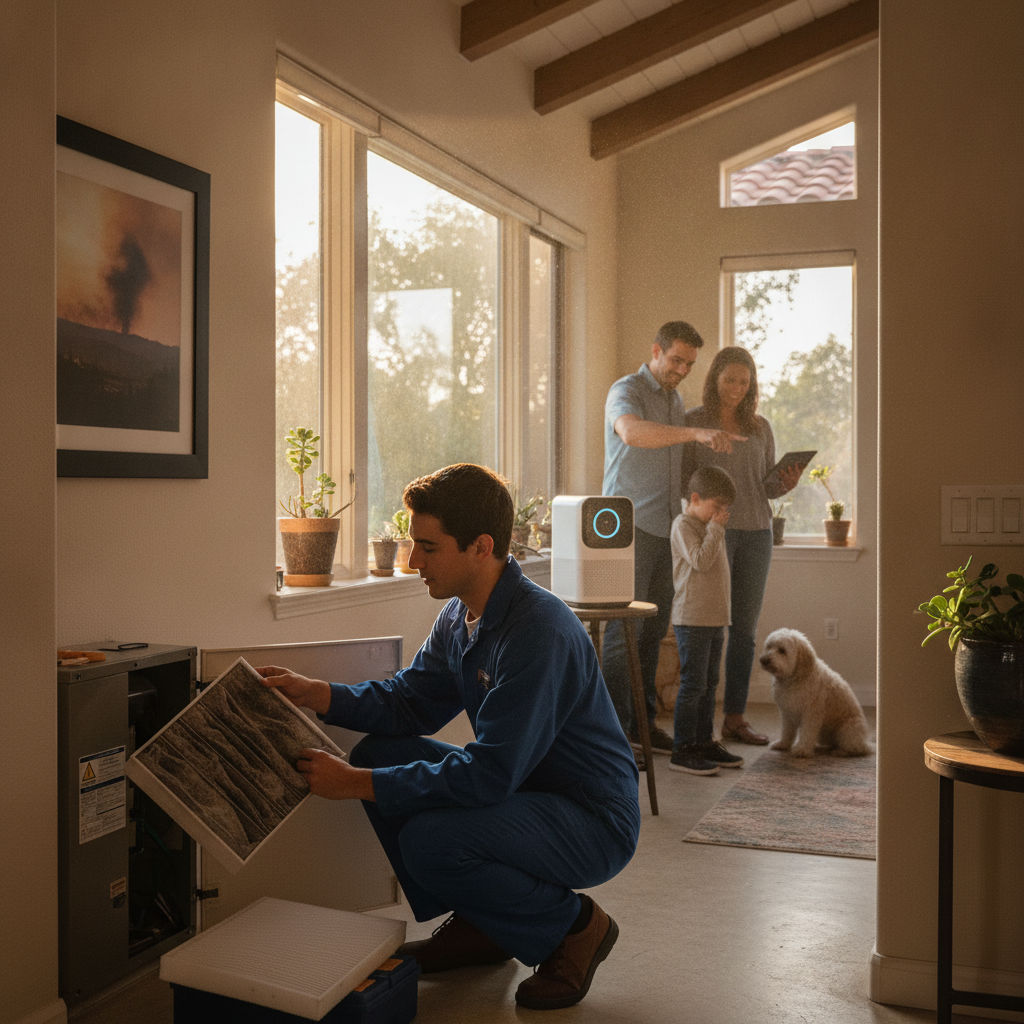
What Santa Rosa Homeowners Should Know About Indoor Air Quality Beyond Wildfire Smoke — Everyday Pollutants, Hidden Sources, and What Actually Improves the Air Inside Your Home
Yes, wildfire smoke is a real and serious indoor air quality concern in Santa Rosa and across Sonoma County. But if that’s the only time you’re thinking about the air inside your home, you’re probably missing a bigger picture. The EPA has estimated that indoor air can be two to five times more polluted than outdoor air — and that’s on a perfectly clear day in September with no fires anywhere nearby. Dust, mold spores, pet dander, volatile organic compounds from furniture and cleaning products, and combustion byproducts from gas appliances are all quietly circulating through your home every day, whether you notice them or not.
This article is about what’s actually in your indoor air when there’s no smoke in the sky, why it matters, and what your HVAC system can — and can’t — do about it.
The Pollutants Nobody Talks About (But Should)
Most homeowners, when they think about air quality, think about visible stuff: dust bunnies, smoke, the occasional musty smell. But the pollutants that cause the most long-term health issues are often the ones you can’t see or smell at all.
Volatile Organic Compounds (VOCs) are chemical gases emitted from everyday household materials — new flooring, paint, furniture, adhesives, cleaning sprays, and even scented candles. Homes in newer neighborhoods like Fountaingrove or recently remodeled properties in Bennett Valley can actually have elevated VOC levels for months after construction or renovation work, simply because materials are still off-gassing. Older homes in Railroad Square or the West End have their own version of this problem: decades-old building materials, original cabinetry finishes, and older insulation products that weren’t manufactured with modern health standards in mind.
Biological pollutants — mold spores, dust mites, pet dander, and bacteria — are year-round concerns throughout Sonoma County. Santa Rosa’s Mediterranean climate means mild, wet winters that create ideal conditions for mold growth inside wall cavities, around windows, and in poorly ventilated crawl spaces. By the time you smell mold, it’s already well established.
Combustion byproducts from gas stoves, fireplaces, and older water heaters include nitrogen dioxide and fine particulate matter. These aren’t dramatic leaks — they’re the low-level byproduct of everyday appliance use in homes that may not have adequate fresh air exchange.
Why Your Standard HVAC Filter Isn’t Enough — and What the Filter Rating Actually Means
Here’s something worth understanding clearly: the filter in your forced-air furnace or air handler was designed primarily to protect the equipment, not to clean your air. A standard 1-inch fiberglass filter catches large debris to keep your blower motor from clogging. It does very little for fine particles, VOCs, or biological contaminants.
MERV ratings (Minimum Efficiency Reporting Value) measure how effectively a filter captures particles of specific sizes. A MERV 8 filter — the most common upgrade sold at hardware stores — will catch a reasonable amount of dust and pollen. A MERV 13 filter will capture fine particles including some bacteria and smoke residue. But here’s the catch: not every system can handle a high-MERV filter without airflow restriction. A MERV 13 filter jammed into a system designed for a MERV 8 can actually reduce airflow, cause your system to work harder, and shorten its lifespan.
Before upgrading your filter rating on your own, it’s worth having someone check whether your system can handle it — especially if you have an older furnace or air handler. If you’re not sure where to start, our residential ventilation services include an assessment of your current setup and what improvements will actually make a difference.
What Whole-Home Air Purification Actually Does (and What It Doesn’t)
Portable air purifiers — the kind you pick up at a big-box store — work reasonably well for a single room. But they have real limitations in a 2,000 square foot home. They don’t treat air at the source, they require constant filter replacement, and they only help in rooms where they’re physically running.
Whole-home air purification systems installed directly into your HVAC system treat all the air that circulates through your home — every time the system runs. There are a few main categories:
- Media air cleaners: Thick, high-efficiency filter media (typically 4–5 inches deep) installed in line with your ductwork. These capture fine particles effectively without the airflow restriction problem of thin high-MERV filters. They’re a good baseline upgrade for most Santa Rosa homes.
- UV air treatment systems: Ultraviolet light systems mounted inside the air handler or ductwork are effective at neutralizing biological contaminants — mold, bacteria, and some viruses — that pass through the unit. They work best in combination with a good filter, not as a standalone solution.
- Electronic air cleaners: These use an electric charge to attract and trap fine particles, including some that slip past standard filters. They require periodic cleaning but don’t need filter replacements.
- Activated carbon filtration: The only category that addresses VOCs and chemical gases rather than just particles. If you’re in a newer home, recently renovated, or using a lot of cleaning products, this is worth discussing.
The right combination depends on your home, your system, and what you’re actually trying to solve. There’s no single product that does everything well.
The Ventilation Problem Most Homeowners Don’t Know They Have
One of the most underappreciated contributors to poor indoor air quality is inadequate fresh air exchange. Modern homes — especially those that have been upgraded with new windows, insulation, and weatherstripping — are significantly tighter than homes built before the 1990s. That’s great for energy efficiency. It’s not so great for air quality, because stale indoor air has fewer opportunities to be replaced with fresh outdoor air.
Older homes in areas like Roseland or South Park often have the opposite problem: they’re drafty enough that outdoor air (including pollen, dust, and on bad days, smoke) comes in whether you want it or not, without any filtration at all.
Mechanical ventilation systems — including energy recovery ventilators (ERVs) and heat recovery ventilators (HRVs) — solve this by bringing in controlled, filtered fresh air while recovering the heating or cooling energy from the outgoing air. For homes in Sebastopol, Windsor, or Petaluma where energy efficiency is already a priority, an ERV pairs particularly well with a heat pump system to maintain air quality without wasting conditioned air.
A Note on Humidity — the IAQ Factor That Gets Ignored
Santa Rosa’s climate is relatively dry in summer and moderately humid in winter. Both extremes affect air quality. Air that’s too dry irritates sinuses and respiratory systems and makes you more susceptible to airborne viruses. Air that’s too humid encourages mold growth and dust mite populations.
Most HVAC systems do some incidental dehumidification in summer as a byproduct of cooling, but they don’t actively manage humidity in winter. A whole-home humidifier or dehumidifier integrated with your HVAC system gives you direct control over humidity levels year-round — something that standalone portable units simply can’t do consistently across a whole house.
If you’re already thinking about your system’s efficiency and long-term performance, our current offers include financing options that make it easier to address filtration, ventilation, and humidity control alongside other system upgrades.
Frequently Asked Questions
Can my existing HVAC system support an air purifier or UV system?
In most cases, yes — but it depends on your system type, age, and configuration. A whole-home purifier or UV system is typically installed directly inside your air handler or ductwork by a licensed HVAC technician. We can assess your current setup and tell you exactly what will work before recommending anything.
How often should I change my HVAC filter for better air quality?
It depends on the filter type. Standard 1-inch filters typically need replacement every 30–90 days. Higher-efficiency 4–5 inch media filters can last 6–12 months. During wildfire season, check your filter more frequently — it can clog quickly during heavy smoke events. A clogged filter is actually worse than no filter because it restricts airflow.
Are whole-home air purifiers worth the cost?
For most homeowners in Sonoma County, yes — especially if anyone in the household has allergies, asthma, or respiratory sensitivities. The upfront cost of a quality media filter or UV system is typically far less than ongoing purchases of portable unit filters, and the coverage is vastly better. The key is making sure the product is matched to your actual system and needs.
My home smells musty sometimes — is that an HVAC issue?
Possibly. Musty odors often point to mold growth inside the air handler, on the evaporator coil, or in the ductwork — all common problems in systems that haven’t been serviced regularly. It can also indicate a drainage issue near the unit. Either way, it’s worth having someone look at it rather than masking it with air fresheners.
Does opening windows help indoor air quality?
On good air quality days, yes — natural ventilation is free and effective. But in Santa Rosa, you need to pay attention to the AQI, especially during fire season, high pollen days in spring, and when agricultural burning is happening in the surrounding valleys. When outdoor air quality is poor, a filtered mechanical ventilation system is a much better option than open windows.
Talk to Someone Who Knows Your Home’s Air
At Stout’s Heating & AC, Inc., we’ve been helping Santa Rosa and Sonoma County homeowners breathe easier since 1992. We’re not going to sell you a product your system can’t support or recommend a solution that doesn’t fit your situation. If you’re concerned about your home’s air quality — whether it’s dust, odors, humidity, or just general stuffiness — we’re happy to take a look and give you a straight answer about what’s going on and what will actually help.
Contact us to schedule an assessment or ask a question — no pressure, no jargon, just honest advice from a local team that’s been doing this work for more than three decades.