
What Petaluma and Sonoma County Commercial Property Owners Should Know About Rooftop HVAC Units — Maintenance, Lifespan, and When Replacement Makes More Sense Than Another Repair
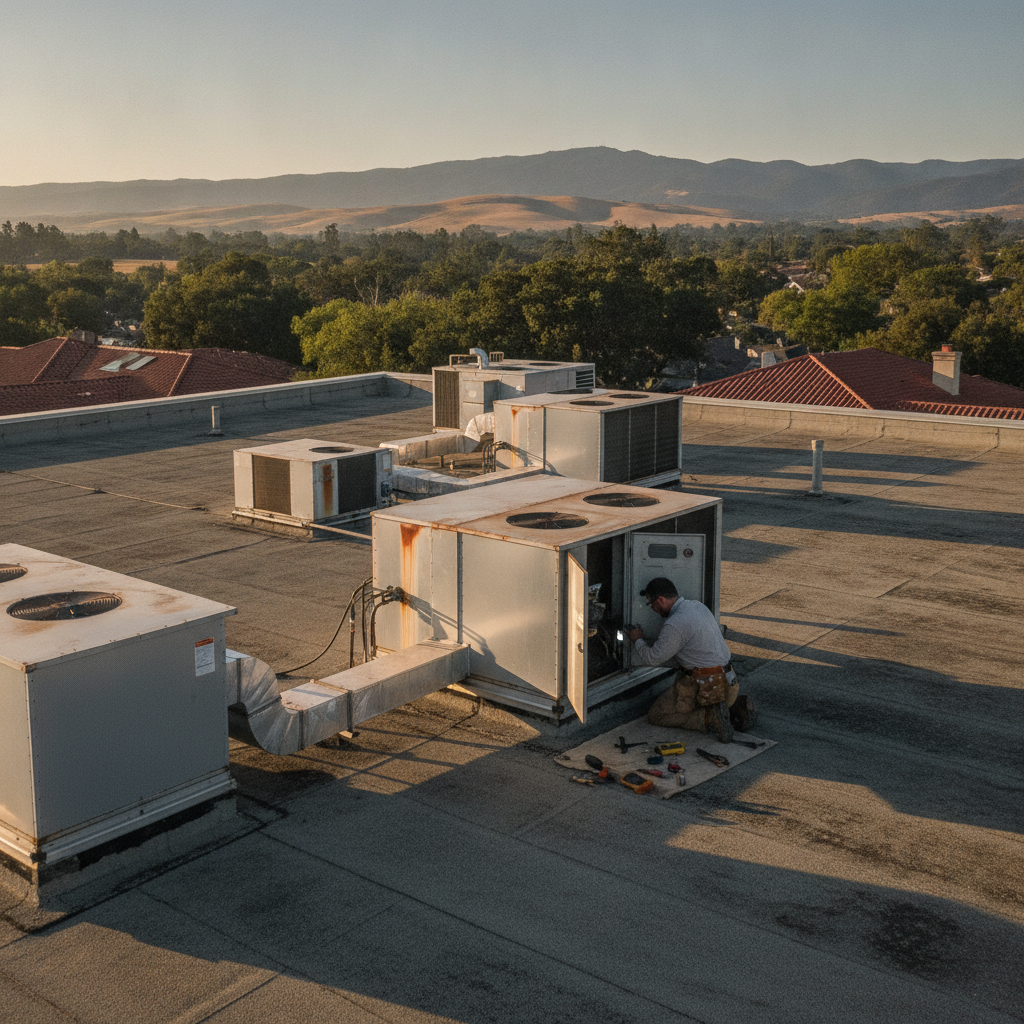
If you own or manage a commercial building in Petaluma — a retail strip, an office suite, a light industrial space along the Highway 101 corridor — there’s a good chance your HVAC system is a rooftop unit (RTU). They’re one of the most common heating and cooling setups in commercial construction across Sonoma County, and for good reason: they keep equipment off the floor, simplify ductwork, and consolidate heating and cooling into one packaged system. But they’re also one of the most neglected pieces of equipment in commercial property ownership, because you simply can’t see them from the parking lot.
Most property owners don’t think about their rooftop units until a tenant calls to say the office is 85 degrees or the heat stopped working during a January cold snap. By then, you’re already in emergency territory — and emergency HVAC calls on commercial equipment are always more expensive than they need to be. Here’s what you should actually know about your RTUs before that call ever happens.
How Long Do Commercial Rooftop Units Actually Last?
A well-maintained commercial rooftop unit has a realistic lifespan of 15 to 20 years. In practice, across older commercial buildings in Petaluma’s downtown district and the retail corridors of Rohnert Park and Cotati, we routinely see units that are 20-plus years old still running — but running badly. They’re drawing more power than they should, cycling on and off inefficiently, and requiring service calls every season.
The factors that shorten RTU lifespan in this region are worth understanding:
- Wildfire smoke seasons. Sonoma County’s smoke events push heavy particulate loads through commercial HVAC systems for weeks at a time. Filters clog faster, coils get dirtier, and units that might otherwise last 18 years start struggling at 13 or 14.
- Temperature swings. Petaluma and inland Sonoma County see genuine seasonal extremes — summer days pushing into the high 90s, winter nights dipping into the 30s. Rooftop units here work hard year-round, not just one season.
- Deferred maintenance. This is the big one. Commercial RTUs are out of sight and easy to forget. Many property owners go years without a proper inspection, which turns minor issues into compressor failures or heat exchanger cracks.
The Repair-vs.-Replace Decision: A Practical Framework
There’s no universal answer to whether you should repair or replace a struggling rooftop unit, but there’s a useful rule of thumb that holds up well in the real world: if the repair cost exceeds 50% of the unit’s replacement value, and the system is more than 10 years old, replacement is almost always the better financial decision.
Here’s how to think through it practically:
- Age matters more than people think. A 12-year-old unit with a failed compressor isn’t just facing one repair — the compressor failure is telling you the whole system is aging. You fix the compressor and six months later the heat exchanger goes, or the economizer fails.
- Energy costs compound over time. Older RTUs have lower SEER and IEER ratings than current equipment. With PG&E rates what they are across Sonoma County, a new high-efficiency unit often pays for itself in reduced utility bills faster than people expect — especially for spaces that run their HVAC heavily, like restaurants, gyms, or retail stores with lots of foot traffic.
- Refrigerant type is a hard cutoff. If your unit uses R-22 refrigerant (the older standard phased out federally in 2020), replacement isn’t a question of if — it’s when. R-22 is no longer manufactured domestically, and what little exists on the secondary market is expensive. Continuing to maintain an R-22 system is throwing money at a dead end.
If your unit is under 10 years old and the repair is straightforward — a capacitor, a contactor, a belt, a clogged drain line — repair almost always makes sense. Our commercial AC repair team can assess your system honestly and give you a straight answer on what it actually needs.
What Routine Maintenance for a Rooftop Unit Actually Involves
This is the section most competitor sites in Sonoma County gloss over. They’ll tell you to “schedule regular maintenance” without explaining what that means for a commercial RTU specifically — which is different from a residential system in meaningful ways.
A proper commercial RTU tune-up at minimum should include:
- Inspecting and cleaning condenser and evaporator coils (dirty coils are the single biggest efficiency killer on rooftop units)
- Checking refrigerant charge and looking for signs of leaks
- Inspecting the economizer, if present — a stuck or failed economizer damper wastes enormous amounts of energy and is frequently overlooked
- Testing all electrical connections, contactors, and capacitors
- Checking the heat exchanger for cracks (critical for gas-fired RTUs — a cracked heat exchanger is a carbon monoxide risk, not just a comfort issue)
- Replacing or inspecting filters and checking static pressure across the system
- Verifying thermostat and controls calibration
- Inspecting the rooftop curb and unit housing for weather damage or pest intrusion
For most commercial properties in the Petaluma and Santa Rosa area, we recommend servicing rooftop units twice a year — once in spring before the cooling season and once in fall before heating season. If your building is in a location with heavy wildfire smoke exposure, or if your business generates a lot of dust or particulates internally (woodworking, manufacturing, food service), quarterly filter checks are worth adding.
Multiple Units, Multiple Zones — Managing Larger Commercial Properties
Many commercial buildings along the Highway 101 corridor — office parks, multi-tenant retail, light industrial — run several rooftop units serving different zones. This creates a management challenge: units age at different rates, get different usage loads, and are often from different manufacturers installed at different times as the building expanded or changed tenants.
A few things worth knowing if you’re managing multiple RTUs:
- Don’t assume all units are the same age. We’ve inspected properties where tenants assumed all the units on a roof were replaced together — they weren’t. Pull the unit data plates and document manufacture dates for every unit.
- Stagger replacement planning when possible. If you have four units and two are aging out, replacing them in planned phases is easier to budget than an emergency replacement of all four.
- Consider VRF systems for larger spaces. If you’re looking at a major capital project, variable refrigerant flow (VRF) systems offer much more precise zone control and efficiency compared to older multi-unit RTU setups. They’re worth a conversation, especially for buildings with varied occupancy loads throughout the day.
Our commercial heating repair team handles RTU systems from all major manufacturers — Trane, Carrier, York, Lennox, and others — regardless of who installed them originally.
The Rebate and Financing Angle Most Property Owners Miss
Replacing a commercial rooftop unit is a significant capital expense, but there are financial tools that meaningfully reduce the out-of-pocket cost — and they’re underutilized by commercial property owners across Sonoma County.
PG&E offers commercial equipment rebates for high-efficiency HVAC equipment, including qualifying rooftop units. Federal tax incentives under current energy legislation also apply to commercial HVAC upgrades, particularly for systems that improve energy efficiency by measurable percentages. These programs have specific requirements and change periodically, so the best approach is to have a conversation with your HVAC contractor before purchasing — not after — so the equipment selection qualifies for available incentives.
We also offer financing options that can help spread the cost of a commercial replacement over time rather than hitting your operating budget all at once. You can review current offers at our HVAC offers page.
Frequently Asked Questions
How often should a commercial rooftop unit be serviced in Sonoma County?
Twice a year is the standard recommendation — spring and fall. If your building is in a high-smoke area or your business generates internal dust or particulates, add quarterly filter inspections. Skipping annual service is where deferred maintenance costs compound quickly.
My RTU is still cooling, but energy bills have gone up significantly. What’s usually causing that?
Dirty condenser or evaporator coils are the most common culprit — they force the unit to work harder for the same output. A stuck economizer damper is another frequent cause that gets missed. A failed capacitor or low refrigerant charge can also show up as higher runtime rather than obvious failure. All of these are diagnosable in a single service call.
Can you service a rooftop unit from a brand you didn’t install?
Yes. We service and repair RTUs from all major commercial brands regardless of who installed them. We’re brand-agnostic and carry parts for the most common manufacturers.
What’s the difference between a packaged rooftop unit and a split system for commercial use?
A packaged RTU houses all components — compressor, condenser, air handler — in one unit on the roof, connected to ductwork that runs inside the building. A split system separates the condenser (outside) from the air handler (inside). RTUs are far more common in commercial construction because they simplify installation, reduce interior mechanical room requirements, and are easier to access for service in multi-tenant buildings.
How do I know if my commercial building qualifies for PG&E rebates on an RTU replacement?
Qualifying equipment generally needs to meet a minimum efficiency threshold (usually measured in IEER for cooling equipment). The specific thresholds and rebate amounts change periodically. We can help you identify qualifying equipment before you purchase so you don’t miss available incentives.
Talk to a Local Commercial HVAC Contractor Who Knows Sonoma County
Stout’s Heating & AC has been serving commercial property owners across Petaluma, Santa Rosa, Rohnert Park, Windsor, Cotati, and the surrounding area since 1992. We’re a local, family-owned business — not a national franchise — and we give you straight answers on whether to repair or replace, what the work actually involves, and how to plan HVAC capital spending over time rather than reacting to emergencies.
If you have a rooftop unit that’s been acting up, or if you simply don’t know when your commercial HVAC equipment was last properly serviced, reach out and we’ll take a look. Contact us here to schedule a commercial assessment or request a free estimate on replacement equipment. No pressure, no upsell — just honest advice from a contractor who’s been doing this in Sonoma County for more than 30 years.