
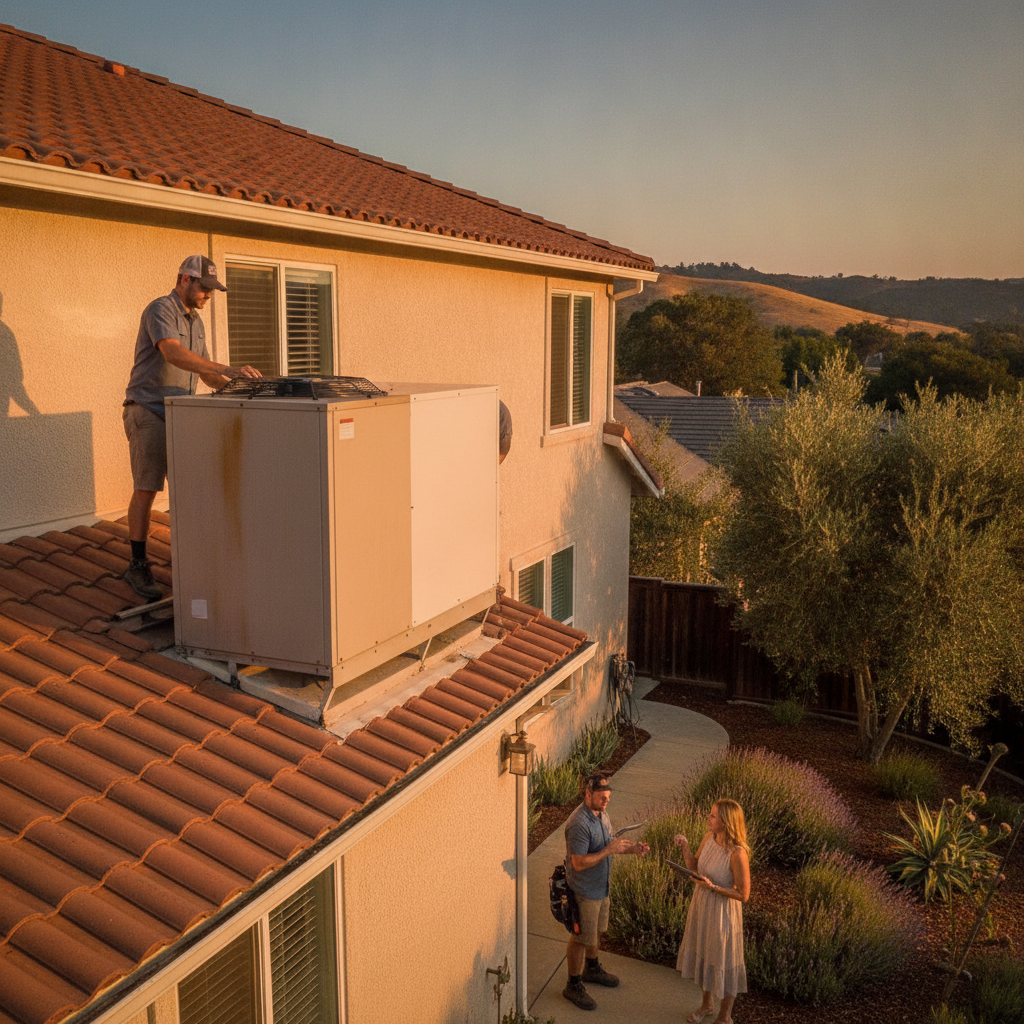
What Ukiah and North Bay Homeowners Should Know About Replacing an Old Swamp Cooler — and Whether It’s Time to Make the Switch
If you live in Ukiah or anywhere along the Highway 101 corridor north of Cloverdale, there’s a decent chance your home has an evaporative cooler — what most people call a swamp cooler. For decades, they were the practical, affordable answer to hot inland summers. They use a fraction of the electricity that traditional AC draws, they’re relatively simple to maintain, and in a genuinely dry climate, they can do a decent job of keeping a house livable. But if yours is aging out, making noise, or simply not cooling the way it used to — or if your summers have started feeling more oppressive than they did ten or fifteen years ago — you may be wondering what your real options are. The answer depends on your home, your budget, and what you actually want from a cooling system.
Why Swamp Coolers Work in Some Places and Struggle in Others
Evaporative coolers operate on a simple principle: they pull hot outside air through wet pads, which cools the air through evaporation, and push that cooled air into your home. The catch is that this process only works effectively when the outside air is dry. Once humidity climbs above roughly 50 to 60 percent, the air is already too saturated to absorb much additional moisture, and the cooling effect drops off sharply.
Ukiah sits inland in Mendocino County and historically runs hot and dry in summer — conditions where an evaporative cooler can perform reasonably well. But the last several summers have not been historically normal. Wildfire smoke events, shifting weather patterns, and occasional humid air masses have made summer cooling less predictable across the entire North Bay region. Homeowners who relied on a swamp cooler without issue for fifteen years are finding that it doesn’t hold up as consistently now.
Beyond climate shifts, there’s the equipment itself. A swamp cooler that’s ten or fifteen years old likely has a worn pump, degraded pads, a corroded pan, or a motor that’s running harder than it should. At some point, you’re spending money on repairs to maintain a system that’s already operating near the edge of what it can do.
Your Real Options When a Swamp Cooler Reaches End of Life
This is the section that most HVAC websites in the area skip over entirely — they’ll tell you to replace your old system with a new one, but they won’t walk you through the actual decision. Here’s what the choices really look like.
Option 1: Replace the Evaporative Cooler With a New One
If your climate is genuinely dry, your home already has the ducting or ceiling configurations suited to a swamp cooler, and your electricity costs are a serious concern, replacing like-for-like makes some sense. A new evaporative cooler is significantly cheaper upfront than central AC, and operating costs are lower. The trade-off is that you’re still locked into a system that underperforms on humid or smoke-heavy days, and you’re still left without any heating capability from the cooling system.
Option 2: Ductless Mini-Split Heat Pump
For many homes in Ukiah, Cloverdale, and northern Sonoma County, a ductless mini-split is the most practical upgrade path. These systems don’t require existing ductwork — they run a refrigerant line through a small penetration in the wall, connecting an outdoor compressor to one or more indoor air handlers. The result is precise, quiet, efficient cooling in the spaces where you actually spend time.
What makes mini-splits especially worth considering in this part of the state is that they’re heat pumps — meaning they provide both cooling in summer and heating in winter from a single system. If your home relies on electric baseboard heaters or an aging wall furnace, adding a mini-split can eliminate both problems at once. Modern mini-splits from brands like Mitsubishi Electric, Daikin, Fujitsu, and LG are engineered to run efficiently even when outdoor temperatures dip into the low 20s Fahrenheit, making them genuinely useful year-round in areas that see real winter cold.
You can learn more about how we approach these installations at our heat pump services page.
Option 3: Central Air Conditioning
If your home already has forced-air ducting from a gas furnace, adding central AC may be the most straightforward option. A central system conditions the entire house evenly, integrates with your existing thermostat and ductwork, and handles high-humidity days without any performance drop-off. The upfront cost is higher than a mini-split for a single zone, but for a three- or four-bedroom home where you want whole-house cooling, it can be the cleanest solution.
The important caveat here: if your existing ductwork is old, undersized, or poorly sealed, adding a central AC system without addressing that first means you’re cooling the attic and the crawlspace as much as your living space. Any reputable contractor should evaluate your ductwork before recommending a central system.
What the Competitor Sites in This Region Don’t Tell You
If you’ve searched around for guidance on swamp cooler replacement in the North Bay, you’ve probably found websites that give you a brief comparison chart and then push you toward whichever product they want to sell. What you won’t typically find is honest guidance about the transition costs and trade-offs specific to homes like yours.
A few things worth knowing that often get glossed over:
- Swamp cooler ducting doesn’t always transfer directly to central AC. Evaporative coolers often use larger, lower-velocity duct runs than forced-air AC systems need. You may need duct modifications that add to the project cost.
- Mini-splits are not always the cheapest option for whole-house coverage. They’re excellent for one, two, or three zones. But if you need to condition eight or ten rooms, a central system may actually cost less than a multi-zone mini-split setup.
- Wildfire smoke filtration is a separate consideration from cooling. Evaporative coolers pull outside air directly into your home — which means during a smoke event, they actively make indoor air quality worse. A sealed refrigerant-based system (mini-split or central AC) does not draw in outside air the same way, giving you much better options for adding filtration. If wildfire seasons have been affecting your home’s air quality, that alone is worth factoring into the decision.
Rebates and Incentives That Apply Right Now
Replacing an evaporative cooler with a heat pump system — whether a mini-split or a ducted heat pump — qualifies for both federal tax credits and, in some cases, PG&E rebates. The federal Inflation Reduction Act currently allows a 30% tax credit on qualifying heat pump installations, capped at $2,000 per year. PG&E’s rebate programs have changed frequently, so the best approach is to confirm current availability when you’re getting quotes. We’re familiar with what’s currently on the table and will walk you through it as part of any free estimate.
If financing is part of the conversation, we offer 0% financing options on qualifying installations — you can see current offers at our HVAC offers page.
Frequently Asked Questions
How do I know if my swamp cooler is worth repairing vs. replacing?
A general rule: if the repair cost is more than 50% of the cost of a new unit, it usually makes more sense to replace. But more importantly, factor in how well it’s actually been working. If it’s struggled through recent summers even when running, a repair just delays the same conversation.
Can I keep my swamp cooler and just add a mini-split for backup?
Yes, and some homeowners in drier inland areas choose exactly that approach. The mini-split handles the days when the swamp cooler can’t perform — humid days, smoke events, extreme heat — while the swamp cooler covers the more manageable summer days at lower operating cost. It’s not always the neatest solution, but it can make financial sense depending on your situation.
Do mini-splits work well enough for winter heating in Ukiah?
Yes. Ukiah winters can get cold, but modern cold-climate heat pumps are rated to operate efficiently down to around 5°F. For most North Bay winters, a quality mini-split handles the full heating load without issue. If you have an existing gas furnace as backup, a dual-fuel setup gives you additional peace of mind.
How long does a swamp cooler replacement or upgrade typically take?
A single-zone ductless mini-split installation is typically a one-day job. A full central AC installation in an existing home with ductwork generally takes one to two days. More complex multi-zone or new-ductwork projects take longer. We’ll give you a realistic timeline when we assess your home.
Do you service homes in Ukiah and Mendocino County?
We serve Ukiah and the surrounding area, in addition to our core service territory across Sonoma County — including Santa Rosa, Healdsburg, Cloverdale, and communities throughout the region. If you’re not sure whether we reach your address, just give us a call and we’ll confirm.
Ready to Talk Through Your Options?
We’ve been working on homes across the North Bay since 1992, and we’ve handled the full range of cooling transitions — from simple swamp cooler swaps to full heat pump installations in older homes that needed new electrical capacity and new line sets. We’re not going to push you toward the most expensive option. We’re going to look at your home, ask about your priorities, and give you an honest recommendation.
If your swamp cooler is on its last legs — or if you’re just ready to explore what modern cooling looks like for your home — request a free estimate and we’ll schedule a time to take a look. No pressure, no sales pitch. Just a straight answer from a local contractor who’s been doing this work in your backyard for over thirty years.