
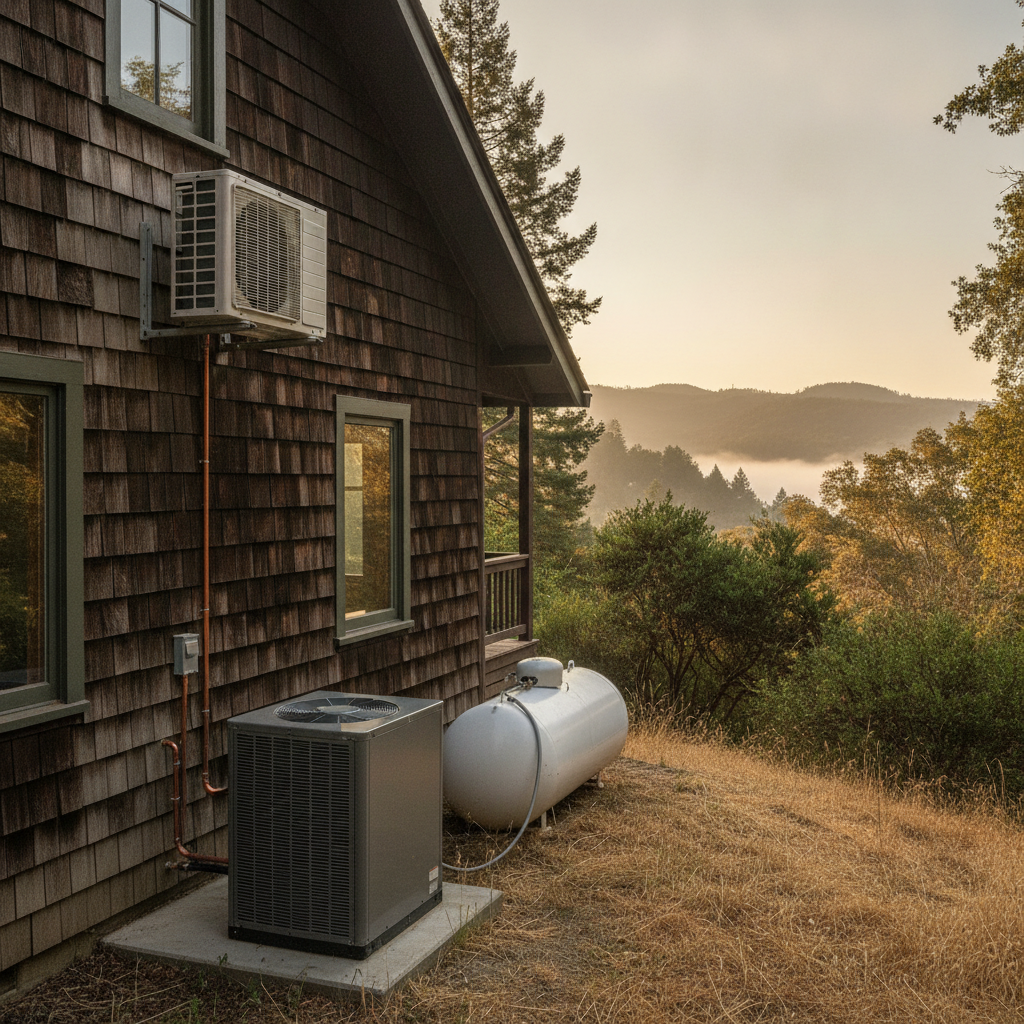
What Occidental and West Sonoma County Homeowners Should Know About Heating a Home With No Gas Line — Your Real Options Explained
If your home in Occidental, Forestville, or the rural hillsides west of Santa Rosa doesn’t have a natural gas connection, you’re not stuck with electric resistance heat and a sky-high PG&E bill. There are genuinely good heating solutions for off-grid and no-gas-line homes in West Sonoma County — and in some cases, they perform better than what your neighbors with gas lines are using. The key is understanding which option fits your home’s layout, your climate exposure, and your long-term energy goals.
Why This Is a Real Issue in West Sonoma County
The farther you get from the Highway 101 corridor, the less likely it is that your home sits on a natural gas main. In communities like Occidental, rural Sebastopol, and parts of Forestville and Guerneville, propane tanks and electric baseboard heat have been the default for decades. That’s partly geography — running gas lines through hilly terrain is expensive — and partly the age of many homes in the area, which were built long before modern utility infrastructure reached these corridors.
The problem is that older electric resistance systems (baseboard heaters, electric furnaces, wall heaters) are genuinely inefficient. They convert electricity to heat at roughly a 1:1 ratio, which gets expensive fast — especially with PG&E rates climbing every year. If that’s what’s currently heating your home, there’s a strong case for replacing it, not just patching it.
Option 1: A Heat Pump — The Right Fit for Most West Sonoma County Homes
A modern heat pump is almost always the first option we recommend for homes without natural gas. Here’s why it works particularly well in this region: heat pumps don’t generate heat — they move it. They extract warmth from outdoor air (even cool air) and transfer it inside. In a climate like West Sonoma County’s, where winters are cool and wet but rarely brutal, a heat pump operates at full efficiency for the vast majority of heating days in the year.
What that means practically is that a good heat pump can deliver two to three units of heat for every one unit of electricity it consumes — compared to the 1:1 ratio of your old baseboard heater. Your heating costs go down even though you’re still on electric service, and you get air conditioning in the summer as part of the same system.
Modern cold-climate heat pumps from brands like Mitsubishi Electric, Daikin, and Fujitsu perform reliably down into the mid-teens Fahrenheit — well below anything Occidental or Guerneville typically sees in winter. If you’ve been told heat pumps don’t work in cold weather, that was true of older equipment. It’s not true anymore.
If your home has existing ductwork, a ducted heat pump can slot into the same air handler and use the same vents. If it doesn’t — and many older rural homes in West Sonoma County were never ducted — a ductless mini-split heat pump is the cleanest solution. You get targeted room-by-room heating and cooling with no major construction, just line sets run through small wall penetrations.
Option 2: A Propane-Powered Dual Fuel System
If your home already has a propane tank — which is common throughout rural Sonoma County — a dual fuel or hybrid heat pump system gives you the best of both worlds. The system uses an electric heat pump as its primary heat source during mild weather, then automatically switches to a propane furnace when temperatures drop far enough that the heat pump loses efficiency. You get low operating costs most of the year, and reliable backup heat when you need it most.
This setup makes a lot of sense for homes in exposed locations — hilltop properties west of Sebastopol, ridgelines near Occidental — where winter nights can get genuinely cold and wind chill is a factor. It also reduces your dependence on propane deliveries, since the heat pump handles most of the load. You’re topping off the tank less often.
We’ve been installing and servicing dual fuel systems since the early days of this technology, and the setup has matured considerably. Modern systems manage the switchover automatically — you set the temperature, and the equipment figures out which fuel source is most efficient at any given moment.
What About All-Electric with a Backup Strip Heater?
Most heat pumps include an electric resistance backup strip built into the air handler. This kicks in automatically if temperatures drop faster than the heat pump can keep up, or if the heat pump is ever taken offline for service. It’s not meant to be your primary heat source — it’s an emergency fallback. For most homes in this part of Sonoma County, it’s adequate backup without needing a separate system.
If you’re concerned about power outages — which are a legitimate concern in rural West County, especially during wildfire-related Public Safety Power Shutoff events — a generator or battery backup system paired with a heat pump is worth considering as a package. That’s a conversation we can have when we’re sizing your system.
What About Solar?
If you have solar panels or are planning to install them, an all-electric heat pump becomes even more financially compelling. Running your heating and cooling on power you’re generating on-site changes the math significantly. If you haven’t coordinated your HVAC system sizing with your solar system’s output, it’s worth doing before you commit to either one — getting them matched up correctly affects both performance and the economics of the investment.
What Competitors Aren’t Telling You About Rural HVAC Options
Most HVAC content you’ll find online treats the absence of natural gas as a minor footnote — a brief mention that propane is an alternative, or a generic recommendation to call a technician. It rarely addresses the specific realities of rural West Sonoma County homes: older structures with single-zone heating, no existing ductwork, irregular floor plans, and the practical challenge of scheduling service in communities that are 30 to 45 minutes from the nearest major HVAC supplier.
We’ve been serving this area since 1992, and we understand the difference between a straightforward ducted replacement in a newer Sebastopol home and a more involved ductless installation in a 1960s hillside cabin outside Occidental. Those aren’t the same job, and they shouldn’t be priced or planned the same way. When we come out to assess your home, we look at your actual structure — insulation, ceiling height, room layout, existing infrastructure — before we recommend anything.
How to Think About Cost and Timeline
A single-zone ductless mini-split installation typically takes one day. A whole-home ducted heat pump replacement in a home with existing ductwork is usually a one-to-two-day job. A dual fuel system installation varies depending on whether the propane furnace is new or existing equipment we’re integrating with. We can give you a free estimate once we see the home — rough numbers over the phone aren’t useful when every rural West County property is different.
California and PG&E currently offer meaningful rebates for qualifying heat pump installations, and federal tax credits are available for high-efficiency systems under the Inflation Reduction Act. The combination can significantly offset your upfront cost. Check our current HVAC offers and financing page for what’s available right now — these programs change, and it’s worth confirming eligibility before you decide on a system.
Frequently Asked Questions
Can a heat pump work if I’m on a well and septic system with no utility gas?
Yes — heat pumps run on electricity, not gas. As long as you have electrical service to your home, a heat pump is an option. Many rural homes throughout West Sonoma County use them without any issues. Your electrical panel capacity is something we’ll check during the assessment, but in most cases it’s not a barrier.
I have propane now. Should I replace my furnace with a heat pump or keep the propane?
The most efficient answer is usually a dual fuel hybrid system — heat pump as the primary, propane furnace as the backup. If your existing propane furnace is reasonably new and in good condition, we may be able to integrate it with a new heat pump rather than replacing it entirely. If it’s older, replacing both at once often makes more financial sense.
Is ductless a good solution for a home that currently has baseboard heat?
It’s often the ideal solution. Ductless mini-splits are specifically designed for homes without existing duct systems, and they’re significantly more efficient than electric baseboard heat. You can heat and cool multiple zones from a single outdoor unit, and the installation is much less disruptive than adding ductwork would be.
What brands do you install in rural areas like Occidental and Forestville?
We work with Mitsubishi Electric, Daikin, Fujitsu, LG, Trane, Carrier, Amana, and others depending on what fits the application. For ductless systems in rural West County homes, Mitsubishi Electric and Daikin have particularly strong cold-climate performance records. We’ll recommend what makes sense for your specific situation, not just what’s cheapest to install.
Do you service homes outside Santa Rosa in West Sonoma County?
Yes — we serve the full West Sonoma County area including Occidental, Forestville, Sebastopol, and Guerneville. We’re based in Santa Rosa and have been working throughout the county since 1992. Distance from the city isn’t a reason we can’t help you.
Ready to Figure Out the Right Heating System for Your Home?
If you’re in Occidental, rural Sebastopol, Forestville, or anywhere else in West Sonoma County and you’re dealing with inadequate heating, a failing electric system, or just trying to understand what your options look like before winter arrives, we’re glad to come take a look. There’s no obligation — we’ll assess your home honestly and tell you what we actually recommend, not just what’s easiest to sell.
Request a free estimate here, or call us directly at (707) 527-1504. We’ve been doing this work in Sonoma County for more than 30 years, and we’re not going anywhere.