
What Kenwood and Sonoma Valley Homeowners Should Know About Replacing a Central AC System — Sizing, Timing, and Why Getting It Wrong Costs More Than the Unit
If you’re replacing a central AC system in Kenwood, Glen Ellen, or anywhere along the Sonoma Valley corridor, the most important decision you’ll make isn’t the brand you choose — it’s whether the system gets sized correctly for your specific home. An oversized or undersized unit will underperform regardless of how much you spend on it, and that mistake gets baked in the moment it’s installed. Getting it right upfront is something Stout’s Heating & AC, Inc has been helping Sonoma County homeowners do since 1992, and it’s where a lot of well-meaning but rushed installations go sideways.
Why Central AC Replacement in the Sonoma Valley Is Different Than Elsewhere
The Sonoma Valley has a climate that doesn’t fit neatly into a single category. Kenwood and Glen Ellen sit in a narrow inland valley that gets significantly hotter in summer than coastal Sonoma County, but also experiences cool nights and mild shoulder seasons that coastal areas don’t. Temperatures in the valley can spike hard during late-summer heat events — sometimes 10 to 15 degrees hotter than Santa Rosa just a few miles north — and then drop sharply after sunset.
This creates a specific challenge when sizing an AC system: a unit sized for your worst-day heat load may be dramatically oversized for the 90% of summer days that aren’t extreme. An oversized system will cool the air quickly but won’t run long enough to pull humidity out, which leaves rooms feeling clammy and uncomfortable even when the thermostat reads correctly. It also short-cycles, which wears out the compressor faster and drives up your energy costs with PG&E rates the way they are.
On the other end, a system that’s too small will run constantly during heat waves and still fail to keep up — exactly the kind of failure that triggers emergency service calls in July and August.
The One Thing Most Contractors Skip (And Why It Matters)
Proper AC sizing requires something called a Manual J load calculation — a detailed analysis of your home’s square footage, ceiling height, insulation levels, window area and orientation, local climate data, and more. It takes time to do correctly, and not every contractor bothers with it. Some will look at your old system’s tonnage and quote you the same size, or use a quick square-footage rule of thumb that ignores everything else about your home.
In Sonoma Valley homes — many of which are older ranch-style or craftsman properties with varying insulation quality, large west-facing windows, and mature tree coverage — rule-of-thumb sizing is especially unreliable. A home in Kenwood with a vine-covered pergola shading the west side may need a meaningfully different system than an identically sized house two streets over with full afternoon sun exposure.
Before you agree to any AC replacement, ask the contractor directly: Are you performing a Manual J load calculation for my home? If the answer is vague or they pivot to discussing brands and financing, that’s worth noting.
When to Replace vs. When to Repair — The Honest Version
Not every struggling AC system needs to be replaced. If your system is under 10 years old, has been maintained reasonably well, and the issue is a failed capacitor, a refrigerant leak that’s been caught early, or a dirty evaporator coil, repair often makes more sense than replacement. A good HVAC contractor will tell you that plainly rather than steering you toward a new unit you don’t need.
That said, there are situations where replacement is clearly the right call:
- The system is 15 or more years old and facing a major component failure like a compressor
- R-22 refrigerant systems that can no longer be economically serviced (R-22 has been phased out and is expensive when available)
- Repeated repairs over two to three seasons that are adding up in cost
- Systems with SEER ratings well below current efficiency standards, especially with PG&E rates continuing to climb
- A system that was improperly sized from the start and has never performed well
A rough way to think about it: if a repair costs more than half the value of a new system and the unit is already past its mid-life point, replacement usually pencils out better long-term. But that’s a conversation worth having with someone who’s actually looked at your equipment — not a number pulled from a website.
SEER Ratings, Efficiency, and What’s Actually Worth Paying For
California has minimum efficiency requirements for new AC installations, and current federal standards have raised the floor on SEER ratings across the board. But there’s a wide range between minimum-compliant and high-efficiency, and the right choice depends on how much you use your system and how long you plan to stay in the home.
For Sonoma Valley homeowners who rely heavily on AC during summer heat events, a higher-SEER unit often pays back the premium over five to eight years through lower PG&E bills. For a vacation property or a home that only runs AC a few weeks a year, the math is different. This is worth talking through with your contractor before deciding on a unit — not assuming that the most expensive option is always the smartest one.
It’s also worth knowing that California and PG&E both offer rebates on qualifying high-efficiency HVAC equipment, and federal tax credits are available for certain systems. Current offers and financing options can reduce upfront costs significantly on the right system.
What the Replacement Process Should Actually Look Like
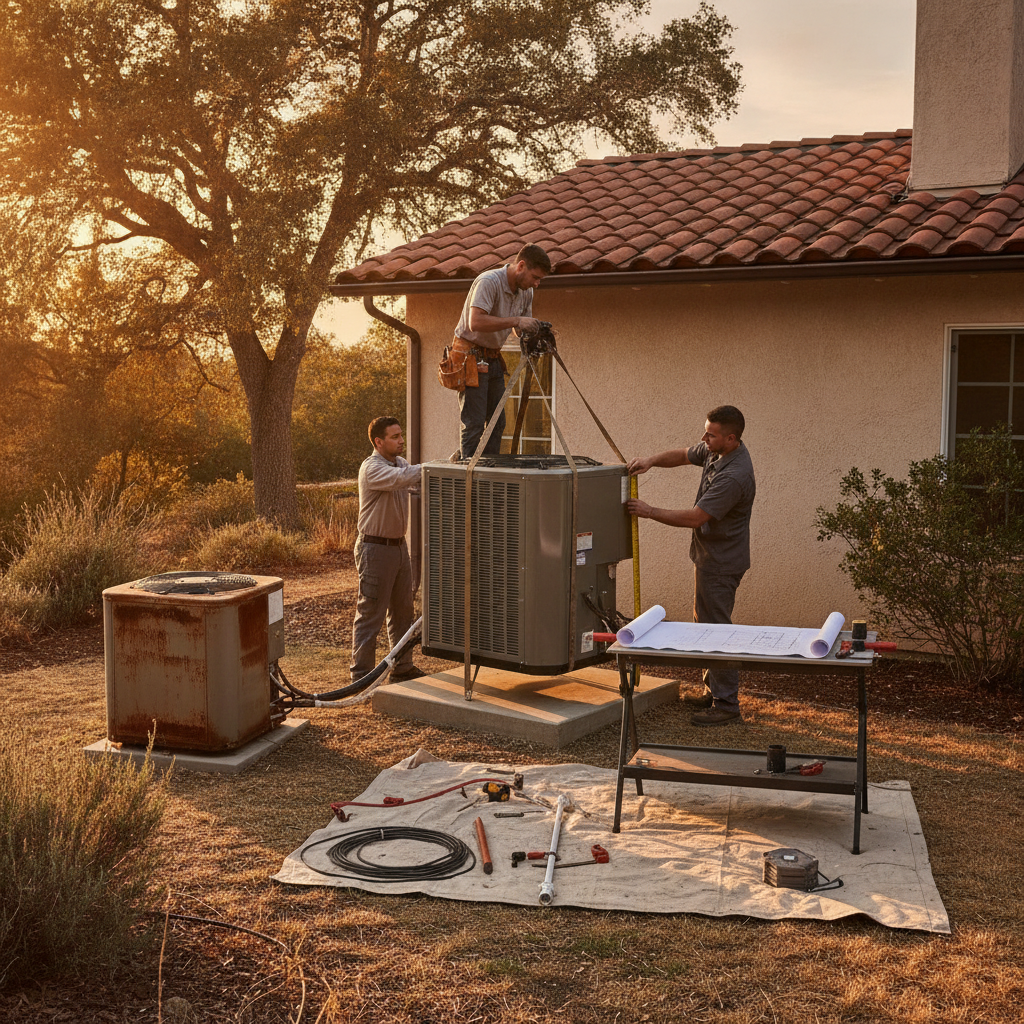
A central AC replacement in Kenwood or Glen Ellen isn’t a same-day turnaround in most cases, though the timeline is usually manageable. Here’s a realistic picture of what to expect from a reputable local contractor:
- Assessment and load calculation: A contractor visits your home, evaluates the existing system, measures the space, checks ductwork condition, and performs or schedules a load calculation. This should not be skipped.
- Equipment recommendation and proposal: You receive a written proposal with the recommended system, sizing rationale, SEER rating, and total cost including labor and any permit fees.
- Permit and scheduling: Most AC replacements in Sonoma County require a permit. A legitimate contractor pulls it — not you, and not a verbal workaround.
- Installation day: For a straightforward replacement on an existing system with intact ductwork, installation typically takes one day. If ductwork needs modification or replacement, it may run longer.
- Inspection and commissioning: The system should be tested, refrigerant levels verified, and airflow balanced before the job is called complete.
If a contractor is pressuring you to commit before doing a site visit, or quoting you over the phone based on square footage alone, slow down. That’s a pattern worth recognizing before you’re locked into anything.
For homeowners in Santa Rosa and the surrounding Sonoma Valley area, residential AC services from Stout’s include honest assessments of whether repair or replacement is the right path — without a sales agenda attached to the answer.
Frequently Asked Questions
How long does a central AC system typically last in Kenwood or Glen Ellen?
Most central AC systems last 15 to 20 years with regular maintenance. In the Sonoma Valley’s hot inland summers, systems that run hard without annual tune-ups often hit the lower end of that range. Staying current on maintenance is the single best thing you can do to extend system life.
Do I need to replace my ductwork when I replace the AC unit?
Not always, but ductwork condition matters more than most homeowners realize. Leaky or undersized ducts can reduce the efficiency of even a brand-new system by 20 to 30 percent. A good contractor will inspect your ducts during the assessment and tell you honestly whether they need attention — not just replace the equipment and leave the underlying problem in place.
Is a heat pump a better choice than a central AC replacement for Sonoma Valley homes?
It depends on how you heat and what your current setup is. Heat pumps provide both heating and cooling from a single system and are well-suited to Sonoma Valley’s moderate climate. If your heating system is also aging, replacing both with a heat pump can be more cost-effective than replacing them separately. Heat pump options are worth exploring if you’re already facing a major equipment decision.
What brands do you install and service in Kenwood and the Sonoma Valley?
We’re brand-agnostic for repairs — we work on Trane, Carrier, Lennox, Amana, American Standard, York, Daikin, and others. For new installations, we’ll recommend equipment based on your home’s specific needs and your budget, not based on what we happen to have on the truck.
How much does a central AC replacement typically cost in Sonoma County?
Costs vary based on system size, efficiency rating, ductwork condition, and access challenges specific to your property. We don’t quote numbers without seeing the home — anyone who does is guessing. We offer free estimates so you know exactly what you’re looking at before committing to anything.
Ready to Talk Through Your Options?
If your central AC system in Kenwood, Glen Ellen, or anywhere in the Sonoma Valley is getting close to the end of its life — or if it’s already struggling and you’re not sure whether repair or replacement makes more sense — we’re happy to give you a straight answer. Stout’s Heating & AC, Inc has been serving Sonoma County homeowners since 1992, and we’ve seen enough rushed or improperly sized installations to know what the right process looks like.
There’s no pressure, no upsell agenda, and no charge for the estimate. Request a free estimate or call us at (707) 527-1504 to schedule a visit at your convenience.