
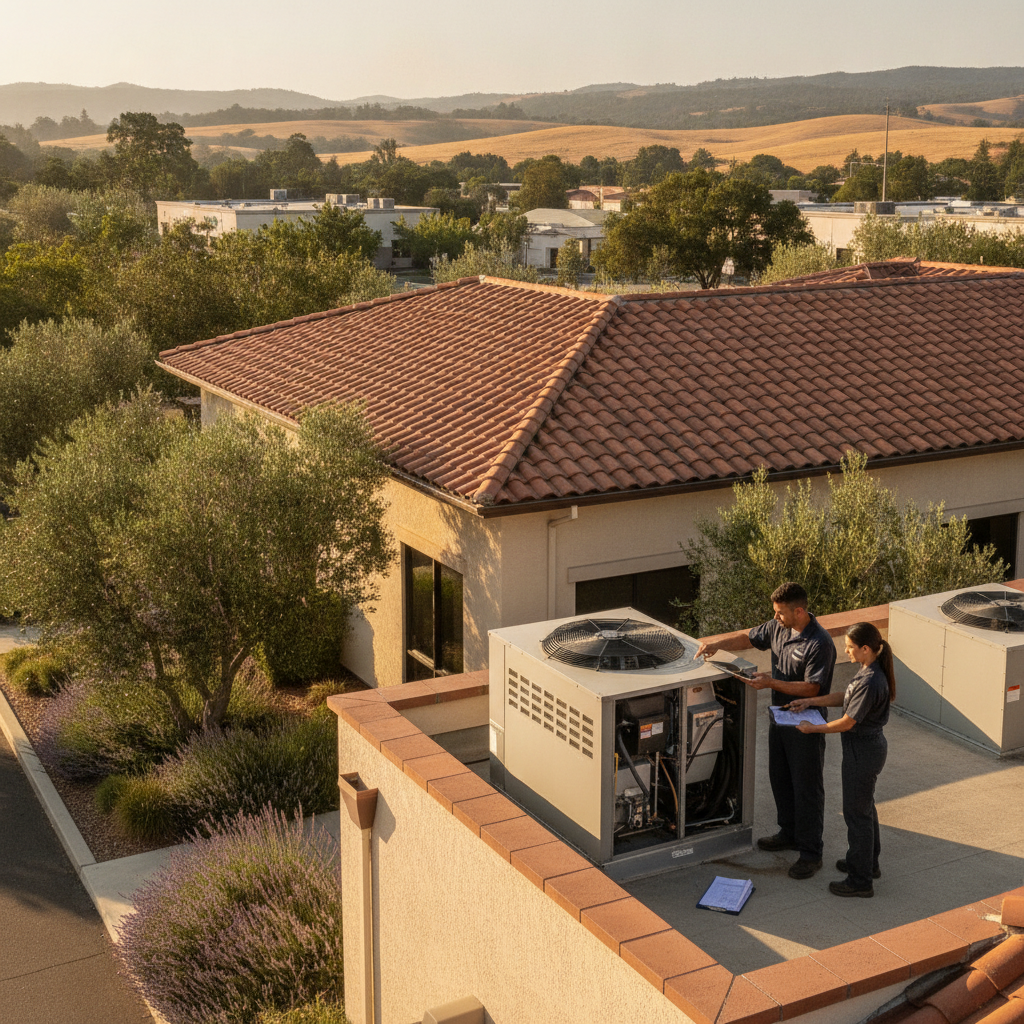
What Santa Rosa Commercial Property Managers Should Know About HVAC Maintenance Contracts — Before the Summer Rush
If you manage a commercial building in Santa Rosa — whether it’s a multi-tenant retail strip along the Highway 101 corridor, an office complex in Rohnert Park, or a restaurant space in Healdsburg — your HVAC system is one of your highest-liability assets. When it fails on a 103-degree July afternoon, your tenants aren’t just uncomfortable. They’re sending angry emails, losing customers, and sometimes invoking lease language. A commercial HVAC maintenance contract is supposed to prevent exactly that situation. But not all contracts are built the same, and many property managers in Sonoma County are signing agreements that leave major gaps — gaps that only show up when something actually goes wrong.
Here’s what you actually need to know before you sign anything.
What a Commercial HVAC Maintenance Contract Should Actually Cover
The most basic maintenance contracts look thorough on paper but deliver very little in practice. You’ll see language about “visual inspections” and “filter checks” — but a visual inspection of a rooftop package unit isn’t the same as a real diagnostic. A properly scoped commercial maintenance agreement should include, at minimum:
- Coil cleaning — both evaporator and condenser — at least once per year, and twice if your building is near a high-traffic road or has heavy kitchen exhaust nearby
- Refrigerant level verification, not just a visual check of the refrigerant lines
- Electrical connection tightening and capacitor testing — two of the most common causes of compressor failure in commercial rooftop units
- Drain pan and drain line clearing — especially important in Santa Rosa’s climate, where the transition from dry summers to wet winters can cause sudden drain blockages
- Thermostat calibration and control system testing, particularly for buildings with programmable or networked controls
- Belt and bearing inspection on older air handling units
- Documentation — you should receive a written report after every service visit, not just a signature on a clipboard
If the contractor can’t tell you exactly what’s done at each visit, that’s a red flag. Vague contracts protect the contractor, not your property.
The Difference Between Preventive Maintenance and a Response Contract
One of the most common points of confusion for property managers — and one that almost none of the local HVAC contractor websites address clearly — is the distinction between a preventive maintenance agreement and a priority response contract. These are often bundled together and sold as a single “maintenance plan,” but they’re actually two different things.
A preventive maintenance agreement covers scheduled tune-up visits — typically twice a year, before cooling season and before heating season. A response contract gives you prioritized scheduling and potentially discounted rates when something breaks between those visits. Some contracts include parts and labor for covered repairs; others only cover the diagnostic visit and bill everything else at full price.
Before you sign, ask these questions directly:
- If a unit fails mid-summer, what is the guaranteed response time?
- Are repair labor and parts included, or is this inspection-only coverage?
- Does this contract cover all units on the property, or only specific ones?
- What happens if a covered unit needs replacement — is there a replacement credit or discount?
For commercial property managers in Windsor, Petaluma, or anywhere else in Sonoma County managing multiple tenants, knowing the answer to each of those questions before a crisis happens is worth far more than whatever you’re saving on a bare-bones agreement.
Rooftop Units, Multi-Zone Systems, and Why One-Size Contracts Don’t Work
Most commercial buildings along the 101 corridor use rooftop packaged units — RTUs — and they have specific maintenance needs that differ significantly from the split systems found in most residential properties. Larger buildings with multiple tenants may have separate RTUs for each suite, or a VRF (variable refrigerant flow) system that handles multiple zones from a single outdoor unit. Some older buildings in downtown Santa Rosa still have aging equipment that predates modern refrigerants and digital controls entirely.
A maintenance contract written for a simple single-zone office won’t adequately cover a multi-unit retail center. Make sure the contractor has actually walked the property, identified every piece of equipment, and priced the contract based on what’s actually installed — not a generic per-square-foot formula.
At Stout’s Heating & AC, Inc., we’ve been doing commercial work in Santa Rosa and across Sonoma County since 1992. We know the difference between a Trane RTU from the late 1990s and a modern Daikin VRF installation, and we write maintenance agreements that reflect the actual equipment on your roof, not a template pulled from a national franchise playbook. You can see more about what we cover on our commercial AC repair page.
Wildfire Season and Air Quality — What Most Contracts Miss Entirely
Here’s a gap that none of the standard commercial maintenance contracts in this area address, and it’s genuinely important for Sonoma County property managers: wildfire smoke and seasonal air quality events put extraordinary stress on commercial HVAC systems.
During a smoke event, outdoor air intake filters load up with particulates far faster than normal. If your building uses economizer controls — which bring in outside air when temperatures allow — those systems can pull heavily contaminated air into occupied spaces if they’re not properly configured or if filters aren’t checked. For tenants in medical, food service, or childcare environments, this isn’t just a comfort issue.
A well-structured maintenance agreement for Sonoma County commercial buildings should include a provision for filter inspection and replacement following any declared air quality emergency, and it should address economizer lockout settings so your system isn’t ventilating with outdoor air during AQI spikes. Most template contracts don’t mention this at all. Ask your contractor specifically how they handle this.
How to Evaluate Cost vs. Value in a Commercial HVAC Contract
Commercial HVAC maintenance contracts vary widely in price depending on equipment count, system complexity, and what’s included. A simple single-zone contract for a small office might run a few hundred dollars a year. A multi-unit property with six or eight rooftop units, proper documentation, and a response SLA will cost more — and should.
The real math isn’t the contract cost versus zero. It’s the contract cost versus the cost of an emergency commercial compressor replacement, a failed inspection from a tenant’s health department, or losing a lease renewal because a tenant’s space was unbearable through August. Emergency commercial HVAC repairs in peak season often run $2,000 to $8,000 or more depending on the equipment — and availability of parts or technicians is never guaranteed when every contractor in Sonoma County is slammed.
Preventive service also extends equipment life significantly. A rooftop unit that gets proper annual maintenance will routinely outlast a neglected one by five years or more. At PG&E energy rates, a well-maintained unit also runs more efficiently — that matters when you’re paying utilities on common areas or triple-net tenants are watching their bills. You can explore current financing and service offers on our HVAC offers page.
Frequently Asked Questions
How many service visits per year does a commercial HVAC maintenance contract typically include?
Most standard contracts include two visits — one in spring before cooling season and one in fall before heating season. Higher-tier contracts may include quarterly visits, which is worth considering for buildings with heavy commercial kitchen use or high occupancy.
Does a maintenance contract affect my equipment warranty?
Yes, and in a positive way. Most manufacturers — including Trane, Carrier, and Daikin — require documented annual maintenance to keep equipment warranties valid. If a unit fails and you can’t show a maintenance record, the warranty claim may be denied. A reputable contractor will provide written service records after every visit.
Should I use the same contractor for maintenance and repairs?
In most cases, yes. A contractor who is familiar with your equipment, its history, and your building layout can respond faster and more accurately when something goes wrong. That relationship also means they’ll flag developing problems before they become failures — which is the entire point of preventive maintenance.
Are commercial HVAC maintenance contracts tax-deductible for property owners?
Generally yes — routine maintenance is typically deductible as a business operating expense. Consult your accountant for specifics, but this is one reason many commercial property owners prefer service agreements over pay-as-you-go repairs.
What’s the right time of year to start a commercial maintenance contract in Sonoma County?
The best time is before peak demand hits — meaning late winter or early spring. By the time summer heat arrives in Santa Rosa and the surrounding area, qualified technicians are already fully booked with emergency calls. Getting on a maintenance schedule in February or March ensures your units are serviced and ready before the rush.
Talk to a Local Commercial HVAC Contractor Who Knows Your Market
Stout’s Heating & AC, Inc. has been working with commercial property owners and managers across Santa Rosa and Sonoma County since 1992. We’re not a franchise. We know Sonoma County’s climate, its older commercial building stock, and what it actually takes to keep a multi-tenant property running reliably through a Wine Country summer.
If you’re currently without a maintenance agreement, managing an aging rooftop system, or just not sure whether your current contract is actually protecting you, we’re happy to take a look. Contact us to schedule a walkthrough or request a free commercial HVAC assessment — no pressure, just honest information from a contractor who’s been doing this work here for over 30 years.