
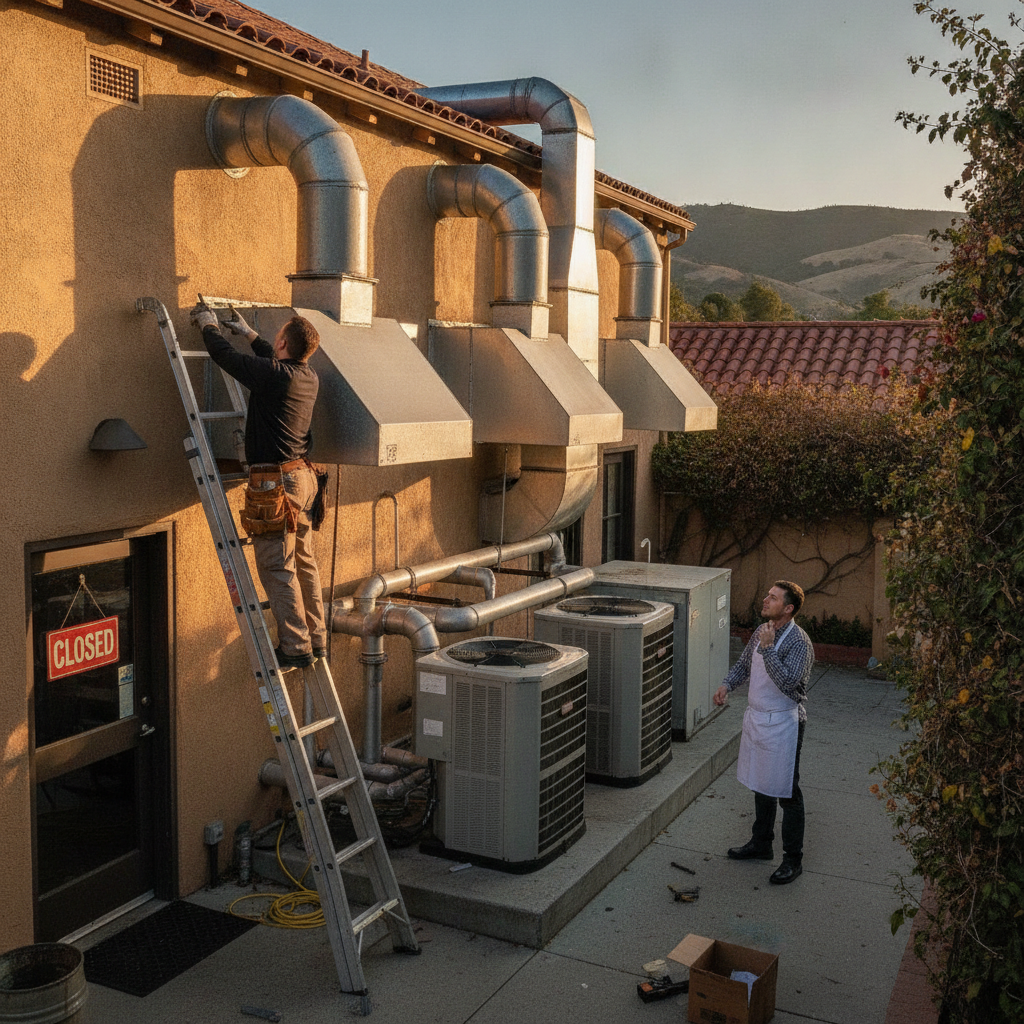
What Santa Rosa Restaurant and Hospitality Owners Should Know About Kitchen Exhaust and HVAC Code Compliance
If you own or manage a restaurant, café, tasting room, or any food-service property in Santa Rosa, kitchen exhaust and HVAC code compliance is one of those things that tends to bite you when you least expect it — usually right before an inspection, a build-out, or when you’re trying to transfer a lease. The short answer is that California has strict requirements around commercial kitchen ventilation, and what you don’t know really can cost you. Here’s a straightforward look at what’s actually involved, what questions to ask, and why getting the right local contractor matters more than most business owners realize.
Why Kitchen Exhaust Is More Than Just a Hood Over the Stove
A lot of restaurant owners think of the kitchen exhaust hood as a standalone piece of equipment — you turn it on, it sucks up smoke and grease, done. In reality, it’s one piece of a system that has to work in balance with your entire building’s ventilation and HVAC setup. The California Mechanical Code, California Fire Code, and NFPA 96 (the national standard for commercial cooking operations) all set requirements for how that system has to be designed, installed, and maintained.
The part that surprises most business owners: for every cubic foot of air your exhaust hood pulls out of your kitchen, roughly the same volume of air has to come back in. That replacement air — called makeup air — has to be conditioned, meaning heated or cooled depending on the season. If your makeup air system is undersized, missing, or improperly balanced, your kitchen staff is uncomfortable, your energy costs go through the roof, and you’re likely failing code whether you know it or not.
What Sonoma County Health and Fire Inspectors Actually Look For
When a Sonoma County Environmental Health inspector or a fire marshal walks through your kitchen, they’re not just eyeballing the hood. They’re checking whether your exhaust system has been installed to match the type of cooking equipment underneath it — different appliances require different exhaust rates — and whether your makeup air supply is adequate. They’ll also want to see that grease filters are properly rated and positioned, that ductwork is grease-tight and accessible for cleaning, and that the system was installed by a licensed contractor pulling the right permits.
For restaurants that have been in the same space for years, one of the most common problems we see in Santa Rosa is that the cooking equipment changed over time — maybe a new fryer was added, or a wok range replaced a standard burner — but nobody updated the exhaust system to match. That’s an easy way to end up with a code violation that requires real work to fix, not just paperwork.
The Makeup Air Problem That Most HVAC Contractors Skip Over
This is the content gap that surprisingly few local resources actually address in plain language: makeup air units are their own category of commercial HVAC equipment, and they’re often handled poorly or ignored entirely during kitchen buildouts. A makeup air unit (sometimes called a MAU) is essentially a dedicated air handler that draws outside air in, conditions it, and delivers it to the kitchen in a way that doesn’t fight your exhaust hood’s airflow.
Without a properly designed makeup air system, you end up with negative pressure in the kitchen. That means your exhaust hood may actually pull air backwards through your dining room, dragging cooking odors out toward your guests. In Santa Rosa’s warm, dry summers, an unbalanced kitchen also overheats rapidly, making it harder on staff and pushing your rooftop HVAC units to work overtime. During wildfire season — which affects the entire Highway 101 corridor from Petaluma up through Healdsburg — an improperly balanced ventilation system can also pull smoke-laden outdoor air directly into your kitchen if the makeup air intake isn’t properly filtered and controlled.
Getting this right requires a contractor who understands both the exhaust side and the HVAC side of the equation. That’s not always the same person, and it’s worth asking specifically about makeup air design before any kitchen ventilation work begins.
What to Expect From the Process — and What It Costs
Commercial kitchen exhaust and makeup air projects vary significantly in scope depending on whether you’re doing a new build, retrofitting an existing space, or simply bringing an older system into compliance. Generally speaking, the process involves:
- Site assessment: A contractor needs to look at your existing equipment list, hood dimensions, ductwork routing, and any existing makeup air equipment before estimating anything.
- Load calculations: Exhaust CFM (cubic feet per minute) requirements are calculated based on your specific cooking equipment and hood type, not guessed at.
- Permit and plan check: In Santa Rosa, commercial kitchen ventilation work requires permits and plan review. Budget time for this — it’s rarely instant, and skipping permits creates liability that follows the building, not just the current owner.
- Installation and inspection: Once work is done, it needs to pass inspection before you’re in the clear. A contractor who has done this locally understands what inspectors in Sonoma County are looking for.
We don’t publish flat prices here because the range is genuinely wide — a simple makeup air retrofit in a small café is a very different job from a full exhaust system replacement in a high-volume restaurant kitchen. What we will say is that getting a proper assessment upfront saves money compared to fixing problems after an inspection failure. If you want a free estimate, you can request one here and we’ll come out and take a look at what you’re actually working with.
Wine Country and Hospitality Properties Have Unique Demands
Santa Rosa and the broader Sonoma Valley have a hospitality economy that runs year-round but peaks during wine country tourism season — spring through fall. That seasonal load matters because tasting room kitchens, event venue catering spaces, and hotel restaurants often don’t operate at full capacity all the time. Systems designed for peak load need to handle partial-load conditions efficiently, or energy costs spiral.
In Sonoma and Healdsburg especially, we’ve worked with tasting rooms that added commercial kitchen permits to expand food service offerings, only to find that the existing ventilation setup wasn’t sized for a real cooking operation. What works for a wine bar warming appetizers is not the same as what’s needed when you add a wood-fired oven or a full prep kitchen. If you’re expanding your food service scope, talk to a commercial HVAC contractor before you talk to a kitchen equipment supplier — the sequence matters.
Why a Local Contractor Matters for This Type of Work
National HVAC franchise chains have started appearing more frequently in Sonoma County, and while they can handle residential work fine, commercial kitchen ventilation in a historic downtown building or a converted Wine Country property is genuinely specialized. Local permit relationships, familiarity with Sonoma County inspection timelines, and hands-on experience with the specific building types in this region make a real difference.
Stout’s Heating & AC has been doing commercial ventilation work in Santa Rosa and the surrounding area since 1992. We’re not a franchise — we’re a local shop that knows these buildings, these inspectors, and these timelines. You can see what our customers say about that experience on our reviews page.
For a full overview of what we offer on the commercial ventilation side, visit our commercial ventilation services page.
Frequently Asked Questions
Does a commercial kitchen exhaust hood in Santa Rosa require a permit?
Yes. Any new installation or significant modification of a commercial kitchen exhaust system requires a mechanical permit through the City of Santa Rosa Building Division. Work done without permits can create complications when you sell the property or renew your health permit, and it puts you in violation of the California Mechanical Code.
What’s the difference between a Type I and Type II hood?
A Type I hood is designed for cooking equipment that produces grease-laden vapors — fryers, griddles, charbroilers, woks. It includes grease filters and fire suppression. A Type II hood handles heat and moisture but not grease — think dishwashers or ovens that don’t produce significant grease. Using the wrong type for your equipment is a common compliance failure.
My dining room always smells like the kitchen. Is that an exhaust problem?
Usually, yes. Cooking odors migrating into the dining room typically indicate that your kitchen is under negative pressure — air is flowing from the dining room toward the kitchen rather than being exhausted properly. This almost always points to an undersized or malfunctioning makeup air system.
Can my existing HVAC system serve as makeup air for my kitchen?
In most commercial kitchen applications, no. Standard HVAC systems are not designed to handle the volume of air replacement required by commercial kitchen exhaust, and using them that way throws the whole building’s pressure balance off. Dedicated makeup air units are almost always required for commercial cooking operations.
How often does a commercial kitchen exhaust system need to be serviced?
Grease filters should be cleaned regularly — weekly or monthly depending on cooking volume. Full hood and duct cleaning frequency is set by NFPA 96 based on cooking type: high-volume operations like charbroiling may require quarterly cleaning, while lower-volume kitchens may qualify for annual cleaning. Your HVAC contractor and hood cleaning company should coordinate on this, and documentation is important for fire inspection purposes.
Ready to Get Your Kitchen Ventilation Right?
Whether you’re opening a new restaurant in downtown Santa Rosa, expanding a tasting room kitchen in Rohnert Park, or dealing with a compliance issue flagged during inspection, Stout’s Heating & AC can help you understand what you’re dealing with and what it takes to fix it — without the runaround. We’ve been doing this work locally since 1992, and we’ll give you a straight answer about what you actually need. Get in touch with us today to schedule an assessment.