
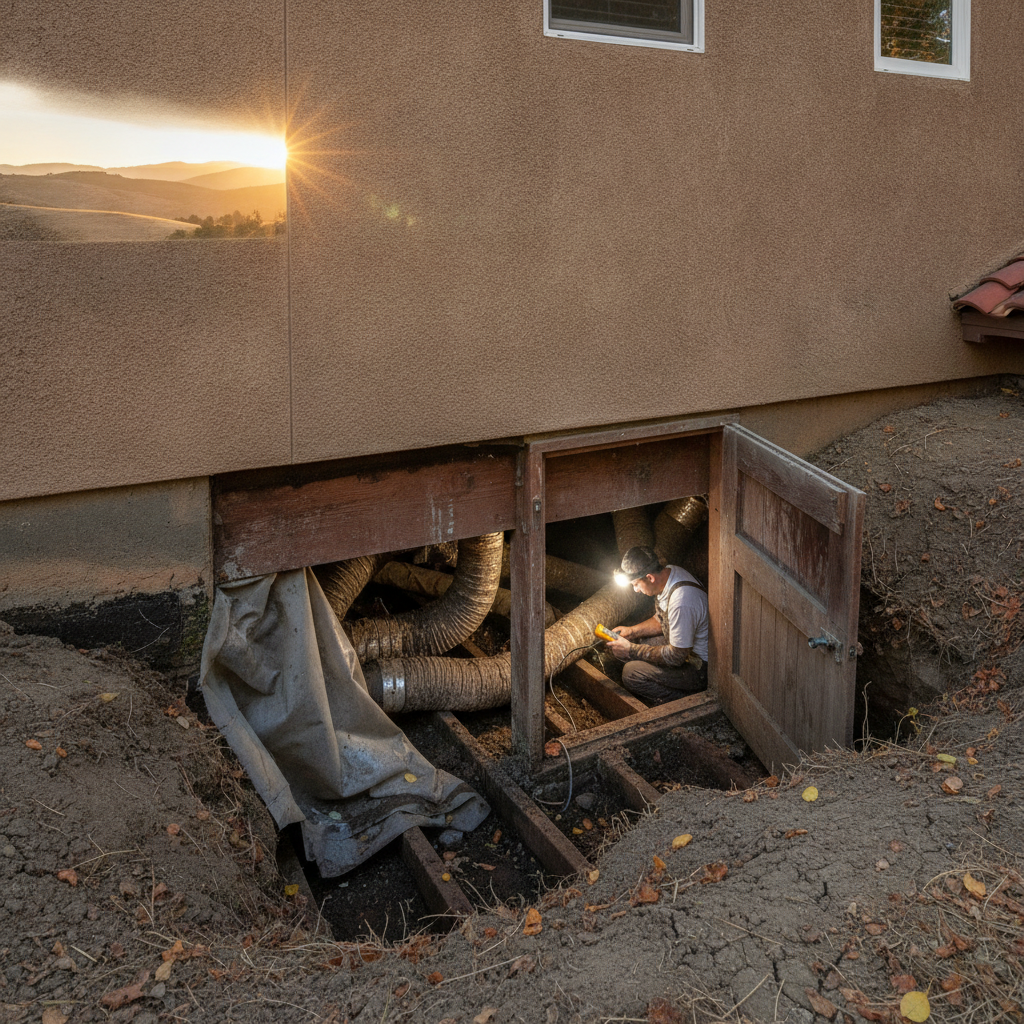
What Sonoma County Homeowners Should Know About HVAC and Crawl Space Moisture — and Why It Matters More Than You Think
If your Santa Rosa home sits on a crawl space, there’s a good chance your HVAC system is dealing with a problem you can’t see and probably haven’t thought much about — moisture. Crawl spaces in Sonoma County are uniquely prone to humidity buildup, especially during our wet winters and the temperature swings that come with a Mediterranean climate. And when that moisture gets into your ductwork or your air handler, it doesn’t stay in the crawl space. It works its way into your living space, your indoor air quality, and eventually your utility bills. We’ve been servicing homes across Santa Rosa since 1992, and this is one of those issues that quietly causes a lot of damage before homeowners realize anything is wrong.
Why Crawl Spaces and HVAC Systems Are More Connected Than You Might Expect
Most people think of their HVAC system as the equipment in the utility closet, the unit outside, and the vents in the ceiling. But in a large number of older Santa Rosa homes — particularly in neighborhoods like Bennett Valley, Rincon Valley, and South Park — the ductwork runs directly through the crawl space. That’s where the real trouble starts.
Crawl spaces naturally accumulate ground moisture. In a climate like ours, where heavy winter rains follow long dry summers, the soil beneath your home goes through dramatic moisture cycles. When that moisture evaporates, it has nowhere to go except up — into the air, onto your duct insulation, and in some cases, directly into your ductwork if there are any gaps or loose connections. Over time, this creates a few serious problems:
- Duct sweating and condensation: When warm air in your ducts meets a cold, moist crawl space environment, the outside of the duct gets cold enough to collect condensation. That moisture soaks into duct insulation and can eventually degrade the duct itself.
- Mold and mildew growth: Damp duct insulation is an ideal environment for mold. Once mold establishes itself in or around your ductwork, your HVAC system can distribute spores throughout your home every time it runs.
- Reduced system efficiency: Moist, degraded duct insulation doesn’t hold temperature well. Your system works harder to deliver conditioned air to your living space, and you end up paying more on your PG&E bill for less comfort.
- Premature equipment wear: If moisture reaches your air handler or furnace — which sometimes sits in the crawl space itself — it accelerates corrosion and can shorten the life of the equipment significantly.
The Sonoma County Climate Factor Nobody Talks About
This is an area where most local HVAC content falls flat. There’s plenty written about choosing between heat pumps and gas furnaces, or how to handle a summer heat wave. But very little addresses the specific conditions that make crawl space moisture a persistent problem in this part of California.
Sonoma County doesn’t get the kind of sustained cold that freezes pipes in Minnesota, but our winters are genuinely wet. Santa Rosa averages around 30 inches of rainfall per year, and much of it comes in heavy bursts between November and March. Homes in lower-lying neighborhoods, or those built before modern vapor barriers were standard practice, are especially vulnerable. The crawl space soil gets saturated, and without adequate ventilation or a proper vapor barrier, that moisture has a long time to do its work before things dry out in spring.
Homes in Sebastopol and western Sonoma County face this even more acutely because of the higher ambient humidity that comes with proximity to the coast. If you’re in Rohnert Park or Windsor and your home was built in the 1960s or 70s, there’s a reasonable chance your crawl space hasn’t been evaluated in years — and your ductwork is in that same crawl space, quietly suffering the consequences.
Signs Your HVAC System May Be Affected by Crawl Space Moisture
You don’t need to go poking around under your house to get an early warning. Here’s what to watch for from inside your home:
- A musty or earthy smell when the heater or AC kicks on
- Rooms that never quite reach the temperature on the thermostat, even after the system has been running for a while
- Unexplained increases in heating or cooling costs without a change in usage habits
- Allergy symptoms or respiratory irritation that seem to get worse when the HVAC system is running
- Visible rust or corrosion on any accessible ductwork, registers, or equipment
- Uneven temperatures between rooms — one room comfortable, another consistently warm or cold
None of these symptoms automatically mean crawl space moisture is the culprit, but they’re all worth taking seriously. A qualified HVAC technician can inspect your accessible ductwork and identify whether moisture damage is contributing to what you’re experiencing. Proper residential ventilation plays a major role in keeping this problem from getting worse once it’s identified.
What the Fix Actually Looks Like — and What It Costs
There’s no single answer here because the right approach depends on what you find under the house. But here’s a realistic breakdown of what homeowners typically deal with:
Vapor barrier installation or replacement: A ground-level vapor barrier in the crawl space is the first line of defense. Many older homes either don’t have one or have one that’s damaged or incomplete. This is often handled in coordination with a general contractor, but your HVAC technician should be part of the conversation because it directly affects ductwork conditions.
Crawl space ventilation: Building codes have evolved significantly on this. Older homes were built with passive crawl space vents along the foundation, but there’s ongoing debate about whether vented or sealed crawl spaces are better in California’s climate. A sealed, conditioned crawl space tends to be more effective at controlling moisture in wet-winter regions like ours, but it requires proper mechanical ventilation to avoid creating a different set of air quality problems.
Duct inspection, sealing, and re-insulation: If ductwork has been compromised by moisture, you’re looking at sealing leaks, replacing damaged insulation, and in some cases replacing sections of ductwork entirely. This is where the HVAC side of the repair takes over. Well-sealed ducts also significantly improve system efficiency — which matters when PG&E rates are what they are right now.
Air handler and furnace inspection: If your equipment sits in the crawl space, it needs to be inspected for corrosion, drain pan issues, and any signs that moisture has gotten inside the unit itself.
Costs vary widely depending on the size of the crawl space, the extent of duct damage, and what other work is needed. What we can tell you is that catching this early is always less expensive than dealing with mold remediation, full duct replacement, or a premature equipment failure. If you want a straight answer on what you’re looking at, a proper inspection is the right starting point — not a quote over the phone based on guesswork.
How This Connects to Indoor Air Quality
Crawl space moisture isn’t just an HVAC efficiency issue. For many Petaluma and Santa Rosa homeowners, it’s also an indoor air quality issue. Mold spores that originate in a damp crawl space can circulate through your living space continuously, and they’re not something a standard HVAC filter catches effectively. Depending on what’s growing under your house and how significant the duct leakage is, you might benefit from a combination of duct sealing, improved filtration, and in some cases whole-house air purification.
This is especially relevant if anyone in your household has asthma, respiratory sensitivities, or allergies that seem difficult to manage despite medication. The source of the irritants may literally be below your feet. Heating system issues are often the first thing homeowners check when air quality declines, but the crawl space deserves equal attention.
Frequently Asked Questions
How do I know if my ductwork runs through the crawl space?
If you have a single-story home built before the 1990s in Santa Rosa or the surrounding area, there’s a good chance your ducts are in the crawl space or in a subfloor cavity. You can confirm by looking at where your floor registers are located — floor-level registers typically indicate ductwork below the living space. An HVAC technician can verify this during a routine inspection.
Can I just seal my crawl space myself to fix the moisture problem?
You can install a vapor barrier yourself, but sealing a crawl space properly involves more than laying down plastic sheeting. If you seal the crawl space without adding adequate mechanical ventilation, you can create a different air quality problem by trapping air with no way to exchange it. It’s worth getting professional guidance before sealing to make sure the result is actually an improvement.
Does homeowners insurance cover duct damage from crawl space moisture?
Generally, no. Moisture damage that develops gradually over time is typically considered a maintenance issue and is excluded from standard homeowners policies. This is another reason early detection matters — the repair is on your dime either way, and catching it before major damage is always cheaper.
How often should ductwork in a crawl space be inspected?
Ideally, every two to three years if your ducts are in the crawl space — and at minimum whenever you notice any of the warning signs listed above. A bi-annual HVAC tune-up is also a good opportunity to flag any accessibility issues or early signs of duct degradation before they become serious.
Will improving crawl space moisture actually lower my energy bills?
Yes, often significantly. Leaky ducts in a damp crawl space can waste 20–30% of conditioned air before it ever reaches your living space. Sealing and re-insulating those ducts, combined with moisture control, frequently shows up as a measurable drop in monthly utility costs — which matters a lot when PG&E rates keep climbing.
Ready to Find Out What’s Going On Under Your House?
If you’ve been dealing with musty air, rooms that don’t heat or cool properly, or climbing energy bills that don’t make sense, it’s worth getting a proper look. Stout’s Heating & AC, Inc has been working in Santa Rosa and across Sonoma County since 1992, and we’re straightforward about what we find and what it actually takes to fix it — no unnecessary upselling, no vague recommendations.
We can inspect your ductwork, evaluate your crawl space conditions, and give you honest guidance on what’s worth addressing and what can wait. Contact us to schedule an inspection or get a free estimate — we’re here when you need us.