
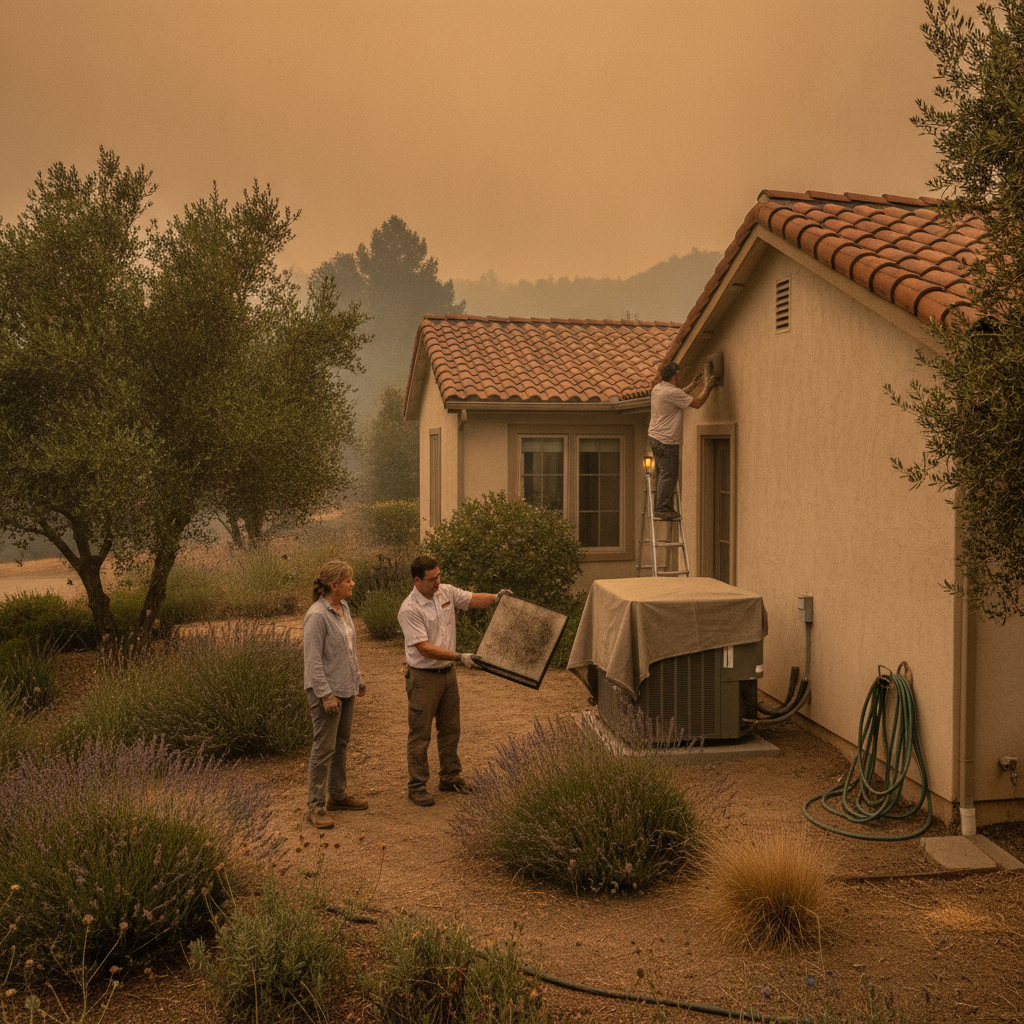
If you live in Healdsburg or anywhere in Sonoma County, wildfire smoke isn’t a once-in-a-decade event — it’s a recurring seasonal reality. From late summer through fall, air quality in the North Bay can shift from clear to hazardous within hours, and the smoke doesn’t stop at your front door. What most homeowners don’t realize is that their HVAC system — the thing running every day to keep the house comfortable — can either help filter that smoke out or actively pull it in, depending on how it’s set up and whether it’s been properly maintained.
This is one of those topics that doesn’t get nearly enough practical attention from HVAC companies in the area. Most wildfire air quality advice focuses on portable air purifiers or just staying indoors — but your central heating and cooling system is circulating air through your entire home, and it deserves a closer look before smoke season peaks.
How Your HVAC System Interacts With Wildfire Smoke
Your central HVAC system pulls indoor air through return vents, runs it past a filter, conditions it, and pushes it back through the house. During normal conditions, that process keeps things comfortable. During a smoke event, that cycle becomes much more significant — and potentially a problem, depending on a few factors.
The first thing to understand is the difference between recirculation mode and fresh air intake. Some HVAC systems — particularly those with mechanical ventilation or economizer controls common in newer construction — are designed to pull in outside air as part of normal operation. When the outdoor air quality index (AQI) is in the red or purple range, that fresh air intake is the last thing you want running. If your system has a fresh air damper, it should be closed during smoke events. Many homeowners don’t know this damper exists, let alone how to close it.
The second issue is your filter. A standard fiberglass or thin pleated filter (typically rated MERV 1–4) does essentially nothing to stop fine particulate matter from wildfire smoke. Smoke particles — particularly PM2.5, the tiny particles that penetrate deep into your lungs — are small enough to pass right through low-rated filters and recirculate through your home.
What MERV Rating Do You Actually Need for Smoke Season in Healdsburg?
MERV stands for Minimum Efficiency Reporting Value, and it’s the standard rating for how well an HVAC filter captures airborne particles. Here’s a plain-language breakdown of what’s relevant for Healdsburg and Sonoma County homeowners dealing with wildfire smoke:
- MERV 1–4: Basic protection against large dust and debris. Does not capture smoke particles.
- MERV 8: Captures mold spores, dust mite debris, and some pollen. Still not adequate for fine smoke particulate.
- MERV 11–13: The sweet spot for most residential systems during smoke events. Captures fine particles including PM2.5 at meaningful rates without overly restricting airflow.
- MERV 16 and above (HEPA-equivalent): Very effective filtration, but not compatible with most residential ductwork and blower systems. Forcing a high-MERV filter into a system not designed for it can restrict airflow, cause the blower to work harder, and ultimately lead to system damage or premature failure.
The honest answer is that MERV 13 hits the right balance for most homes in Santa Rosa, Healdsburg, Windsor, and surrounding areas — but you need to confirm your existing system can handle that level of filtration before switching. A quick call to a local HVAC technician can answer that question in minutes.
The Fresh Air Ventilation Problem — and Why It’s Easy to Miss
Here’s the section that most HVAC blogs skip entirely, and it’s the one that catches Sonoma County homeowners off guard: some whole-house ventilation setups are designed to bring in outdoor air, and they’ll keep doing it even when the air outside is thick with smoke.
Homes built or upgraded in the last 10–15 years — especially in newer neighborhoods in Windsor or Cloverdale — often include energy recovery ventilators (ERVs) or heat recovery ventilators (HRVs) as part of a tight building envelope strategy. These systems are excellent for normal air quality. During a smoke event, they need to be switched off or bypassed manually.
Older homes in areas like Sebastopol or around Healdsburg’s historic district tend to be naturally leakier, which means outdoor smoke infiltrates through gaps around windows, doors, and attic bypasses regardless of the HVAC system. No filter rating fully compensates for a poorly sealed building envelope — but a higher-MERV filter in a well-maintained system helps significantly.
If you’re not sure whether your system includes a fresh air intake, or you want to understand what your whole-house ventilation setup is actually doing during a smoke event, that’s worth a service call before the next smoke season — not during it.
Whole-Home Air Purification: When a Filter Upgrade Isn’t Enough
For households with asthma, COPD, young children, or elderly family members, a filter upgrade alone may not provide adequate protection during severe smoke events. In those cases, in-duct air purification systems installed directly into your HVAC system offer a meaningful step up.
We’ve installed systems like the iWave and similar in-duct units in homes throughout Sonoma County. These use ionization technology to actively neutralize particulates, allergens, and pathogens as air passes through the system — not just passive filtration, but active treatment of the air your family is breathing. They work in conjunction with your existing filter and run continuously without requiring separate maintenance beyond your regular HVAC tune-up.
That said, these systems aren’t right for every home or every budget, and we won’t upsell you on one if your current setup is adequate. The right answer depends on your system, your household’s health needs, and how your home is built.
Practical Steps to Take Before Smoke Season Hits
Rather than waiting until the AQI alert hits your phone, here’s what we recommend doing in the spring or early summer — before conditions deteriorate:
- Check your current filter rating and upgrade to MERV 11 or 13 if your system supports it.
- Ask your HVAC technician whether you have a fresh air damper, where it’s located, and how to close it during smoke events.
- Schedule a spring tune-up that includes inspecting your ductwork for leaks — smoke (and heat) gets in through the same gaps that conditioned air escapes through.
- Consider duct sealing if your home is older and has accessible attic or crawlspace ductwork. This improves both energy efficiency and smoke resistance.
- Discuss in-duct air purification if your household includes people with respiratory vulnerabilities.
Our spring and fall tune-up visits — available for $90 as part of our current service specials — include a full system inspection that covers filtration, airflow, and overall system health. It’s the right time to have this conversation before you need it.
Frequently Asked Questions: HVAC and Wildfire Smoke in Sonoma County
Should I run my HVAC system continuously during a smoke event?
Running the fan continuously (using the “fan on” setting rather than “auto”) increases the number of air passes through your filter, which helps. But this only works if you have an appropriate MERV-rated filter installed. Running the system continuously with a low-grade filter just recirculates smoky air more efficiently — which isn’t helpful.
Can wildfire smoke damage my HVAC system?
Heavy smoke exposure over multiple seasons can accelerate wear on your blower motor, coil, and internal components — especially if filters aren’t changed frequently during smoke events. A clogged filter causes the system to strain, which shortens equipment life. During severe smoke events, check your filter every two to three weeks rather than monthly.
My house smells like smoke even with the AC running. What’s going on?
If smoke smell is persisting indoors, it usually points to one of three things: a low-rated filter that isn’t capturing particles, a fresh air intake pulling in outdoor air, or infiltration through unsealed gaps in the building envelope. A service visit can identify which issue is causing the problem in your specific home.
Do portable air purifiers work better than upgrading my HVAC filter?
Portable units are effective in individual rooms — particularly bedrooms — and can be a good complement to a whole-home strategy. But they don’t replace proper HVAC filtration because they only treat the air in one space. For whole-home protection, your central system is the right tool, provided it’s set up correctly for smoke conditions.
Is there financial help available for air quality upgrades in California?
In some cases, yes. PG&E and various California programs have offered rebates on qualifying air purification and HVAC efficiency upgrades. Availability changes, so it’s worth asking at the time of your service visit. We’ll let you know what’s currently available without any pressure to purchase something that isn’t right for your situation.
Talk to a Local HVAC Company That Understands Sonoma County Conditions
We’ve been serving homeowners in Santa Rosa, Healdsburg, Windsor, Sebastopol, Cloverdale, and throughout Sonoma County since 1992. Wildfire smoke season is something we take seriously — not as a sales opportunity, but as a real concern for the families we work with every year. If you want an honest assessment of how your HVAC system handles smoke and what, if anything, makes sense to change, we’re glad to help.
Contact Stout’s Heating & AC, Inc. to schedule a service visit or ask a question. No pressure, no upsell — just straight answers from a local team that’s been here long enough to know what Sonoma County homes actually need.