
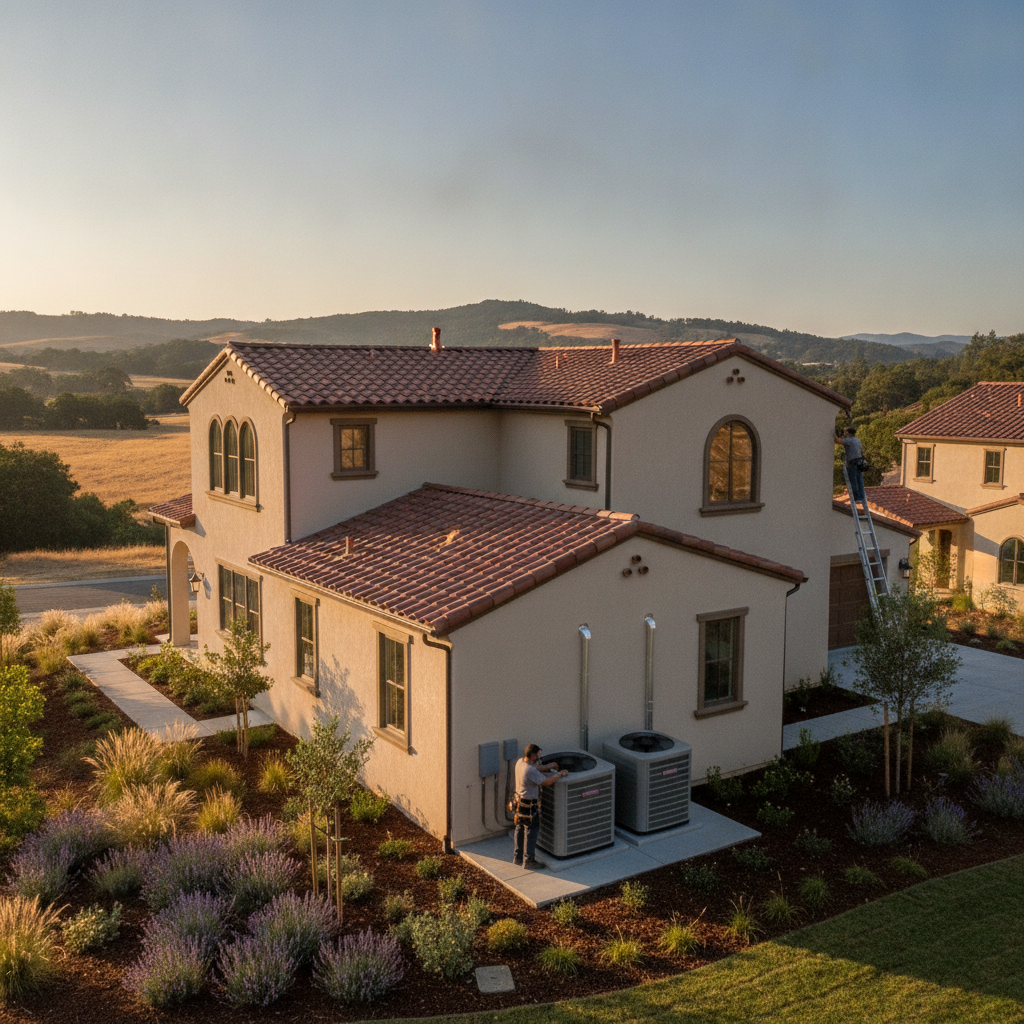
What Coffey Park and Roseland Homeowners in Santa Rosa Should Know About Choosing the Right AC System After a Rebuild
If you rebuilt your home in Coffey Park or Roseland after the 2017 Tubbs Fire — or if you’re finishing up a major renovation in one of Santa Rosa’s established westside neighborhoods — you’re making decisions right now that will affect your comfort and your energy bills for the next 15 to 20 years. The framing is fresh, the walls are open, and an HVAC contractor is probably asking you to sign off on equipment quickly. That’s exactly when it pays to slow down and ask the right questions.
We’ve been doing this work in Santa Rosa since 1992, and we’ve seen what happens when homeowners choose an AC system based on the lowest bid or whatever the general contractor happened to recommend. This article is for people who want to get it right the first time — because in a new build or post-fire rebuild, you actually have the opportunity to do that.
Why Rebuilt Homes in Coffey Park Are Different From a Typical New Build
Coffey Park and Roseland are primarily made up of modest single-family homes, many of them rebuilt after 2017 to modern California building codes — which are significantly more stringent than what was in place when the originals were constructed. That’s actually good news for HVAC sizing. A well-insulated, properly sealed new build typically requires less cooling capacity than a comparable older home with drafty windows and aging insulation.
Here’s the problem: not every HVAC contractor accounts for that. It’s still common to see contractors install oversized AC systems in newly rebuilt homes because they’re used to sizing for older construction, or because bigger equipment is easier to sell. An oversized system will cool your home fast — but it’ll short-cycle, meaning it turns on and off too frequently, wears out faster, doesn’t dehumidify properly, and costs more to operate. In Santa Rosa’s Mediterranean climate, where summer afternoons can spike well above 90°F but mornings are often cool, a properly sized system matters more than most homeowners realize.
A correct load calculation — done to Manual J standards — takes into account your square footage, ceiling heights, window orientation, insulation values, local climate data, and more. Ask any contractor you’re considering whether they perform a Manual J calculation before recommending equipment. If they eyeball it or use a rough rule-of-thumb like “one ton per 600 square feet,” that’s a red flag.
Central AC vs. Ductless Mini-Split: Which Makes More Sense in a Rebuild?
This is the question we get most often from Coffey Park and Roseland homeowners who are deep into the rebuild process. And the honest answer is: it depends on your floor plan, your budget, and your long-term energy goals.
Central AC with new ductwork is a reasonable choice for a full rebuild where the walls are open and ducts can be run cleanly through conditioned space. If the duct design is done well — and that’s a big if — central AC delivers consistent whole-home comfort and tends to be less expensive upfront than a multi-zone ductless system. The key phrase is “done well.” Poorly designed duct systems in new construction are extremely common and create hot spots, uneven airflow, and efficiency losses that can haunt you for years.
Ductless mini-splits, on the other hand, give you room-by-room temperature control, don’t depend on duct quality at all, and typically operate at higher efficiency ratings (SEER2). Brands like Mitsubishi Electric, Daikin, and Fujitsu make systems that are well-suited to Sonoma County’s climate. A multi-zone ductless setup in a three-bedroom home costs more upfront but can qualify for PG&E rebates and federal tax credits that offset a meaningful portion of that cost.
If you’re rebuilding in Coffey Park and your lot is smaller or your floor plan is more open, a single-zone or two-zone ductless system might handle your cooling needs more efficiently than a full central system. We’re happy to walk through the tradeoffs with you without pushing you toward one product over another. Learn more about residential AC options on our services page.
The SEER2 Conversation Your Contractor Might Be Skipping
California adopted the updated SEER2 efficiency standards for new AC installations starting in 2023. Any contractor selling and installing equipment in Santa Rosa should be quoting you equipment that meets or exceeds these minimums — but not all of them are having the broader conversation about what SEER2 actually means for your utility costs.
In simple terms: a higher SEER2-rated system costs more upfront and costs less to run over time. Given what PG&E rates look like right now in Sonoma County, the math on higher-efficiency equipment has gotten a lot more compelling. If a contractor is only showing you the minimum-compliant option without explaining what a step up would save you annually, ask them to run the numbers.
Also worth knowing: California’s Title 24 energy code requires that newly installed AC systems in new construction or permitted rebuilds pass a commissioning and verification process — including duct leakage testing. Make sure whoever you hire is familiar with this requirement. We’ve had homeowners come to us after the fact when their original contractor didn’t pull the right permits or pass final inspection.
Air Quality Matters in Santa Rosa — Especially After What This Community Has Been Through
This is an angle that most HVAC contractors in the area barely mention, and it’s one we feel strongly about. If you lived in Santa Rosa during the 2017 fires or any of the subsequent wildfire seasons, you know what smoke infiltration feels like in your home. A new build gives you a chance to address that proactively.
When your ductwork is being designed or your HVAC system is being specified, ask about filtration options beyond the basic 1-inch filter slot. MERV-13 filtration can be integrated into a central system without significant airflow penalty on properly designed equipment. If you’re going ductless, look at whether the indoor units support enhanced filtration. For maximum protection during wildfire season, whole-house air purification systems — including ionization-based solutions — can be added to most central systems. See our residential ventilation services for more information on air quality options.
What About Financing and Rebates for Rebuilt Homes?
Post-fire rebuilds in Santa Rosa often involve insurance settlements, construction loans, and tight budgets — we understand that. The good news is that high-efficiency AC and heat pump systems qualify for both California utility rebates through PG&E and federal tax credits under the Inflation Reduction Act. Depending on the equipment you choose, these incentives can add up to real money.
We offer 0% financing options on qualifying equipment, which can make the difference between choosing minimum-efficiency and actually future-proofing your home. Ask us about current offers when you call — the landscape changes, and we’ll tell you exactly what’s available at the time of your estimate. Check our current HVAC offers and financing options here.
Frequently Asked Questions From Coffey Park and Roseland Homeowners
Can I add AC to my rebuild after the fact if I didn’t include it initially?
Yes, but it’ll cost more and may require opening walls or running refrigerant lines in less-than-ideal locations. Ductless mini-splits are the cleanest option for post-construction installation since they don’t require ductwork. We’d recommend including at least the rough-in provisions for AC during the build if budget is the concern right now.
Does my new home need a heat pump instead of a traditional AC and furnace combo?
Not necessarily, but it’s worth considering. California is moving toward phasing out gas appliances in new construction in certain jurisdictions, and a heat pump handles both heating and cooling from a single system. In Santa Rosa’s climate — mild winters, hot summers — heat pumps perform extremely well year-round. We can help you compare the total cost of ownership against a traditional split system.
How do I know if my contractor sized my AC correctly?
Ask to see the Manual J load calculation. If they can’t produce one, that’s your answer. A properly sized system for a well-insulated new build in Santa Rosa might be smaller than you’d expect — and that’s a feature, not a problem.
Will my homeowner’s insurance affect what HVAC system I can install?
Indirectly, yes. If you’re in a high fire risk zone or rebuilding in an area with specific code requirements, your insurer may have requirements around electrical load, code compliance, or permitting that affect HVAC choices. We work with permits through the City of Santa Rosa and can make sure your installation is fully documented.
What brands do you install and service for new construction?
We work with Trane, Carrier, Daikin, Amana, American Standard, Lennox, Fujitsu, LG, Mitsubishi Electric, and York, among others. We’re brand-agnostic — we recommend what makes sense for your home, your budget, and how you plan to use the system. We’re not locked into any manufacturer’s incentive program.
Ready to Get Your AC Right the First Time?
Rebuilding a home is one of the most stressful things a family can go through. The last thing you want is to discover three summers later that your AC system was sized wrong, your ducts leak, or you left money on the table with rebates you didn’t know about. Stout’s Heating & AC has been doing this work in Santa Rosa and across Sonoma County since 1992 — through the booms, the fires, the rebuilds, and everything in between. We’ll give you a straight answer, a honest estimate, and work that’s done right and permitted properly.
If you’re in the middle of a rebuild in Coffey Park, Roseland, or anywhere else in the Santa Rosa area — or if you’re in Rohnert Park, Petaluma, or another part of Sonoma County planning a new installation — reach out and we’ll set up a free estimate. No pressure, no upsell, just a real conversation about what your home needs. Contact us here to schedule your free estimate.