
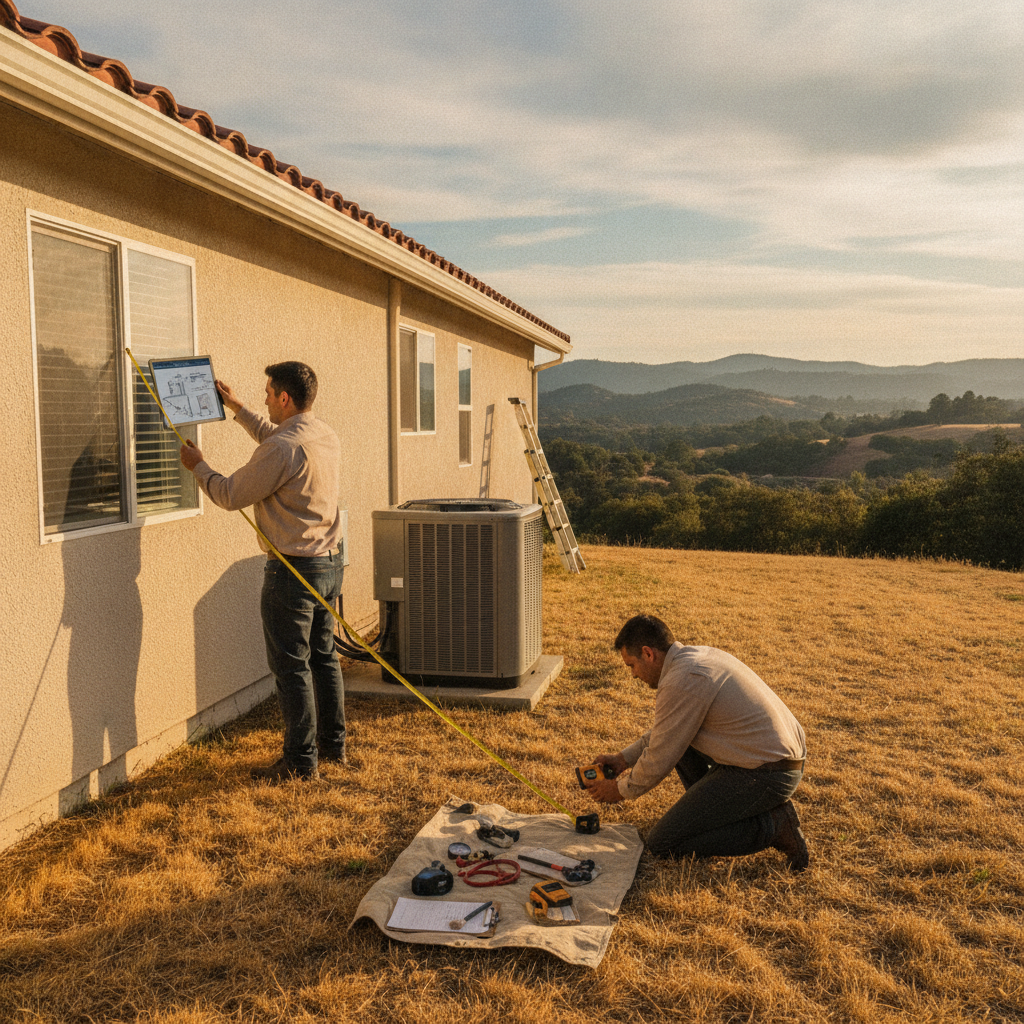
What Windsor and North Sonoma County Homeowners Should Know About HVAC Load Calculations Before Installing a New System
If you’re replacing a furnace, installing central AC, or upgrading to a heat pump in Windsor or the surrounding North Sonoma County area, the single most important step in that process has nothing to do with brand names or equipment warranties. It’s the load calculation — a systematic analysis of how much heating and cooling your home actually needs. Skip it, and you’re likely to end up with a system that’s the wrong size, costs more to run, and wears out faster than it should. This is one of the least-discussed topics in local HVAC content, and yet it’s one of the most consequential decisions made during any installation.
What Is an HVAC Load Calculation — and Why Does It Matter in Windsor?
A load calculation — most commonly performed using the industry-standard Manual J methodology — is a detailed assessment of how much heating and cooling capacity your home requires. It’s not a guess, and it’s not based on square footage alone. A proper Manual J takes into account your home’s insulation levels, window placement and glazing type, ceiling height, local climate data, duct conditions, air infiltration, and even which direction your house faces relative to the sun.
In Windsor specifically, this matters more than you might expect. The town sits in the northern part of the Santa Rosa plain, where summer afternoons regularly push into the mid-to-upper 90s and occasionally cross 100°F — hotter than coastal areas to the west and cooler than inland valleys to the north like Cloverdale and the Alexander Valley corridor. Windsor’s newer subdivisions also tend to have a mix of 1990s-era tract homes and more recently built housing, each with different insulation standards and duct configurations. A one-size-fits-all approach simply doesn’t work here.
What Happens When the Calculation Gets Skipped
The most common shortcut contractors take — especially high-volume national franchise operations that have been expanding into Sonoma County — is to size equipment based on a quick square footage estimate, or to simply match whatever size unit was there before. This approach leads to two equally bad outcomes.
Oversized systems cool or heat your home too quickly without running long enough to properly dehumidify the air. In Sonoma County’s shoulder seasons — spring and fall — that humidity problem becomes real. You’ll feel clammy indoors even when the thermostat reads the right temperature. Oversized systems also short-cycle, meaning the compressor or burner fires up and shuts down repeatedly in short bursts. That mechanical stress dramatically shortens the lifespan of the equipment.
Undersized systems run constantly trying to keep up, driving up your PG&E bill and still not reaching your set temperature on the hottest summer days or coldest winter nights. With electricity rates in Sonoma County continuing to climb, an undersized system grinding away all afternoon is an expensive problem.
Neither scenario is acceptable, and both are entirely avoidable with a proper load calculation done upfront.
The Local Factors That Make This Calculation More Complex in North Sonoma County
Sonoma County’s Mediterranean climate — hot, dry summers and cool, wet winters — creates some unique sizing challenges that a contractor unfamiliar with the region might underweight. Here are a few factors that genuinely affect load calculations in this part of California:
- Radiant heat gain from direct sun exposure. Homes in Windsor’s newer subdivisions with large west-facing windows experience significant afternoon heat loads that inflate cooling requirements beyond what square footage alone would suggest.
- Wildfire season and air sealing. Many North Sonoma County homeowners — particularly those who rebuilt after recent fire seasons — have tighter, better-insulated homes than the region’s older housing stock. Tighter homes require less capacity but may need more attention to ventilation and air quality.
- Older ductwork in 1980s and 1990s construction. A significant portion of Windsor’s housing was built during that era. Duct leakage in those systems can account for 20–30% of conditioned air never reaching living spaces — a factor that absolutely must be accounted for when sizing a replacement system.
- Healdsburg and Cloverdale elevation and exposure differences. Homes further north in the county, up toward Healdsburg and Cloverdale, can see meaningfully different temperature swings and wind exposure than Windsor or Santa Rosa proper. A load calculation done for a home in one part of the county shouldn’t be copied for a home elsewhere.
What to Ask Your HVAC Contractor Before They Size Your System
You have every right to ask a contractor how they’re sizing your new equipment before any proposal is finalized. Here are the questions that separate thorough contractors from the ones cutting corners:
- “Are you running a Manual J calculation, and can I see it?” Any reputable contractor should be able to show you the inputs and outputs. If they say they don’t need one, that’s a red flag.
- “Are you accounting for my duct condition?” If your ducts are old or you know you have leakage, this must be part of the calculation — not an afterthought.
- “Is this a like-for-like replacement, or are you actually evaluating what my home needs?” Sometimes the previous system was already the wrong size. Replacing it with the same tonnage just repeats the mistake.
- “What SEER rating are you recommending, and why?” Higher SEER doesn’t matter much if the unit is oversized. Efficiency only pays off when the system is running at the right capacity for the right amount of time.
At Stout’s Heating & AC, we’ve been doing this work since 1992. We know the housing stock across Windsor, Healdsburg, Santa Rosa, and the surrounding area well enough to know that the right answer for one home on a Windsor cul-de-sac isn’t automatically right for the home next door. We serve Windsor and the surrounding area and take the time to do the calculation properly before we ever recommend equipment.
How Load Calculations Affect Heat Pump Sizing Specifically
If you’re considering switching to a heat pump — which makes a lot of sense for homes in Windsor and the broader Santa Rosa area given the moderate climate and rising gas costs — proper sizing becomes even more critical. Heat pumps operate most efficiently when they’re running at the right capacity for your home’s actual demand. An oversized heat pump will short-cycle just like an oversized AC, and an undersized one will struggle on the coldest nights when you need it most.
There are also California and PG&E rebate programs tied to qualifying equipment installations, and in some cases the rebate eligibility depends on proper sizing documentation. If you’re hoping to capture those incentives, having a real load calculation on file protects that investment. You can review current offers and financing options on our HVAC offers page.
Frequently Asked Questions
How long does an HVAC load calculation take?
For a typical single-family home in Windsor or North Sonoma County, a thorough Manual J assessment usually takes one to two hours on-site. The contractor needs to walk through the home, measure rooms, assess insulation, inspect the duct system, and note window placement and construction details. It’s not a five-minute walkthrough.
Does every HVAC replacement require a new load calculation?
It’s strongly recommended, yes — even if you’re replacing a unit that seemed to work fine. Systems are often oversized to begin with, and building conditions change over time. If your home has had insulation added, windows replaced, or rooms added since the original installation, the old sizing assumptions no longer apply.
Will a load calculation cost extra?
At Stout’s, the load assessment is part of our installation process — we’re not going to propose equipment without doing the work to know what you actually need. Some contractors charge separately for it, which is fine as long as they’re genuinely doing it. Be cautious of any contractor who skips it entirely and prices the job in five minutes.
My house is only 1,400 square feet. Don’t I just need a standard two-ton unit?
Square footage is one factor, but it’s not a reliable standalone basis for sizing. A well-insulated 1,400-square-foot home in Windsor with north-facing windows may need considerably less capacity than a poorly insulated 1,400-square-foot home with large south- and west-facing glass. The difference can easily be half a ton or more — which matters a lot in terms of efficiency and comfort.
Does the age of my home affect how load calculations are done?
Absolutely. Older homes — especially those built before California’s current Title 24 energy standards were established — often have less insulation, single-pane windows, and leakier envelopes. All of that changes the load profile significantly. Homes rebuilt after wildfire events in Sonoma County, by contrast, often exceed current code and may require less capacity than you’d expect for their size.
Get the Sizing Right the First Time
Installing a new HVAC system is one of the larger investments you’ll make in your home. In Windsor, Healdsburg, Cloverdale, or anywhere in North Sonoma County, the best way to protect that investment is to make sure the equipment is sized correctly from the start — not swapped in based on a quick measurement and a sales quote. At Stout’s Heating & AC, Inc., we’ve been doing honest, thorough work in this community for over 30 years, and we’re not going to shortcut the process to close a job faster.
If you’re planning a system replacement or want a second opinion on a proposal you’ve already received, we’re happy to take a look. Request a free estimate and we’ll come out, do the work properly, and give you a straight answer on what your home actually needs.