
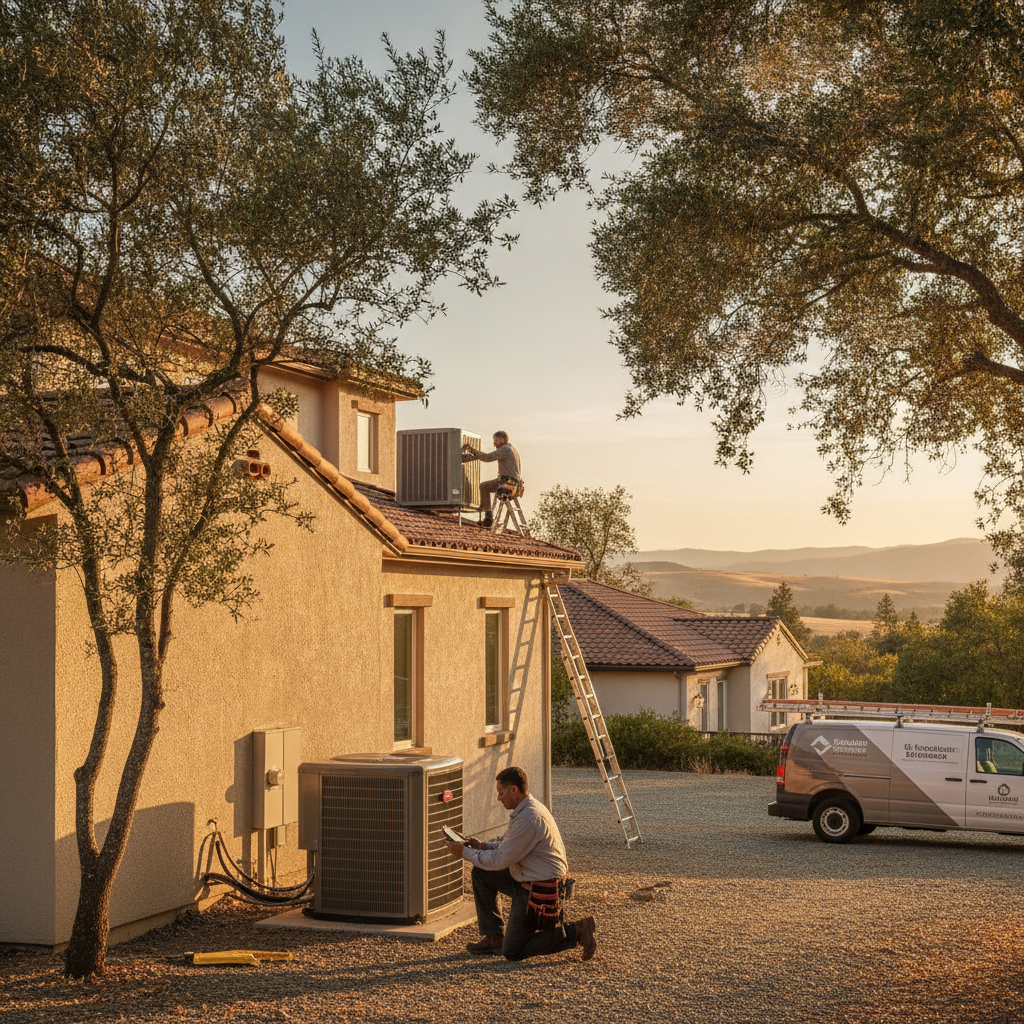
What Petaluma and Sonoma County Landlords Should Know About HVAC Responsibilities in Rental Properties
If you own rental property in Petaluma, Santa Rosa, or anywhere else in Sonoma County, you probably already know that heating and cooling problems don’t wait for a convenient time. A furnace that stops working in January or an AC unit that gives out during a July heat wave isn’t just an inconvenience — in California, it can put you on the wrong side of habitability law. Understanding your responsibilities before something breaks is one of the smartest things you can do as a landlord or property manager. Here’s what you need to know.
California Law and Heating: What Landlords Are Actually Required to Provide
California’s implied warranty of habitability requires that rental units maintain a minimum indoor temperature of 70°F in any room used for living. In practical terms, that means every unit you rent out needs a functioning heating system — full stop. There’s no legal gray area here. If a tenant reports a broken furnace or heater and you don’t respond within a reasonable timeframe, you’re exposed to rent withholding, repair-and-deduct remedies, and potentially code enforcement complaints.
Cooling is a separate question. California law doesn’t currently mandate air conditioning in rentals the way it mandates heat. That said, more local jurisdictions are moving toward stronger protections as extreme summer temperatures become more frequent. If your rental unit in Rohnert Park, Cotati, or inland Santa Rosa gets into the 100s during a heat event — and it can — that’s worth factoring into your planning even if you’re not legally required to install AC today.
The practical takeaway: keep your heating systems in working order, document your maintenance, and don’t let deferred repairs become a habitability dispute.
The Aging System Problem: What Sonoma County Rental Stock Actually Looks Like
A significant portion of rental housing in Sonoma County — especially in older neighborhoods of Santa Rosa, south Petaluma, and parts of Sebastopol — was built in the 1960s through the 1980s. The HVAC systems in those units, if they haven’t been replaced, are well past their expected service life. A gas furnace that’s 20-plus years old isn’t just inefficient. It’s a liability.
Older forced-air systems in this kind of housing stock tend to develop a predictable set of problems: cracked heat exchangers, failing ignitors, worn blower motors, and ductwork that’s lost its seal over decades of use. A cracked heat exchanger is a carbon monoxide risk — and that’s not something you want discovered by a tenant rather than a technician during a scheduled inspection.
If you’re managing older units and you don’t have a service relationship with a local HVAC company, that’s the first thing to fix. Residential heater repair for a rental is fundamentally the same work as for an owner-occupied home, but as a landlord you need to be proactive rather than reactive. Annual or bi-annual tune-ups catch the small problems before they become emergency calls — and emergency calls in the middle of a cold snap, when every HVAC company in the county is backed up, are exactly what you want to avoid.
Should You Repair or Replace When a System Fails in a Rental?
This is the question we get from property managers and landlords all the time, and there’s no one-size answer. What we generally tell people is this: if a system is under 10 years old and the repair cost is under roughly one-third of replacement cost, repair usually makes sense. If it’s over 15 years old and you’re looking at a major component failure — compressor, heat exchanger, control board — replacement is often the smarter financial decision.
For rentals specifically, there are a few factors worth weighing beyond the age-and-cost calculation:
- Reliability matters more in a rental than in your own home. You’re not there to manage a breakdown. Your tenant is, and they’re going to call you at 9 PM.
- Energy efficiency affects your competitiveness. In a market like Petaluma or Windsor, tenants increasingly pay their own utilities and care about PG&E bills. A newer, more efficient system can be a legitimate selling point at lease renewal.
- California rebates and federal tax credits apply to rental property owners too. High-efficiency heat pumps installed in rental units can qualify for PG&E rebates and federal tax credits, which changes the math on replacement in ways many landlords don’t realize.
Heat pumps deserve a specific mention here. For single-family rentals and smaller multi-unit buildings in Sonoma County’s moderate climate, a heat pump handles both heating and cooling from one system. That simplifies maintenance, reduces the number of components that can fail, and can significantly lower utility costs for your tenants. Heat pump systems have become one of the more practical upgrade paths for rental property owners in this area — especially with available incentives offsetting the upfront cost.
Managing HVAC Across Multiple Units: What Property Managers Should Set Up
If you’re managing more than one or two rental units in Sonoma County, ad-hoc repair calls are going to cost you more over time than a structured maintenance relationship with a local contractor. Here’s what a workable setup looks like in practice:
- Scheduled bi-annual tune-ups in spring and fall on each unit — this keeps systems running efficiently and creates a paper trail that matters if a habitability issue ever comes up.
- A direct line to a contractor you trust for same-day or next-day service when a tenant reports a problem. Not a national dispatch line. An actual local company that knows your properties.
- A running log of system age and repair history for each unit so you can plan capital replacements instead of getting blindsided by them.
- Clear tenant communication about filter changes. Tenants who never change filters cause a surprising number of preventable repairs. A simple clause in your lease and a supply of filters left in the unit goes a long way.
We’ve been working with landlords and property managers across Santa Rosa and the surrounding area since 1992. The ones who have the fewest emergency calls are the ones who treat HVAC maintenance the same way they treat any other scheduled property upkeep — on a calendar, not just when something breaks.
A Note on Wildfire Smoke and Air Quality in Rental Units
This is a topic that almost never comes up in landlord HVAC conversations, but it should. Wildfire smoke has been a recurring reality across Sonoma County, and tenants in rental units — especially those with older, leaky ductwork — can be significantly exposed during smoke events. If your rental property has a forced-air system, the filtration quality of that system matters.
Upgrading to a higher-MERV filter and making sure duct connections are properly sealed is a low-cost step that meaningfully improves air quality during smoke season. For landlords managing properties in areas that saw wildfire damage in past years — parts of Coffey Park, Fountaingrove, or communities east of Santa Rosa — this is particularly relevant. It’s not a legal requirement today, but it reflects the kind of property stewardship that retains good tenants.
Frequently Asked Questions: HVAC and Rental Properties in Sonoma County
How quickly do I have to fix a broken heater in a rental unit in California?
California law requires landlords to address habitability issues within a reasonable time. For heating failures, that’s generally interpreted as 24 to 72 hours depending on conditions. During cold weather, faster is always better — both legally and for your tenant relationship.
Is a landlord required to provide air conditioning in a Sonoma County rental?
Not under current state law, no. But if an AC unit is installed and included in the lease, you are responsible for maintaining it. And with summer temperatures continuing to push higher in inland areas like Rohnert Park and Cotati, this is worth considering as a property amenity even if it’s not mandated.
Can I deduct HVAC replacement costs on a rental property?
Generally yes, though the tax treatment (immediate deduction vs. depreciation) depends on whether it qualifies as a repair or capital improvement. Your accountant can walk you through this — and don’t forget that high-efficiency systems may also qualify for federal tax credits and PG&E rebates.
What happens if a tenant causes damage to the HVAC system?
Normal wear and tear is your responsibility as a landlord. Damage caused by tenant negligence — running a system without filters, blocking vents, misusing equipment — is typically recoverable from the security deposit with proper documentation. Having a maintenance log and move-in inspection records matters here.
How do I know if a rental property’s HVAC system needs to be replaced versus repaired?
System age, repair history, and the nature of the failure are all factors. A local HVAC technician who’s seen the system can give you an honest assessment. We’re always straightforward with property owners about whether a repair makes sense or whether replacement is the better investment — we’re not going to upsell you on a new system if a repair will genuinely serve you well.
Work With a Local Contractor Who Understands Rental Properties
Managing HVAC across rental units in Petaluma, Santa Rosa, Windsor, Sebastopol, or anywhere else in Sonoma County is easier when you have one reliable contractor who knows your properties and responds when you call. Stout’s Heating & AC has been doing exactly that since 1992 — no national call centers, no subcontracted crews you’ve never met, just the same local team that’s been serving this county for over three decades.
Whether you need a same-day repair on a tenant’s furnace, a system assessment on an aging unit, or help planning a phased replacement across multiple properties, we’re here to help. Contact us or request a free estimate and let’s talk about what your rental portfolio actually needs.