
How Does a Ductless Mini-Split Work in an Older Guerneville or Forestville Home Without Existing Ductwork?
If your home out in Guerneville or Forestville was built in the 1950s, 1960s, or even earlier — and it’s never had central heat or air — a ductless mini-split is probably the most practical way to get comfortable year-round without a major renovation. The short answer is this: a mini-split moves heat in or out of your home using a small outdoor compressor connected to one or more indoor units mounted on your wall. No ducts required. Installation typically takes one to two days, and the result is a fully functioning heating and cooling system that runs quietly, efficiently, and doesn’t require you to rebuild your walls.
That said, there’s more to know before you call anyone out to your property — especially if your home has its own quirks, which most Russian River Valley houses do.
Why Older Russian River Valley Homes Are Particularly Good Candidates
The housing stock in Guerneville, Forestville, and nearby Occidental tends to be older, smaller, and built for a time when a wood stove or wall heater was considered plenty. Many of these homes were originally vacation cabins or summer retreats that got converted into year-round residences over the decades. They’re charming, and they’re often structurally solid — but they were never designed around a central HVAC system.
Running new ductwork through a house like that is a significant project. You’re looking at cutting into walls and ceilings, possibly dealing with low crawlspace clearance, and in some cases finding out mid-project that the layout simply doesn’t allow for clean duct runs. It adds cost, disruption, and time — and for a lot of homeowners, it just doesn’t make sense when a ductless system can do the same job without any of that.
The Russian River Valley’s climate also makes mini-splits a particularly good fit. Summers get warm — sometimes sharply so, especially during the dry inland heat waves that push down through Sonoma County — but winters are mild enough that you rarely need the raw heat output of a gas furnace running full tilt. Mini-splits are heat pumps at their core, and heat pumps are most efficient in exactly the kind of moderate, wet-winter climate this area sees. You get solid heating performance without a gas line, and efficient cooling when summer arrives.
What the Installation Process Actually Looks Like
Here’s what happens when a qualified technician installs a ductless mini-split in an older home:
- Site assessment first. Before any work begins, a technician walks the home to figure out the best placement for the indoor air handler units and the outdoor compressor. In older homes, this step matters more than people expect — wall construction, insulation quality, window placement, and where you actually spend time all affect where the units should go.
- A small penetration through the wall. The indoor and outdoor units are connected by a refrigerant line, a power cable, and a condensate drain line. These run through a hole roughly three inches in diameter bored through an exterior wall. That’s the most invasive part of the whole job.
- Indoor unit mounting. The indoor air handler is mounted high on the wall — typically in a corner or central location for the best airflow coverage. It sits flush against the wall and is about the size of a large window AC unit, though far less obtrusive.
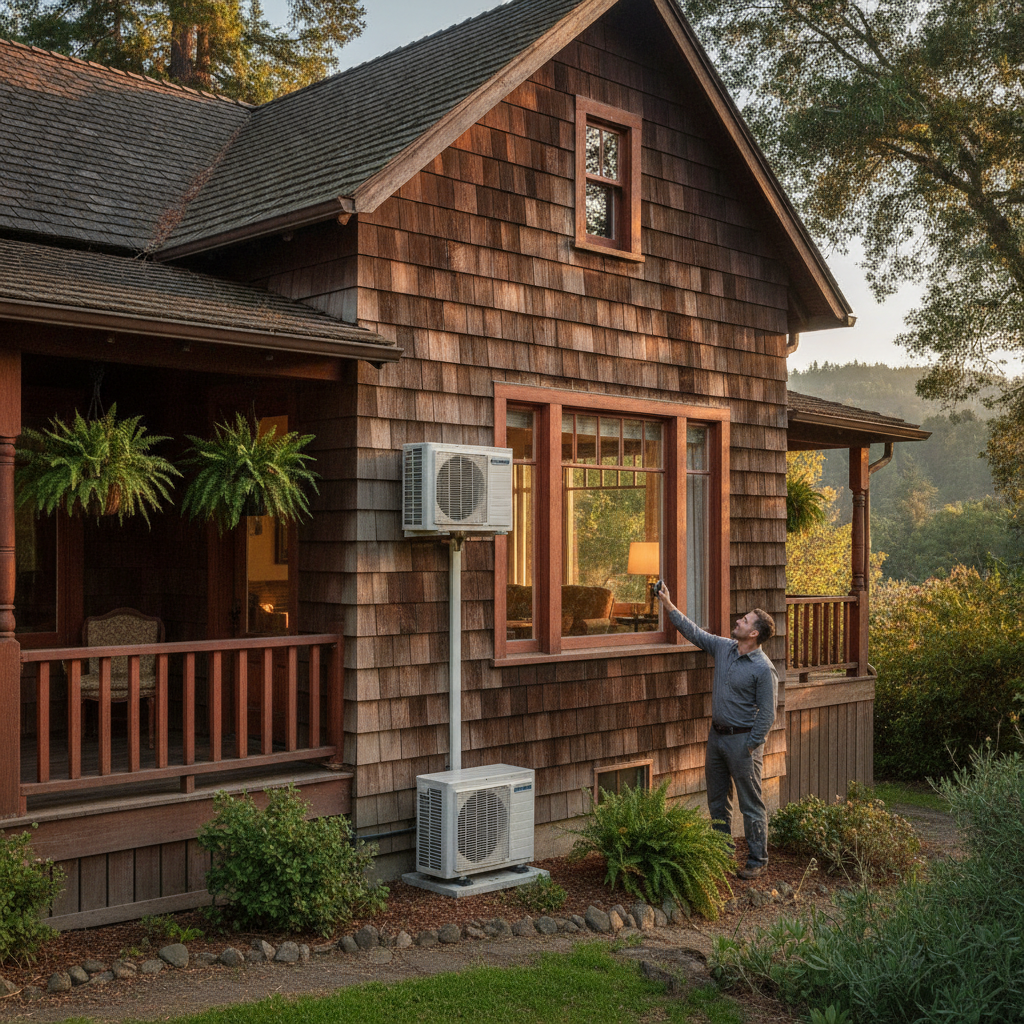
- Outdoor compressor placement. The outdoor unit is set on a pad or bracket outside, away from windows and foot traffic when possible. In older homes with limited yard space, technicians can get creative with placement as long as there’s adequate airflow around the unit.
- Electrical work. Mini-splits require a dedicated circuit. If your electrical panel is older — common in homes from the mid-century era — this may involve a separate electrician visit, which your HVAC contractor should coordinate or at least flag in advance.
A single-zone installation (one outdoor unit, one indoor unit) typically takes a full day. Multi-zone setups — where one outdoor compressor serves two, three, or four rooms — take a bit longer but are still usually finished within two days. Learn more about heat pump systems and how they compare to traditional heating and cooling options.
Multi-Zone Systems: Heating Different Rooms Independently
One of the most useful features of ductless systems — and one that rarely gets explained clearly — is the ability to run multiple indoor units from a single outdoor compressor. This is called a multi-zone configuration, and it’s particularly useful in the kinds of homes common to Guerneville and Forestville.
If you have a two-bedroom cabin where the back bedroom never gets warm in winter or cool in summer, you don’t have to size a system for the whole house just to fix one room. You can add a second indoor unit to that zone independently and control it separately. Each indoor unit has its own thermostat. You can run the living room at 70°F and leave the back bedroom at 65°F overnight without fighting the whole house’s system to do it.
This kind of zone control isn’t just convenient — it’s genuinely more energy-efficient. You’re not heating or cooling rooms that don’t need it. In a vacation rental context, which applies to quite a few properties along the Russian River, this also means guests can adjust comfort in their own space without affecting the whole house.
What Competitors Aren’t Telling You About Mini-Split Performance in Coastal and River Valley Climates
Here’s something worth knowing that tends to get glossed over in generic HVAC content: not all mini-split systems perform equally in high-humidity environments. The Russian River Valley sees significant moisture — coastal marine influence pushing inland, heavy fog in the mornings, and wet winters that keep humidity elevated for months at a time. Some lower-cost mini-split units struggle with coil corrosion and drainage issues in these conditions.
When a technician recommends a brand for your property, that choice should account for local conditions, not just price point. Brands like Mitsubishi Electric, Daikin, and Fujitsu have strong track records in Sonoma County’s varied microclimates, and their cold-climate heat pump models maintain efficient heating output well into temperatures lower than you’ll see in a typical Guerneville winter. It’s worth asking your contractor specifically how they select equipment for coastal and river valley properties — if they don’t have a clear answer, that’s a flag.
If your Forestville or Sebastopol home also has existing ductwork from an older furnace, a hybrid approach may be worth exploring — pairing a heat pump with a gas backup for the coldest stretches. That’s a different conversation, but hybrid heat pump systems are worth understanding if you’re also replacing aging heating equipment.
California Rebates and Incentives That Apply Here
Ductless mini-splits qualify for several incentives that can meaningfully reduce your out-of-pocket cost. PG&E and the state of California have both expanded rebate programs for heat pump technology in recent years, partly driven by the push to electrify home heating. Federal tax credits for qualifying high-efficiency heat pump systems are also available under the Inflation Reduction Act — as of 2026, that credit can cover up to 30% of installation costs for eligible systems.
The specifics change from year to year and depend on your system’s efficiency rating and whether you own the property. A local HVAC contractor should be able to walk you through what’s currently available and help you document the installation correctly. If a contractor can’t speak to rebate eligibility, that’s worth pressing on — it can be the difference between a project that costs $4,000 and one that nets out closer to $2,500 after incentives. Check our current HVAC offers and financing options for what we’re currently able to offer.
Frequently Asked Questions
How long does a ductless mini-split installation take in an older home?
Most single-zone installations are completed in one day. Multi-zone setups — where one outdoor unit serves two or more rooms — typically run two days. Older homes sometimes require additional prep work if wall construction or electrical panels need attention first.
Do I need a gas line for a mini-split to heat my Guerneville home?
No. Mini-splits run entirely on electricity and don’t require a gas line. They extract heat from outdoor air — even cold air — and move it inside. That makes them a practical option in areas where gas service isn’t available or where homeowners prefer to avoid fossil fuels.
Will a mini-split keep up on the coldest winter nights in Forestville?
In most cases, yes. The Russian River Valley rarely sees sustained temperatures cold enough to push a quality heat pump to its limits. Modern cold-climate heat pump units maintain solid output down to around 5°F, well below anything Forestville typically experiences. If you want a safety net for unusual cold snaps, a hybrid system with gas backup is an option worth discussing.
Can I install a mini-split myself to save money?
You can purchase mini-split equipment online, but handling refrigerant requires an EPA 608 certification, and most manufacturers void the warranty on DIY installations. The electrical work also needs to be done to code. In practice, the permit complications, warranty risks, and potential for improper refrigerant handling make professional installation the right call for most homeowners.
How much maintenance does a ductless system need?
Less than a ducted system, but not zero. The indoor unit filters need to be cleaned every few weeks — it takes about five minutes. An annual or bi-annual professional tune-up keeps the refrigerant charge, coil condition, and drainage in good shape. In higher-humidity environments like the Russian River Valley, that annual check is particularly worthwhile.
Ready to Talk Through Your Options?
At Stout’s Heating & AC, Inc, we’ve been working in homes across Santa Rosa and Sonoma County since 1992 — including plenty of older properties in Guerneville, Forestville, Occidental, and the surrounding communities that were never designed with central HVAC in mind. We’re not here to sell you the most expensive system on the shelf. We’re here to figure out what actually makes sense for your home, your budget, and how you use the space.
If you’re ready to stop tolerating a house that’s too hot in August and too cold in January, request a free estimate and we’ll come out, take a look, and give you a straight answer on what a ductless system would cost and what you’d actually get out of it. No pressure, no upsell. Just honest advice from a local contractor who knows this area.