
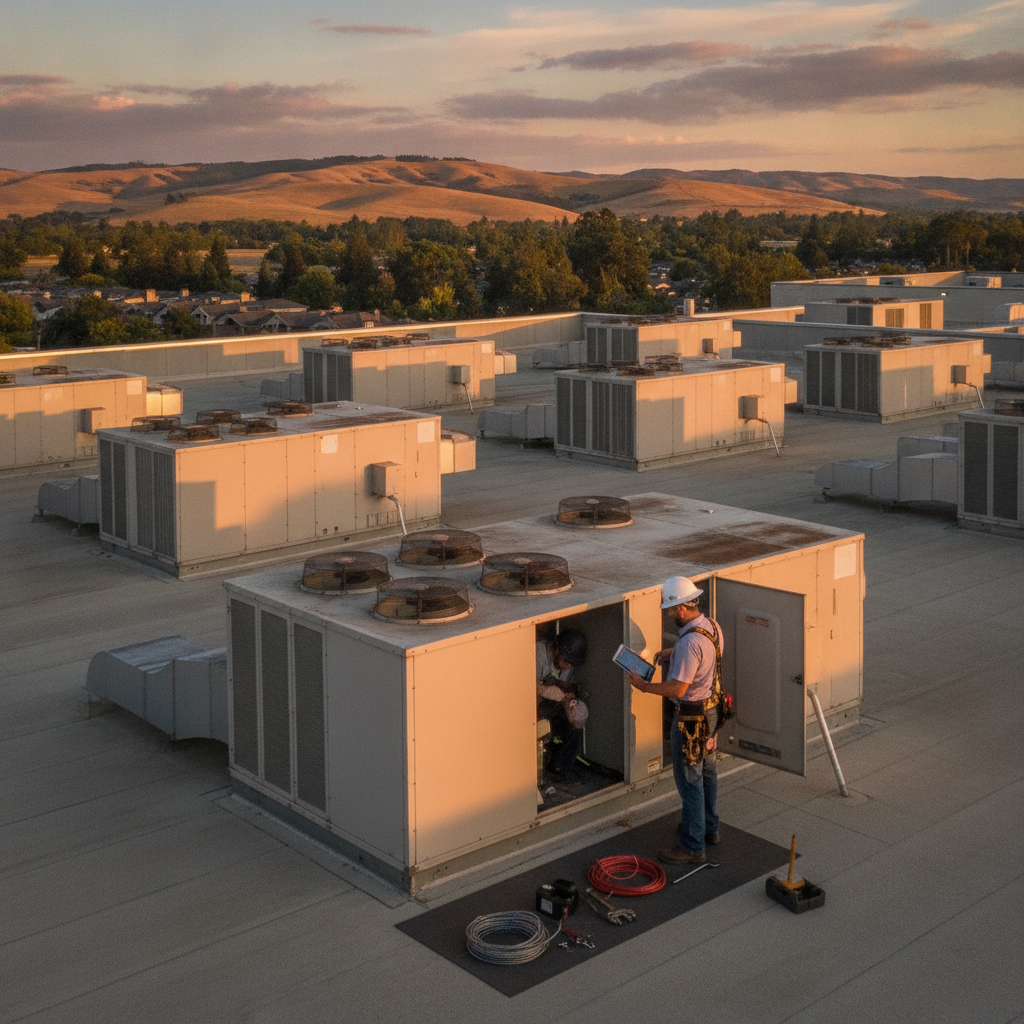
What Petaluma and South Sonoma County Business Owners Should Know About Commercial Rooftop HVAC Units
If your business operates out of a retail strip, an office suite, a light industrial space, or a freestanding commercial building anywhere between Petaluma and Santa Rosa, there’s a good chance your heating and cooling system is sitting on your roof right now — and you may not have thought about it since the day you moved in. Rooftop HVAC units, commonly called RTUs, are the workhorse of commercial climate control across Sonoma County. They’re reliable, space-efficient, and mostly invisible until something breaks. That’s exactly where most business owners get caught off guard.
We’ve been servicing commercial RTUs throughout the region since 1992, and the call pattern is almost always the same: it’s July, the system hasn’t been touched in three years, and now it’s 95 degrees and the compressor is gone. This article is for business owners who want to get ahead of that situation — not react to it.
What Is a Commercial Rooftop HVAC Unit, and Why Do So Many Buildings Use Them?
A rooftop unit is a self-contained HVAC system installed on the flat or low-slope roof of a commercial building. Unlike a residential setup — where you have a furnace in a closet and a condenser unit in the backyard — an RTU packages the heating, cooling, and sometimes ventilation components all in one cabinet up top. Conditioned air drops down through ductwork into the space below.
They’re popular for commercial construction because they free up interior square footage, they’re easier to access for service (no need to move around furniture or navigate mechanical rooms), and they scale well. A 10,000-square-foot retail space along Petaluma’s East Washington Street corridor might run two or three RTUs. A larger office complex near Rohnert Park or Cotati might have a dozen.
The tradeoff is that rooftop exposure accelerates wear. Sun, rain, and wildfire smoke season all take a toll on RTU components — especially filters, coils, and electrical connections. In Sonoma County, where dry summers can be intense and air quality drops during fire season, that exposure matters more than it would in a more temperate coastal climate.
The Maintenance Reality Most Commercial Tenants Don’t Know About
Here’s something that surprises a lot of business owners when they lease a commercial space: in most triple-net leases, HVAC maintenance falls on the tenant, not the landlord. That means if you’re in a retail strip or an office suite anywhere from south Petaluma to the Highway 101 corridor through Santa Rosa, you may be legally responsible for keeping that rooftop unit serviced — even if you didn’t pick the equipment and have never seen what’s up there.
The minimum standard for a commercial RTU is a bi-annual inspection — typically once before summer cooling season and once before winter heating season. At each visit, a qualified technician should be checking refrigerant charge, cleaning evaporator and condenser coils, inspecting the heat exchanger or heat strips, testing electrical components, and replacing filters. This isn’t optional maintenance. A dirty coil can reduce system efficiency by 20 to 30 percent, which hits directly on your PG&E bill. A clogged filter in a restaurant or retail environment can turn into a full system shutdown within weeks.
If your building has multiple RTUs serving different zones, each one needs to be on a maintenance schedule. It’s easy for one unit to get missed — and those are usually the ones that fail mid-summer.
Repair vs. Replacement: What the Decision Actually Looks Like
Commercial RTUs are built to last roughly 15 to 20 years with proper maintenance. In practice, we see a lot of units pushing 20-plus years in older commercial buildings throughout Petaluma, Rohnert Park, and the older parts of Santa Rosa. At that age, the question isn’t whether to replace — it’s when and with what.
A few honest markers to help you think through the decision:
- Age and repair frequency: If a unit is over 15 years old and has needed two or more significant repairs in the past 24 months, replacement is almost always more economical than another repair cycle.
- Compressor failure: A failed compressor on an older RTU is often a replacement trigger. Compressor replacement on an aging unit typically costs more than the repair is worth given the remaining system lifespan.
- Refrigerant type: Many older commercial RTUs still run on R-22 refrigerant, which was phased out federally and is now expensive to source. If your unit takes R-22, you’re already in an expensive repair situation every time it needs a recharge.
- Efficiency ratings: Older RTUs commonly have SEER ratings in the 10 to 12 range. Modern commercial units are typically 14 SEER or higher, and high-efficiency options go considerably above that. On a large commercial space running all summer, the energy savings from a replacement can be substantial — especially with PG&E rates where they are right now.
When replacement does make sense, it’s worth asking your contractor about available financing options and utility rebates. PG&E offers commercial rebates for qualifying high-efficiency HVAC equipment, and federal tax incentives for commercial energy improvements have expanded in recent years. A reputable local contractor should be able to walk you through what’s currently available — not just hand you a replacement quote and move on.
What Competitors’ Websites Don’t Tell You About Commercial RTU Service
Most local HVAC websites — and frankly most of the competitor sites in the area — talk about commercial HVAC in very general terms. They’ll mention that they service commercial buildings, list a few equipment brands, and call it done. What they rarely address is the operational reality for the business owner on the other side of the transaction.
A few things worth knowing that tend to get glossed over:
- Roof access isn’t always simple. RTU service requires a contractor with the equipment and insurance to work on a commercial roof. Not every HVAC company that services residential systems is properly set up for commercial rooftop work. Make sure whoever you call has actual commercial RTU experience — not just a line on their website.
- Multi-unit buildings need coordinated scheduling. If your building has four or five RTUs and some are serving tenant spaces you don’t control, coordinating access and scheduling can get complicated. A contractor who understands commercial building dynamics will handle that more smoothly than one who mostly does residential work.
- Emergency service timelines differ. When a residential AC goes down, the homeowner is uncomfortable. When a commercial RTU goes down mid-July at a Petaluma restaurant or a Rohnert Park medical office, you’re potentially looking at lost revenue, health code concerns, or patient care issues. Your HVAC contractor needs to have real commercial emergency response capability — same-day service, not a three-day waitlist.
At Stout’s, our commercial AC repair service is built around exactly that kind of response. We’ve been doing this work across Sonoma County long enough to know that a business owner in Petaluma can’t wait until next Tuesday.
A Note on Wildfire Smoke and Commercial Air Quality
This is something that almost never comes up in local HVAC marketing, but it’s genuinely relevant for commercial building operators in Sonoma County. During fire season — which in recent years has stretched from late summer well into fall — your RTU is pulling outdoor air into your building. If you don’t have proper filtration in place, you’re circulating smoke-contaminated air through your workspace, your restaurant, your retail floor.
Most standard commercial RTU filters are not rated for fine particulate filtration. Upgrading to higher-efficiency commercial filters or adding supplemental filtration is a relatively low-cost modification that makes a meaningful difference during smoke events. It’s also increasingly something that commercial tenants and employees expect, especially in a post-2017 North Bay climate where wildfire smoke is a known annual reality.
Frequently Asked Questions
How often should a commercial rooftop unit be serviced in Sonoma County?
At minimum, twice a year — once in spring before cooling season and once in fall before heating season. If your building has heavy occupancy, kitchen exhaust nearby, or runs equipment that generates dust or particulates, quarterly filter checks are reasonable.
Who is responsible for RTU maintenance in a commercial lease — the landlord or the tenant?
It depends entirely on your lease. Triple-net leases typically place HVAC maintenance on the tenant. Modified gross or full-service leases may put it on the landlord. Read your lease carefully, and if it’s ambiguous, get it clarified in writing before something breaks.
Can you replace a rooftop unit without disrupting business operations?
In most cases, yes. RTU replacements are typically done during off-hours or over a weekend to minimize disruption. Your contractor should be able to stage the work around your schedule. The actual crane lift and unit swap is usually completed in a single day.
Do commercial RTUs qualify for PG&E rebates or federal tax incentives?
Yes, in many cases. PG&E offers commercial equipment rebates for qualifying high-efficiency RTUs, and the federal government has expanded commercial energy efficiency tax incentives. The specifics change periodically, so talk to your contractor and your accountant together to understand what applies to your situation.
Do you service commercial rooftop units in Petaluma and Rohnert Park, not just Santa Rosa?
Yes. We serve commercial and residential customers throughout Sonoma County, including Petaluma, Rohnert Park, Cotati, and the broader south county area. We’ve been doing this work in the region since 1992 and know the local building stock well.
Ready to Get Your Commercial RTU on a Real Maintenance Schedule?
If you’re a business owner or property manager in Petaluma, Rohnert Park, Santa Rosa, or anywhere else in Sonoma County and you’re not sure when your rooftop unit was last serviced — or if it’s showing signs of trouble — we’re straightforward to reach and honest about what we find. We’ll give you a real assessment, not a sales pitch.
Call us at (707) 527-1504, email help@stoutshvac.com, or schedule a visit through our contact page. We’ve been taking care of commercial HVAC in this county for over 30 years, and we’re not going anywhere.