
What Sonoma County Business Owners Should Know Before Signing an HVAC Maintenance Contract
If you own or manage a commercial property in Sonoma County — a restaurant in Healdsburg, a retail shop along Santa Rosa’s Highway 101 corridor, a tasting room in Kenwood, or a professional office in Rohnert Park — you’ve probably been approached about signing an HVAC maintenance contract at some point. The pitch sounds simple: pay a flat annual or monthly fee, and someone will keep your heating and cooling system running. But the details buried in those contracts vary enormously, and signing the wrong one can leave you with unexpected repair bills, slow response times, and a contractor who doesn’t know your equipment. Here’s what you actually need to understand before you commit.
What a Commercial HVAC Maintenance Contract Should Actually Include
A well-structured maintenance agreement isn’t just a reminder to change your filters twice a year. For most Sonoma County commercial properties, a legitimate contract should cover a minimum of two scheduled service visits annually — one in spring before cooling season and one in fall before your heating system gets tested by the region’s wet, cold winters. Each visit should include a thorough inspection of your equipment, not a 20-minute walk-through.
Here’s what each preventive maintenance visit should cover for a typical commercial system:
- Inspection and cleaning of evaporator and condenser coils
- Checking refrigerant levels and inspecting for leaks
- Lubrication of motors and moving parts
- Electrical connection tightening and voltage checks
- Thermostat calibration and controls testing
- Drain pan and condensate line clearing
- Filter replacement or inspection (confirm who supplies the filters)
- Belt and blower inspection on older equipment
- Carbon monoxide testing if you have gas heating equipment
If a contractor’s contract doesn’t spell out what’s included in each visit, that’s a red flag. You should be able to read the agreement and know exactly what you’re getting — not find out after the fact that the tech only checked filters and left.
The Fine Print That Catches Sonoma County Business Owners Off Guard
The biggest source of frustration we hear from commercial clients who’ve been burned by previous contracts usually comes down to three things: exclusions, response time guarantees, and equipment coverage limits.
Exclusions
Most contracts cover labor for the scheduled visits and may discount repair labor — but they often exclude parts entirely, or exclude specific components like compressors, heat exchangers, and control boards. Read the exclusions section carefully. If your rooftop unit’s compressor fails in the middle of a July heat wave and your contract doesn’t cover parts, you’re paying full price for a major repair on top of your contract fee.
Response Time Guarantees
Some national HVAC chains sell maintenance contracts with vague language like “priority service” that doesn’t translate into any actual commitment. Ask directly: if my system fails on a Friday afternoon in August, what’s your guaranteed response window? A local contractor who knows your building and your equipment can often get to you the same day. A regional dispatch center routing calls through a national franchise may not.
Equipment Coverage Limits
Larger commercial properties in Santa Rosa and surrounding areas often run multiple rooftop units, split systems, and dedicated exhaust or ventilation equipment. Make sure your contract covers every piece of HVAC equipment on the property — not just the main unit. Contracts that only cover “one system” can leave significant gaps, especially in multi-tenant buildings or restaurants with separate kitchen ventilation equipment.
Why Local Business Context in Sonoma County Changes What You Need
Generic HVAC maintenance contracts written for strip malls in Phoenix don’t account for what’s actually happening with commercial buildings in Wine Country. A few factors that make Sonoma County different:
Wildfire smoke season. Every fall, air quality in the region can drop significantly during fire events. Commercial properties with hospitality, food service, or healthcare functions often need enhanced filtration during these periods — sometimes on short notice. A local contractor familiar with this pattern can help you plan ahead rather than scramble when the AQI spikes.
Tourism seasonality. Restaurants, wineries, and hotels in areas like Sonoma, Healdsburg, and Kenwood see dramatically different occupancy levels between summer and off-season. Your HVAC load patterns aren’t constant, and a good maintenance contractor should understand how to adjust service timing to match your peak demand rather than running a one-size-fits-all schedule.
Aging commercial inventory. A significant portion of Sonoma County’s commercial building stock is older construction. Equipment compatibility, parts availability, and the right approach to rooftop unit maintenance on a 20-year-old system requires hands-on local experience — not a technician who’s never seen the equipment before.
Our commercial AC repair and service experience across Sonoma County means we know the equipment, the buildings, and the seasonal patterns that affect your business — not just what a training manual says.
What Competitors’ Contracts Often Miss: The Ventilation and IAQ Gap
One area where commercial HVAC maintenance contracts consistently fall short — and where most local competitors don’t go deep enough — is ventilation and indoor air quality as part of routine commercial maintenance. Most contracts focus entirely on the heating and cooling equipment and treat ventilation as an afterthought.
For restaurants, this is a serious oversight. Kitchen exhaust systems, makeup air units, and hood ventilation need to be inspected and maintained as part of any complete commercial HVAC agreement — not as a separate, expensive add-on conversation that happens only when something fails. The same applies to offices and retail spaces where CO2 buildup, humidity control, and filtration directly affect employee comfort and productivity.
When you’re evaluating a maintenance contract, ask your contractor directly: does this cover my ventilation equipment? If they hesitate or tell you that’s a separate conversation, you have your answer.
Questions to Ask Before You Sign Anything
- What specific tasks are performed at each scheduled visit, in writing?
- Are parts covered, discounted, or excluded entirely?
- What is your guaranteed response time for emergency calls?
- Does this contract cover all HVAC equipment on the property, including ventilation?
- Are there auto-renewal clauses and what’s the cancellation policy?
- Will the same technician service my property each visit, or does that vary?
- Do you have experience with my specific equipment brand?
That last question matters more than people realize. At Stout’s, we service equipment from Trane, Carrier, Daikin, Lennox, York, Amana, American Standard, and others — so we’re not going to recommend replacing a system just because it’s a brand a national chain doesn’t carry parts for. You can check out our customer reviews to see how Sonoma County business owners describe working with us over the long term.
Frequently Asked Questions
How much should a commercial HVAC maintenance contract cost in Sonoma County?
Costs vary significantly based on the number of units, equipment age, and what’s included. A basic two-visit agreement for a single rooftop unit typically runs a few hundred dollars annually, while larger properties with multiple systems will cost more. Be cautious of unusually low prices — they often signal minimal service scope or hidden exclusions.
Can I get a maintenance contract that also covers emergency after-hours calls?
Yes, and you should ask about this upfront. Some contracts include after-hours labor at a reduced rate; others treat it as a separate billable event. For businesses that operate evenings or weekends — restaurants, hospitality, event venues — this matters a lot.
Do commercial HVAC maintenance contracts cover rooftop units specifically?
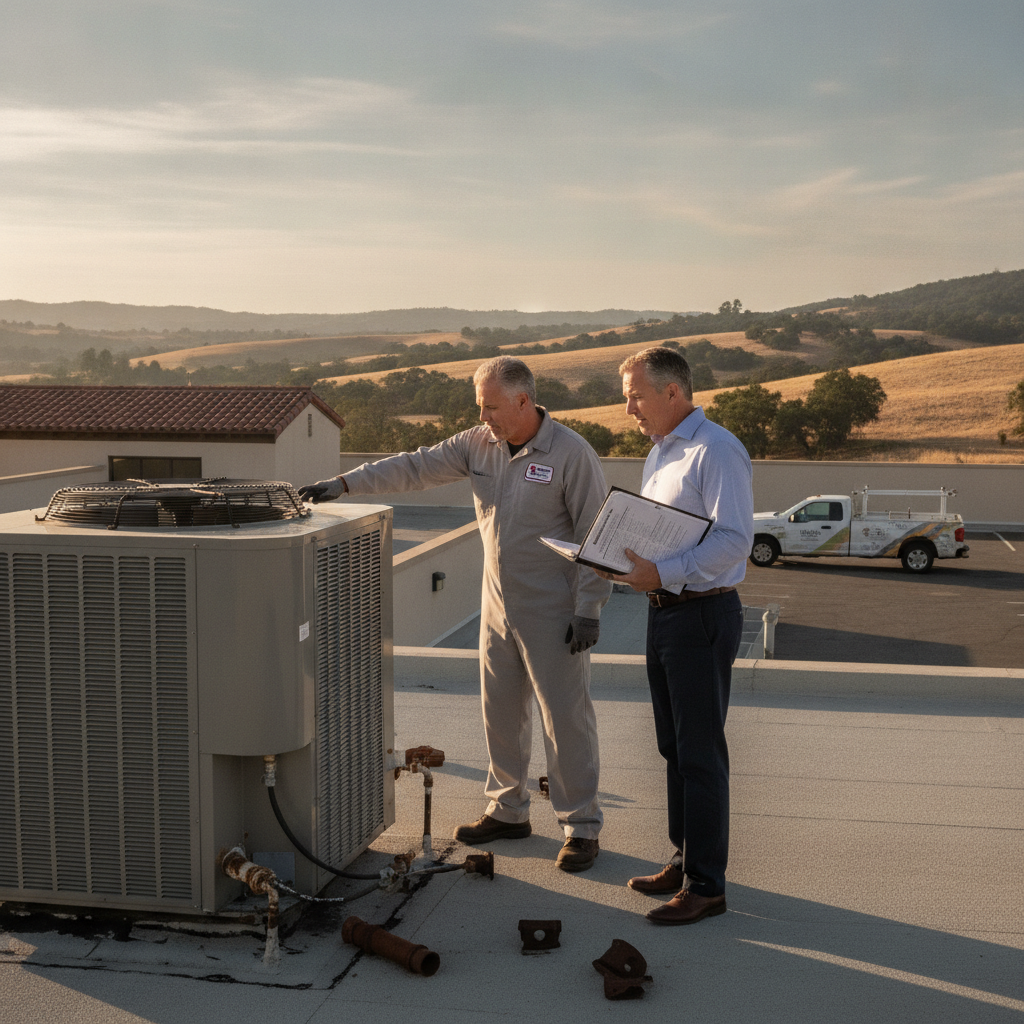
They should, but confirm explicitly. Rooftop units are common across Sonoma County commercial properties and require specific inspection steps. Ask whether the contract includes a full coil cleaning, not just a visual inspection.
Is a maintenance contract worth it if my equipment is older?
Often yes — older equipment needs more attention, not less. That said, a good contractor will be honest with you about whether it makes more sense to invest in maintenance or plan for replacement. We’re not going to sell you a multi-year contract on a system that’s realistically at the end of its life.
Do you offer commercial maintenance contracts for businesses in Windsor and Sebastopol, not just Santa Rosa?
We serve commercial clients throughout Sonoma County, including Windsor, Sebastopol, Petaluma, Rohnert Park, and beyond. Our service area covers the full region, and we’re not going to refer you out because you’re 20 minutes from our shop.
Talk to a Local Contractor Who Knows Your Business
At Stout’s Heating & AC, Inc., we’ve been working with Sonoma County homeowners and business owners since 1992. We’re not a national franchise, and we don’t run a call center. When you call us, you’re talking to someone who has been inside commercial buildings across Santa Rosa, Windsor, Healdsburg, Petaluma, and the surrounding area for decades.
If you’re evaluating your options for a commercial HVAC maintenance agreement — or you’ve inherited an existing contract that you’re not sure is worth renewing — we’re happy to review your situation and give you a straight answer. No pressure, no upsell script.
Request a free commercial HVAC estimate or call us directly at (707) 527-1504. We’ll come out, assess your equipment, and tell you exactly what we’d recommend — and what we wouldn’t.