
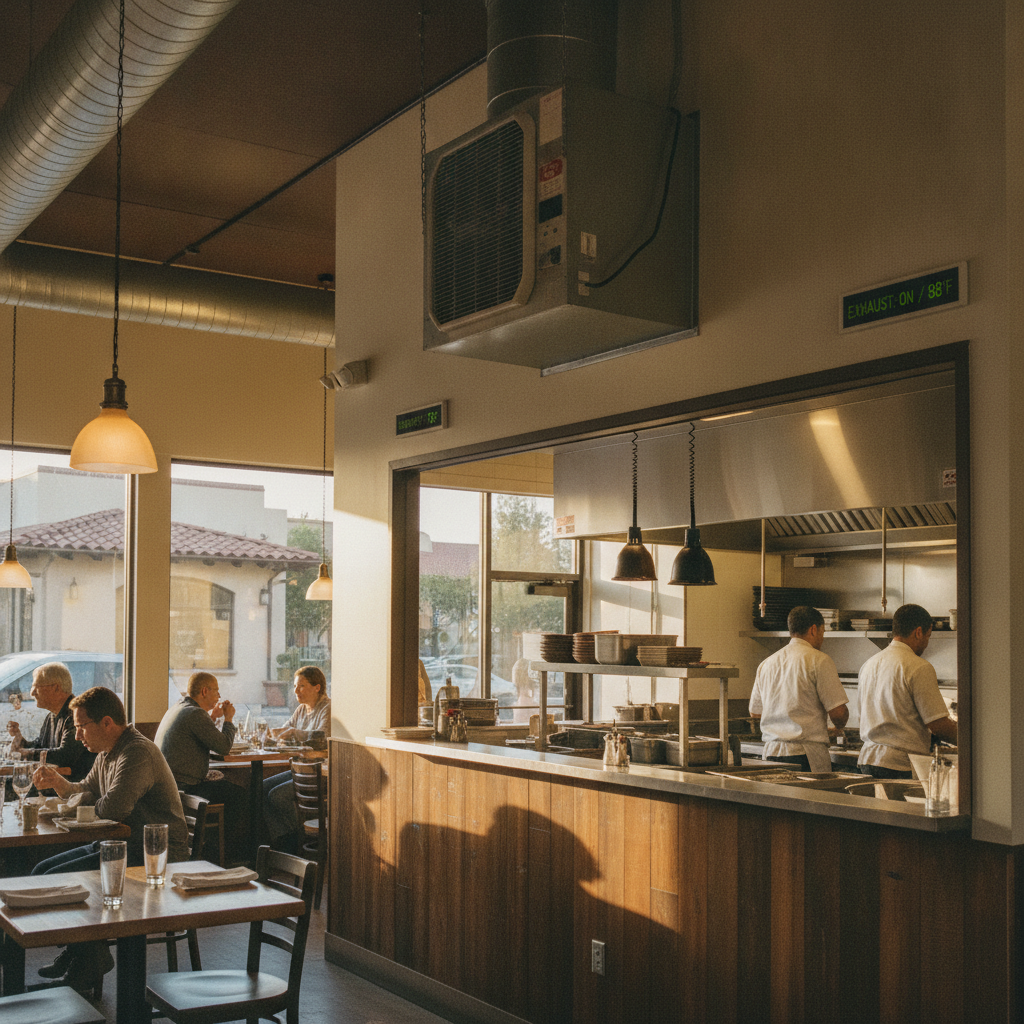
Does a Commercial Restaurant in Santa Rosa Need a Separate HVAC System from Its Dining Room?
Yes — and if your current setup doesn’t treat them separately, you’re likely paying for it in comfort complaints, health code headaches, and equipment that wears out faster than it should. This is one of the most commonly mishandled aspects of commercial HVAC for restaurants in Santa Rosa and across Sonoma County, and it’s a topic that most local contractors barely scratch the surface on.
Whether you’re opening a new spot near Railroad Square, retrofitting an older building in Petaluma, or managing a winery tasting room with a full kitchen in Healdsburg, the short answer is the same: your kitchen and your dining room are two fundamentally different environments, and they need to be treated that way from an HVAC standpoint.
Why Kitchen and Dining Room HVAC Are Not the Same Problem
A commercial kitchen generates an enormous amount of heat, grease-laden air, steam, and combustion byproducts — all of which need to be exhausted out of the building continuously while the kitchen is running. That job belongs to your kitchen exhaust hood system, which is a code-required mechanical ventilation system entirely separate from your comfort cooling.
The problem is what happens when you exhaust all that air without properly replacing it. Every cubic foot of air your hood pulls out has to come from somewhere. If your building envelope is tight and you don’t have a make-up air unit (MUA) feeding tempered fresh air back into the kitchen, you create negative pressure — doors that are hard to open, pilot lights that won’t stay lit, exhaust that backdrafts into the dining room, and a kitchen staff that’s miserable in the summer heat.
On the dining room side, you’re dealing with a completely different set of variables: occupancy loads, ambient outdoor temperatures, wildfire smoke filtration concerns during fire season, and the simple expectation from your guests that they’ll be comfortable while they eat. Trying to manage both zones with a single system almost always means one of them is going to suffer.
The Make-Up Air Problem Most Contractors Skip Over
This is the gap we see most often — and frankly, it’s one that most HVAC companies in this area don’t spend nearly enough time educating restaurant owners about. A properly sized make-up air unit does two things: it replaces the air being exhausted by your hood, and it conditions that incoming air so your kitchen doesn’t turn into an oven in July or an icebox in January.
In Santa Rosa’s climate, summers can push well past 95°F inland. Without a make-up air unit that pre-cools incoming outside air, your kitchen staff is working in an environment where the ventilation system is actively pulling in superheated outdoor air to replace what the hood exhausts. That’s a heat and safety issue, not just a comfort one.
A well-designed commercial kitchen ventilation setup will typically include:
- A hood exhaust system sized to your cooking equipment (measured in CFM — cubic feet per minute)
- A make-up air unit that delivers an equivalent volume of tempered, filtered outside air
- Separate comfort cooling (typically a rooftop unit or split system) for the kitchen to handle residual heat load
- A completely independent front-of-house system for your dining room, bar, and service areas
If any one of those pieces is missing or undersized, the whole system underperforms — and the person who feels it most is your kitchen manager.
Front-of-House Comfort: What Dining Rooms Actually Need
Your dining room HVAC is simpler in concept but still deserves proper attention. The key variables are occupancy density, your hours of operation, window exposure, and how much heat is migrating from the kitchen into the front of house. In older Sonoma County buildings — think repurposed historic structures in downtown Sonoma or converted rail-era buildings in Santa Rosa — the lack of proper thermal separation between kitchen and dining areas makes this even more pronounced.
For most restaurant dining rooms in this region, a properly sized rooftop packaged unit or a zoned commercial AC system with independent controls for different dining zones gives you the flexibility to manage comfort without overcooling empty sections or overworking the system during a full Friday night rush.
During wildfire season — which has become a real operational concern for restaurants in Sebastopol, Windsor, and the areas closer to the Sonoma Coast — having proper filtration on your front-of-house air handling units makes a meaningful difference. Guests notice smoke odor. A dining room that smells clean on a bad air quality day is a competitive advantage.
What to Ask Before Any Commercial HVAC Contractor Starts Work
Not every HVAC contractor has hands-on experience with the full complexity of restaurant systems. Before you agree to any scope of work, here are the questions worth asking:
- Have you done a Manual N load calculation for the kitchen and dining room separately? If they haven’t, the equipment sizing is a guess.
- Are you coordinating with the hood manufacturer or kitchen equipment installer? The make-up air CFM has to match the exhaust CFM — this requires actual coordination, not assumptions.
- How will you handle building pressure balance? Negative pressure is a real code and safety issue, not just a comfort complaint.
- What filtration options are available for the dining room air handler? During wildfire smoke events, this matters to your guests and your staff.
- What service and maintenance plan are you proposing? Commercial kitchen exhaust systems need more frequent attention than residential systems.
If a contractor waves off these questions or gives you a vague answer, that’s useful information. Commercial ventilation work in restaurants requires a specific kind of experience — it’s not the same skill set as replacing a residential furnace.
Wine Country Seasonality and What It Means for Your System
If you’re running a restaurant or tasting room in Healdsburg, Glen Ellen, or anywhere along the Highway 101 corridor that sees heavy tourism traffic from spring through fall, your HVAC load isn’t constant throughout the year. A summer Saturday with a full house of wine country visitors puts very different demands on your system than a quiet Tuesday in February.
Zoning your commercial system so you’re not conditioning empty dining rooms during slow periods is a straightforward way to reduce your PG&E bill — and with energy costs in California continuing to climb, that’s a real-dollar impact on your bottom line. A properly zoned system with programmable controls can make a meaningful difference across a season.
Frequently Asked Questions
Is a kitchen exhaust hood the same as an HVAC system?
No. A commercial kitchen exhaust hood is a ventilation system designed specifically to remove grease, smoke, heat, and combustion byproducts from the cooking area. It operates independently from your comfort heating and cooling system. Both are required, and both need to be properly designed and balanced together.
How often should a restaurant’s commercial HVAC system be serviced?
For most restaurant operations, a minimum of twice per year for the comfort systems, and more frequently for kitchen exhaust components. Grease accumulation in kitchen exhaust ductwork is also a fire code issue — that cleaning schedule is separate from HVAC maintenance and typically falls to a licensed hood cleaning service.
Can I use a residential mini-split in a commercial kitchen?
Generally, no. Residential equipment isn’t rated for the heat loads, grease exposure, or duty cycles of a commercial kitchen environment. Commercial-grade equipment is built differently and carries the appropriate certifications for that application.
What’s a make-up air unit, and do I need one in Santa Rosa?
A make-up air unit (MUA) supplies tempered fresh air to replace the air exhausted by your kitchen hood. California mechanical code requires adequate make-up air for commercial kitchen exhaust systems. Without it, you’ll have negative pressure issues, backdrafting, and a much harder time keeping the kitchen comfortable for staff.
Does Stout’s Heating & AC work on commercial restaurant systems in Sonoma County?
Yes. We’ve been serving commercial clients across Santa Rosa and Sonoma County since 1992, including restaurants, tasting rooms, and hospitality businesses. We handle commercial heating repair, cooling, and ventilation — and we’ll give you a straight answer about what your system actually needs before recommending anything.
Ready to Get Your Restaurant’s HVAC Right?
If you’re opening a new restaurant, renovating an existing space, or dealing with a kitchen that’s consistently uncomfortable for your staff, Stout’s Heating & AC, Inc has the commercial experience to sort it out properly. We’re a family-owned contractor based in Santa Rosa — not a national franchise — and we’ve been doing this work in Sonoma County since 1992. We’ll come out, look at what you have, and give you an honest assessment of what it will take to get your system working the way it should.
Request a free commercial HVAC estimate or call us directly at (707) 527-1504. We’re available for both scheduled consultations and same-day emergency service when your system goes down mid-service.